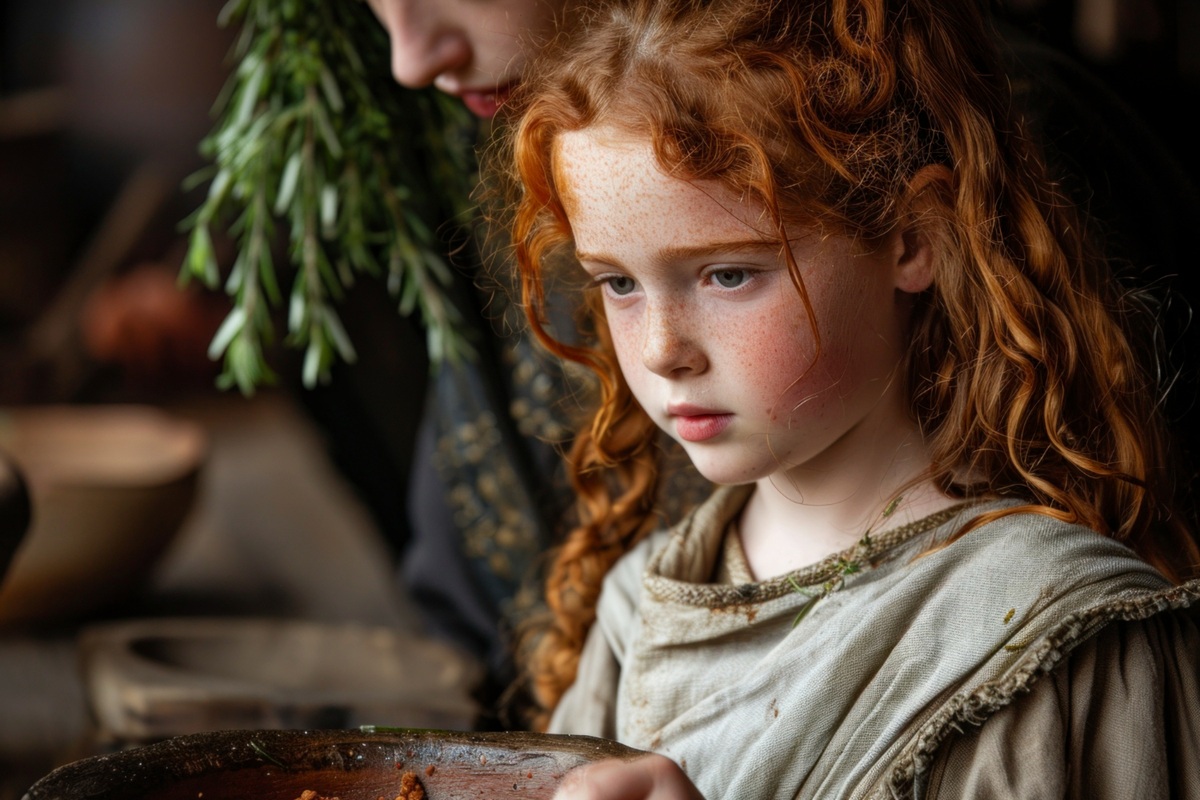
Medieval children never blew out a candle on their birthday. They didn’t have one to celebrate. Growing up in the Middle Ages followed rules almost nobody would recognize today, and archaeology and church records reveal a world stranger than the old “tiny adults” cliché.
No birthdays, only saint’s days
A medieval child’s calendar had no room for a birthday party. Instead, families marked the feast day of the saint whose name the child carried. The date of birth barely mattered next to the date tied to the church calendar.
This wasn’t neglect. It reflected how deeply medieval identity was rooted in community and faith rather than in the individual’s own timeline, something a modern birthday cake would have made little sense of.
A race against limbo
Baptism could not wait. Parents rushed a newborn to the font within hours, sometimes a single day, terrified the child might die unbaptized and be condemned to limbo.
That urgency says everything about the emotional stakes medieval parents carried. Fear for a child’s soul mobilized an entire household the moment a baby drew its first breath.
Toys buried by time, unearthed by archaeology
The idea that medieval children never played is a myth built on the “brutal childhood” stereotype. Excavations across medieval towns and villages have turned up dolls carved from wood, bone, and clay, along with dice, balls, and tiny lead soldiers.
These objects prove play was a recognized, ordinary part of growing up, not a luxury invented centuries later.
A celebration that wasn’t about the birth
Birth itself went uncelebrated, treated as a purely biological, even spiritually unclean event. What families did celebrate was churching, the ritual purification of the mother once she had recovered, marked with a family gathering.
It was, in effect, a party for the mother’s return to community life rather than for the baby.
A birth that was already a political deal
For noble families, a birth wasn’t just a family milestone. It was the opening move of a political negotiation. Marriage alliances were sometimes arranged before a child could even walk, occasionally before it was born at all.
A newborn in an aristocratic household could already carry the weight of a future treaty.
Leaving home at 13 for a decade of study
Medieval universities, from Bologna in 1088 to Paris around 1150, accepted students as young as 13. Courses ran six to twelve years, meaning a young man could spend the bulk of his adolescence living alone in a foreign city.
By 19 or 20, that same student could already have years of serious academic training behind him, far from any family protection.
A childhood built on faith, not indulgence
None of this matches a modern checklist of what childhood should include. There were no birthday candles, no guaranteed safety, and precious little sentimentality by today’s standards.
Yet behind the baptisms, the saints’ days, and the political cradles, medieval families were doing exactly what parents do now: trying to protect a child’s future in the only ways their world allowed.