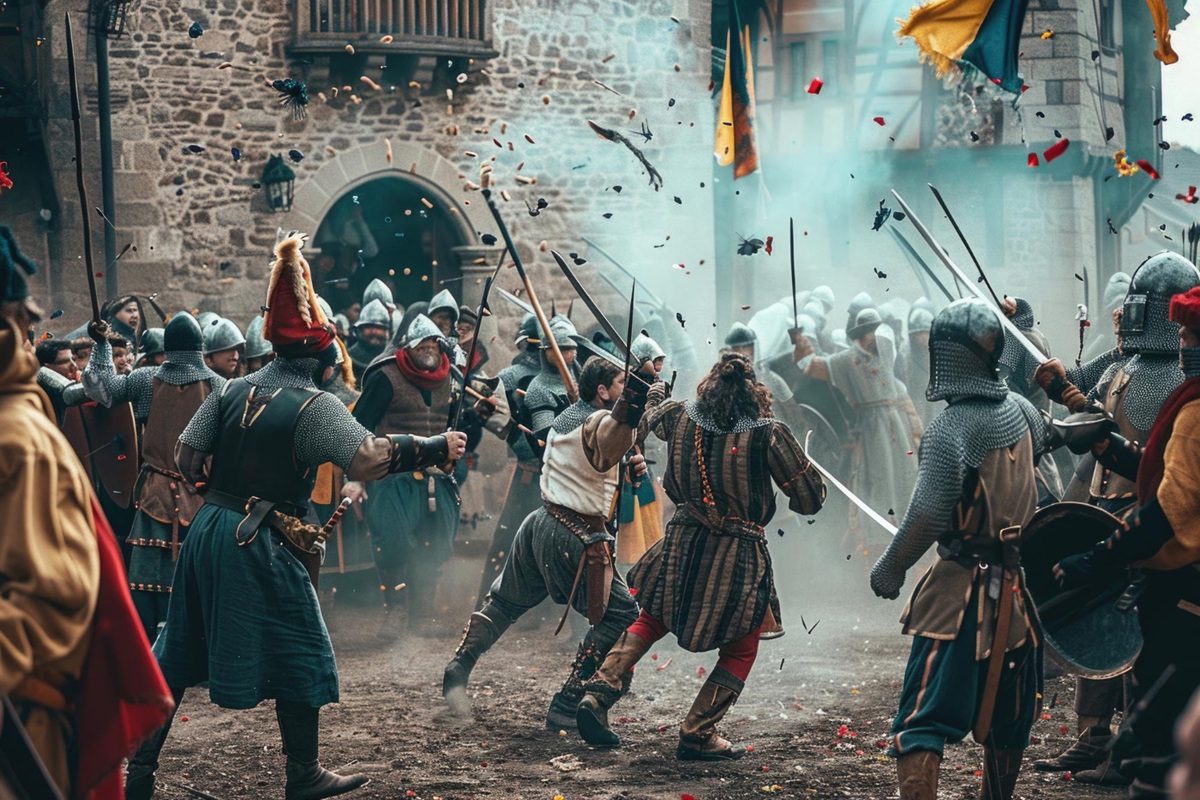
In February 1355, a two-day riot in Oxford left 63 people from the university side dead, the bloodiest flashpoint in a conflict that simmered in nearly every medieval university town.
A privilege that made enemies
Students in a medieval university held the legal status of clerics, and that status came with real power. They were exempt from many local taxes, they had the right to be judged by lenient ecclesiastical courts instead of civil ones, and a protection called libertas scolastica shielded them from arbitrary arrest by town authorities.
As universities grew, they expanded onto urban land the town itself needed. Tax-exempt and largely untouchable by local law, students became increasingly unpopular with the ordinary bourgeois who lived alongside them and enjoyed none of those protections. English chroniclers even had a name for the standoff: town and gown.
Trained to argue, not just to fight
Inside the lecture hall, medieval students were drilled in two core methods. The lectio was a close, commented reading of authoritative texts such as Aristotle or Galen. The disputatio was something closer to a codified intellectual duel: two students defended opposing theses on a set question in front of a master, and generations of medieval scholars learned to reason through that formal, adversarial exercise.
It is a striking contrast. The same young men trained to fight their battles with logic and rhetoric inside the schools carried that same combative, closed ranks culture straight into the streets outside them.
Two days of violence
Clashes between students and residents were routine in medieval Oxford and had already cost lives on both sides for generations before the fourteenth century. On February 10, 1355, Saint Scholastica’s Day, that chronic tension exploded into two full days of fighting across the town. When it ended, 63 people from the university side were dead.
The scale of the massacre made something plain: Oxford, like every other medieval university town, was in practice an island of privilege inside a population that tolerated it only reluctantly. The same pressure had already reshaped the map of European learning once before. In 1209, a group of Oxford students fled the city after a string of conflicts with local residents and settled elsewhere to keep studying. That migration became the founding moment of the University of Cambridge.
Violence the students kept among themselves
Not all the friction ran between students and townspeople. Inside their own ranks, medieval universities enforced brutal initiation rituals known as bejaunus, from a word for an immature bird. New students, nicknamed béjaunes, were publicly humiliated, forced to pay for meals for their elders, and subjected to degrading jokes, an institutionalized form of hazing that built the same fierce group loyalty which, elsewhere, turned outward against the town.
A network built on privilege, and on friction
Medieval universities were, in one sense, remarkably open institutions. Because every one of them taught in Latin, a student could move from Bologna to Paris to Salamanca without ever facing a language barrier, making them the first transnational network of scholars in the West.
That same freedom rested on a bundle of legal privileges ordinary townspeople never received. Wherever privilege and resentment sat side by side on a crowded medieval street, it rarely took much to set it alight.