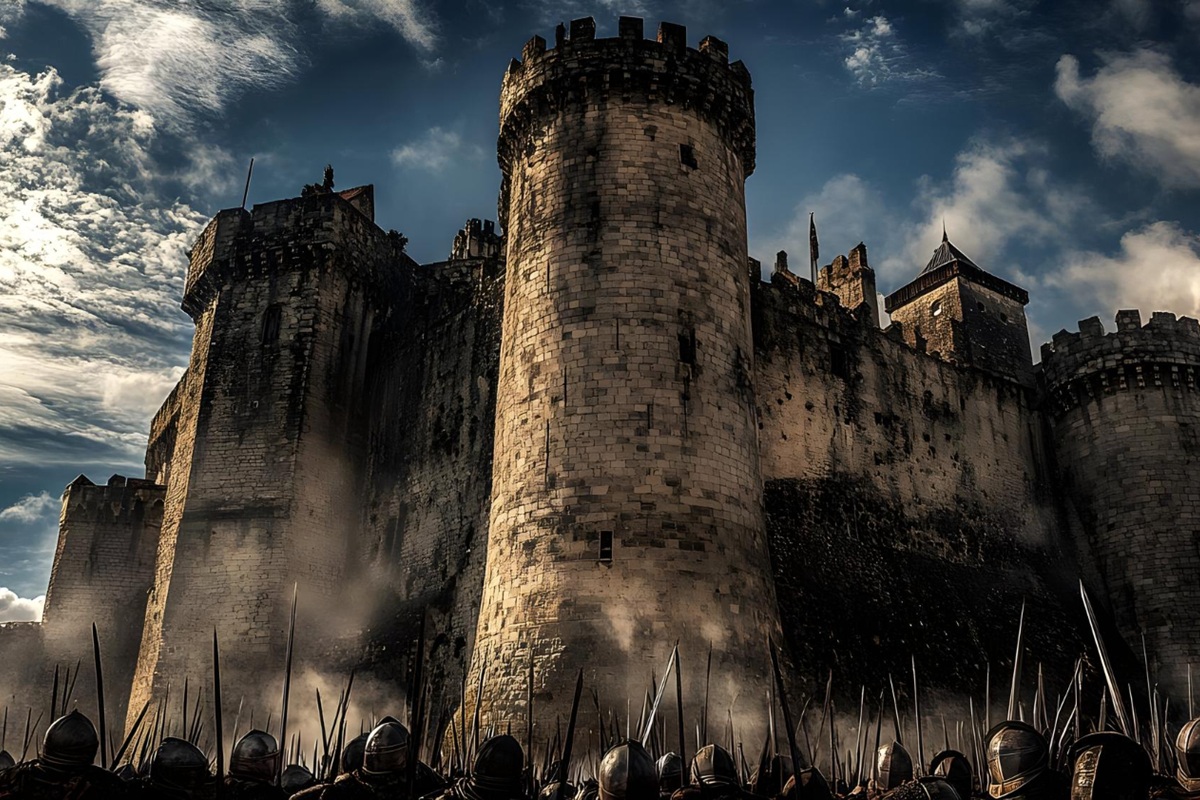
Medieval warfare, as cinema imagines it, is all thundering knights, battering rams, and walls crumbling under dramatic assault. The reality was something far slower, far grimmer, and often far more creative.
Most castles never fell to an attack
This is the fact historians know but filmmakers rarely bother with: across medieval Europe, the vast majority of sieges were not decided by assault. They were decided by water.
The defenders of Carcassonne lost not because their walls were breached, but because attackers seized control of their water supply in 1209. One of the most formidable fortresses in France, with three kilometers of walls and over fifty defensive towers, fell to thirst. The same fate befell Minerve the following year. The same logic ended the siege of Chateau-Gaillard in 1204, where Philip II of France built two full rings of circumvallation around the fortress and simply waited.
Medieval military engineers understood this instinctively. The most important question when designing a castle was not how thick the walls should be, but where the water was coming from, and whether the enemy could cut it off.
Forget the boiling oil
Hollywood has trained us to expect one particular scene: defenders pouring vats of boiling oil or scalding water from the parapets onto climbing attackers. It almost never happened.
Water and oil were too valuable during a siege to waste this way. A garrison under blockade rationed every drop. What defenders actually hurled from their battlements was far more varied and often far more vicious: stones, heavy beams, burning pitch, sulfur-soaked cloth, and heated sand. A handful of sand, red-hot from a furnace, would pour into every joint and gap of an armored man’s suit and cause burns in places no bandage could easily reach.
The weapons that movies skip entirely
Medieval siege commanders were extraordinarily inventive at inflicting psychological damage alongside physical harm. At Caffa in 1346, the Mongols used trebuchets not to hurl stone but to catapult corpses of soldiers who had died of plague over the city walls. Historians consider this one of the first documented uses of biological warfare in European history, and it may have helped carry the Black Death westward as survivors fled the city.
On less apocalyptic occasions, besieging forces flung dead animals, barrels of waste, and anything else that would rot through a summer. The goal was not just to injure but to demoralize and infect. A garrison breathing decomposing air for months was a garrison losing its will to hold.
The castle that held for 129 years, then fell to a letter
The Krak des Chevaliers in Syria is widely considered the greatest surviving example of medieval military architecture. Its concentric double walls, its 22-meter anti-sapping earthworks, its underground galleries stretching 270 meters, its storerooms capable of feeding 2,000 soldiers for five years. Saladin himself, after his decisive victory at Hattin in 1187 with 40,000 men, chose to bypass it rather than risk an assault.
The Krak held for 129 years. When it finally fell in 1271, it was not to siege engines or starvation. Sultan Baybars had a forged letter delivered to the garrison, purportedly from the Grand Master of the Knights Hospitaller, ordering them to surrender. They complied.
The lesson medieval commanders understood, and that rarely makes it onto screen, is that the strongest castle in the world has one irreducible vulnerability: the human beings inside it.
The army outside the walls also suffered
A detail that films almost universally omit: the besieging army was often dying just as fast as the besieged. Camped for months in the same ground, without adequate sanitation, with water sources easily contaminated, armies outside fortress walls regularly lost more men to dysentery and fever than to any sortie from the defenders.
The siege of Paris by the Vikings in 885-887 lasted two full years, and when the Frankish king Charles the Fat eventually paid the Vikings to leave rather than relieve the city by force, the political scandal was severe enough to contribute directly to his deposition. Patience, in medieval siege warfare, was not a virtue. It was the primary weapon on both sides, and both sides paid for it in full.