The first mechanical clocks in medieval Europe did not tell you the time by looking at them. Most had no face at all. They were machines built to ring a bell, and the very word we still use for them is a souvenir of that.
Between 1280 and 1320, church records start mentioning clocks far more often than before. Something new had been invented: a clock driven by falling weights instead of flowing water. Here are five facts about these strange early machines.
1. The word clock simply means bell
“Clock” comes from the medieval Latin clocca, meaning bell. Its cousins say the same thing: Middle English clokke, Old North French cloque, Middle Dutch clocke. Clocks reached England from the Low Countries, and the name came with them.
The name was an honest description. Early clocks were above all audible signals. Where they did have a dial, it usually carried a single hand. For most people, time was something you heard from a tower, not something you read.
2. Monks needed them before anyone else
The demand came from monasteries and cathedrals. Monastic life was built around the canonical hours, a rigid cycle of prayers repeated many times a day, and someone had to ring the bell at the right moment.
The earliest large mechanical clock on record was at Norwich Cathedral around 1273. Dunstable Priory installed a large clock in 1283, and Canterbury Cathedral got its “great horloge” in 1292. The first clock known to strike regularly on the hour appears in Milan in 1336.
Those hours were not ours, either. Early clocks usually followed unequal hours, which stretched and shrank with sunrise and sunset through the seasons.
3. They could be wrong by two hours a day
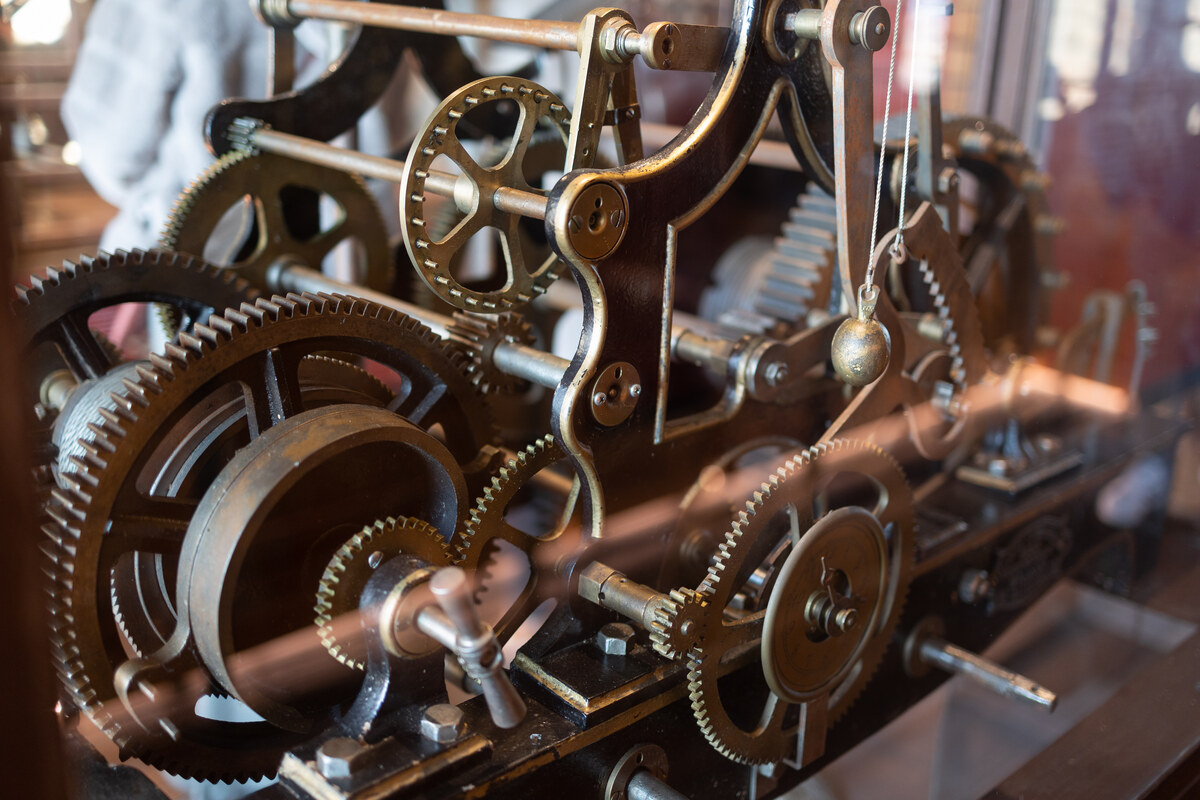
The heart of these machines was the verge and foliot escapement, invented around 1275. A weight turned a toothed wheel, and a swinging bar called the foliot let it advance one notch at a time. Historians count it among the most important inventions in the history of technology.
It was also wildly imprecise. Around 1360, Henry de Vick designed a famous clock that set the basic layout of clocks for the next 300 years. It could still drift by up to two hours in a single day.
4. A blacksmith’s son built a clock that predicted the tides
Richard of Wallingford was born in 1292, the son of a blacksmith. Orphaned, he was taken in by the prior of Wallingford, studied at Oxford, and became abbot of St Albans in 1327. On his way to Avignon to have the Pope confirm his election, he caught what was believed to be leprosy.
It did not stop him. He designed an astronomical clock that showed equal and unequal hours, true solar time, the phases of the Moon and even the height of the tide at London Bridge. He died in 1336, and the machine was only completed some 20 years later by William of Walsham.
It survived until 1539, when Henry VIII dissolved St Albans Abbey and it was destroyed. Several modern reconstructions now exist, including one built at St Albans Cathedral in 1988.
5. The oldest working clock is still up for debate
Salisbury Cathedral displays a large iron clock often dated to around 1386. It has no dial and was designed to strike a bell once an hour. Its wrought iron frame is held together with wedged tenons, not nuts and bolts, and it was powered by two large stone weights hanging from ropes wound around wooden barrels.
It was forgotten in the cathedral tower until T.R. Robinson rediscovered it in 1928, then restored in 1956 by John Smith & Sons of Derby. A later pendulum was replaced with a reproduction verge and foliot.
Its title is far from settled. Some doubt it is really the clock mentioned in 1386, given how advanced it looks. Beauvais Cathedral in France claims a clock from 1305, and Chioggia in Italy and Comayagua in Honduras have their own contenders. The oldest clock with a proven engraved date, the Backhaus clock in Germany, only goes back to 1463.
From ringing bells to counting gears
Within a century, these bell-ringers grew astonishingly ambitious. Between 1348 and 1364, Giovanni Dondi dell’Orologio built his Astrarium in Padua, with seven faces and 107 moving gears tracking the heavens. Dante, writing his Paradiso in the early 14th century, may have left the first literary description of a mechanical clock.
It all started with monks who simply needed a bell to ring on time. Every time you check your phone, you are still using a word that means exactly that.