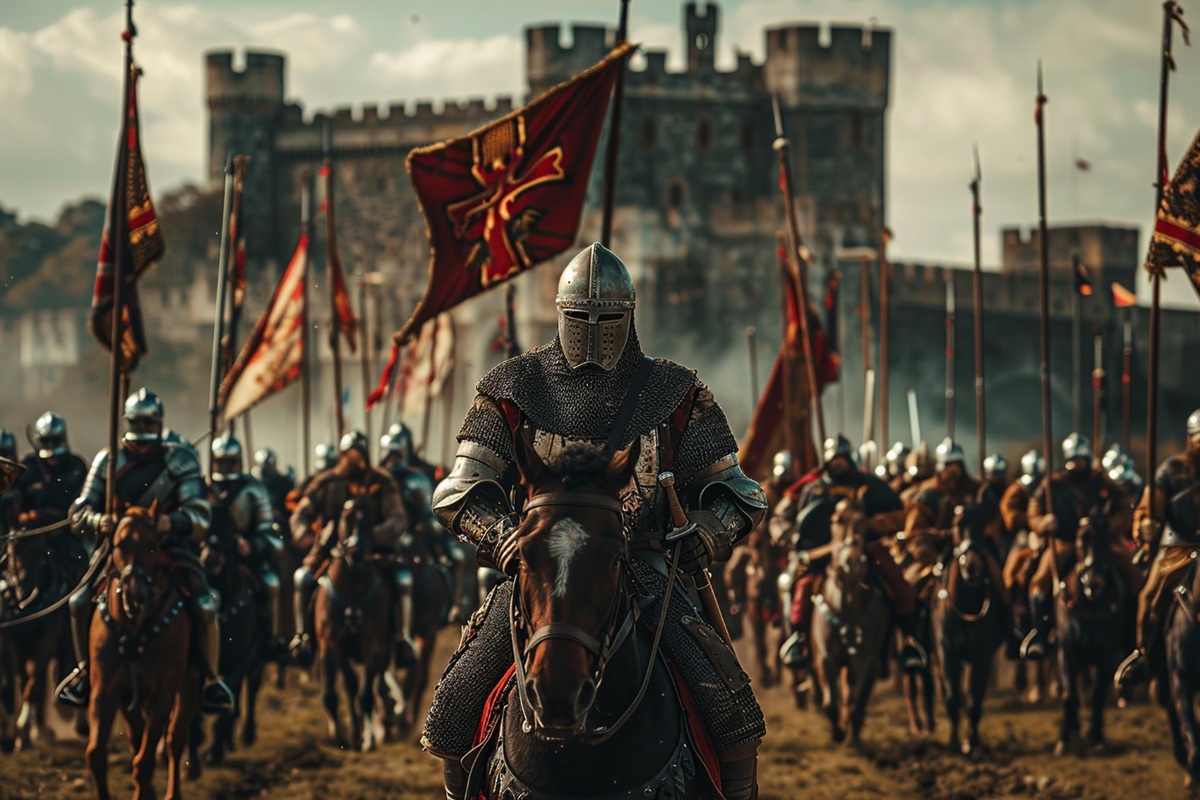
Becoming a knight in medieval Europe rarely started with a noble ideal. It started with land, money, and a door that kept closing tighter over the centuries. Here are five facts about knighthood that had far more to do with economics and politics than with glory.
Land, not lineage, first defined a knight’s value
Around the year 800, Charlemagne commanded roughly 35,000 mounted warriors. Keeping just one of them equipped and mounted required at least 12 manses, small farming estates that produced the food, income, and horses a cavalryman depended on.
That made early chivalry a landholding institution as much as a military one. A knight was, first and foremost, someone wealthy enough to afford a horse, and the network of farms behind him mattered just as much as his skill in battle.
Winning a tournament could turn into a full-time income
Medieval tournaments were not purely about honor. A knight who unhorsed or captured an opponent could demand a ransom to release him, along with his horse and armor.
Some knights built an entire career out of this. Riding the tournament circuit and collecting ransoms from defeated rivals turned single combat into a genuine business model, one that had nothing to do with the loyalty and sacrifice celebrated in medieval poetry.
The church invented the protector role on purpose
The idea of the knight as guardian of the weak did not emerge naturally from a warrior’s conscience. It was built deliberately by the Peace of God movement in the 10th and 11th centuries, an effort by church authorities to redirect chronic warrior violence.
The movement assigned knights a specific job: protect women, clergy, and peasants from the very kind of raiding and pillaging that armed horsemen had been doing for generations. The moral code came from an institutional campaign, not from an inborn virtue.
By 1250, knighthood had quietly become a closed shop
Two centuries earlier, picking up a sword and serving a lord could realistically lift a man into the warrior class. That door narrowed steadily, and by around 1250, the fusion of nobility and chivalry was complete.
From that point on, becoming a knight required noble birth going back generations. A path that had once offered a rare form of social mobility through combat had turned into a privilege reserved for families that already held power.
Its military role died, but the club never really closed
Professional standing armies and firearms made the individual mounted knight militarily obsolete by the 15th century. Chivalry, as a fighting force, was finished.
Its prestige was not. Royal courts across Europe kept the titles and rituals alive through honor orders such as the Golden Fleece, the Garter, and Saint Michael, several of which are still awarded by European monarchies today. The battlefield disappeared. The ceremony survived it by more than five centuries.
Strip away the poetry and what remains looks less like a fellowship of noble warriors and more like a system built on farmland, ransom money, and a bloodline requirement. The romantic knight of legend was largely a literary invention layered on top of that reality, and it is the invention, not the institution, that ended up outliving the Middle Ages.