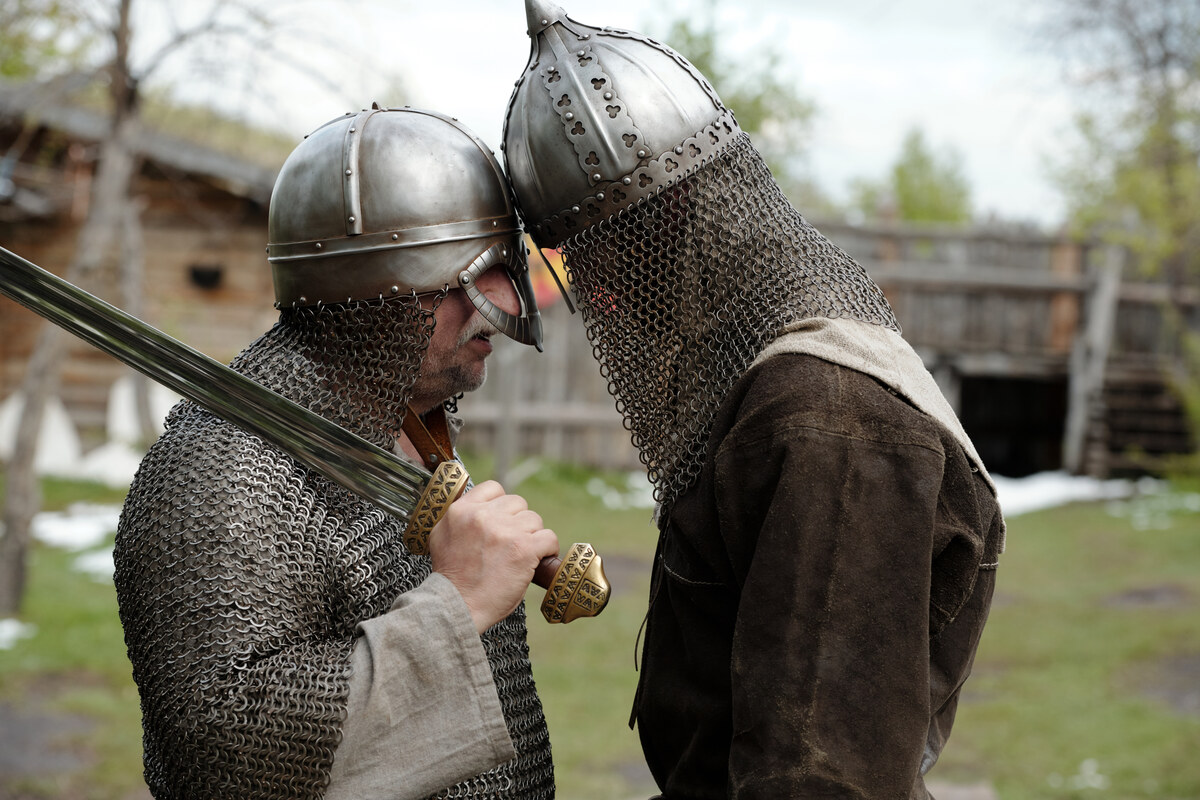
When a French army officer is promoted to a command, a superior draws a sword and lays the blade on both of the new officer’s shoulders. That gesture is not a modern invention. It comes straight from the medieval knighting ceremony, the adoubement.
A sword on both shoulders, nine centuries later
The modern ritual is simple. A superior removes the sabre from its scabbard, places the blade on each shoulder of the newly ranked officer, and in doing so officially recognizes that person as a leader.
Strip away the uniforms and the logic is the same one that governed medieval knighting: someone with authority uses a blade to mark, in public, that another person has crossed into a new rank.
The oldest detailed knighting on record
The earliest precise description of an adoubement that has survived concerns Geoffroy V of Anjou, better known as Geoffroy Plantagenet, in 1128.
The man who knighted him was no ordinary lord. Henry I of England personally handed him his arms and equipment, ahead of Geoffroy’s marriage to the king’s daughter. The ceremony sealed a royal alliance as much as it marked a military promotion.
Geoffroy (1113-1151) went on to rule as count of Anjou. For historians, though, that single well-documented day matters most: it is the moment knighting stops being a vague custom and becomes a ceremony we can actually see.
Three blows, each with a meaning
The medieval ceremony was built around distinct ritual gestures. The paumée was a symbolic slap. The colée was a blow to the neck or shoulder. The accolade was a tap with the flat of a sword on the shoulder.
Each gesture stood for pain accepted and duty taken on. The colée was the one blow a knight had to receive without ever returning it, a lesson in absolute self-control.
The new knight then received the gear that defined him: golden spurs, a shield bearing his arms, a banner and, above all, a blessed sword.
From warrior rite to second baptism
The ceremony kept changing. Toward the end of the 12th century, a night vigil in a chapel was added, fusing a secular warrior ritual with Christian meditation.
By the 14th century, blessing formulas for weapons had become widespread, and the future knight took a purifying bath before the ceremony. The symbolism was hard to miss: the adoubement now looked like a second baptism.
At the same time, the rite was quietly closing its doors. From the second half of the 12th century, it was progressively reserved for the sons of knights, turning an open warrior ritual into a hereditary privilege.
When kings turned knighting into a spectacle
For the powerful, a knighting was also a chance to show off. Some royal adoubements of the 14th century mobilized hundreds of craftsmen, cooks and musicians, with feasts lasting several days. The cost was colossal, and that was exactly the point.
The French crown tied itself ever closer to the ritual. From 1365, the coronation of the kings of France began to include a knighting, binding royalty and chivalry together in dynastic ceremony. Illuminations of the 14th and 15th centuries repeatedly show King Jean II le Bon (1319-1364) knighting men himself, a sign of how central the crown had become to the rite’s prestige.
A medieval gesture that refused to retire
Knights left the battlefield centuries ago. Their ceremony never really did. Every time a French officer feels a blade rest on one shoulder, then the other, a ritual first described in detail in 1128 plays out again, without the spurs or the chapel vigil, but with the same message: from today, you lead.