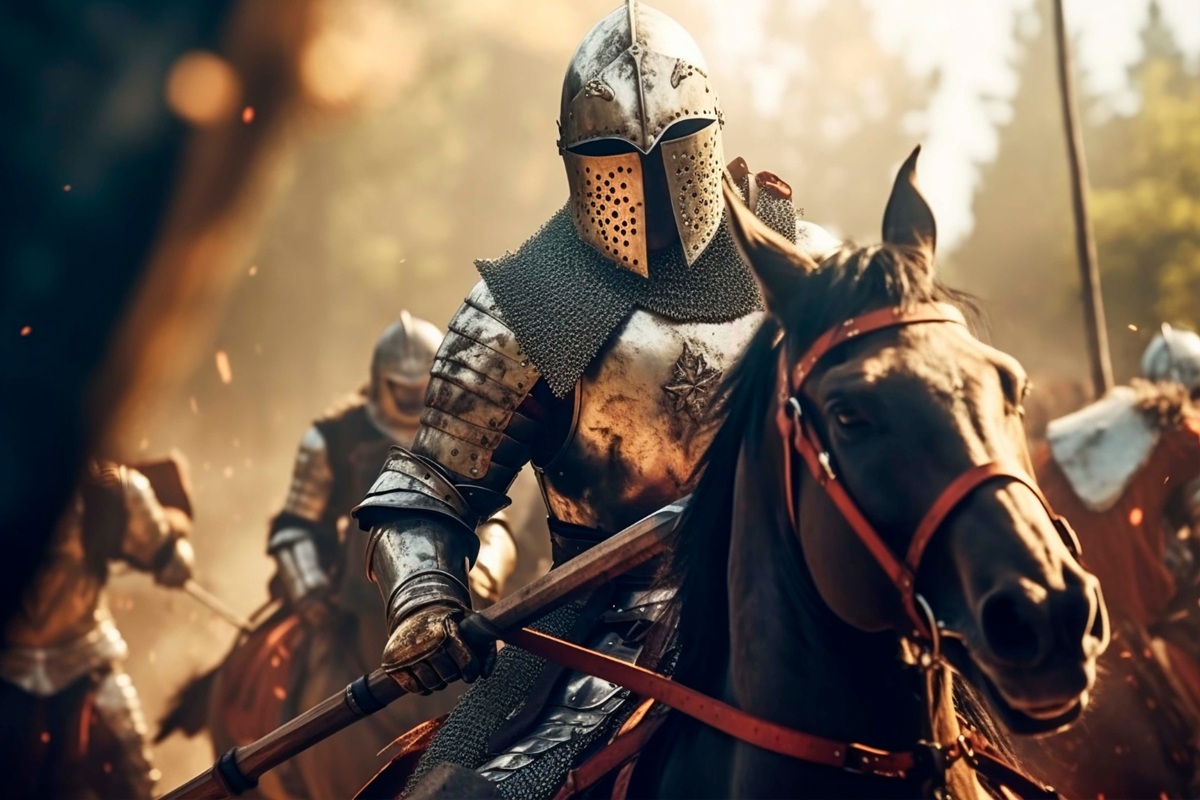
In 13th-century Europe, a fully equipped knight could run, sprint, jump back to his feet after falling, and mount his horse without a single assistant. The crane-hoisted knight in shining armor? A 19th-century invention.
Moving in Iron: The Myth of the Immobile Knight
The most persistent image of the medieval knight is a man barely able to move under the weight of his own armor. Historical re-enactors and sports scientists have dismantled this completely. Modern experiments using accurate replicas of 15th-century plate armor confirm that a well-fitted suit allowed its wearer to sprint, wrestle, climb, and mount a horse unassisted.
The key word is fitted. A great lord’s armor was custom-built to account for his exact measurements — including asymmetries from old wounds and battle scars. The suit moved with the body, not against it. Articulated lames, sliding rivets, and interlocking plates provided continuous protection without sacrificing range of motion. This was a technological marvel, not a cage.
The Staggering Price of Knighthood
What movies also skip: becoming a knight was extraordinarily expensive. By the 12th century, outfitting a single knight cost the equivalent of the annual yield from 150 hectares of farmland. By the 15th century, a full plate harness commissioned from Milan’s finest armorers — men like Antonio Missaglia, who dressed kings across Europe — represented several years’ wages for a skilled craftsman. Some royal suits were valued at the equivalent of an entire estate.
This is why Charlemagne, whose cavalry included roughly 35,000 mounted warriors, required each cavalryman to hold at least 12 agricultural domains just to fund his equipment. The medieval knight was, before anything else, a financial institution on horseback.
Tournaments Were Business, Not Sport
Here is what the romantic vision of knighthood systematically conceals: many knights attended tournaments not for glory, but for income. The rules of the game allowed the winner to capture his defeated opponent and demand a ransom for his release — along with his horse and armor.
Some professional tournament knights built entire careers on this circuit, accumulating wealth fight by fight. Victory meant another horse, another suit, another purse. Defeat meant negotiating your own release. The tournament was medieval prizefighting — except the wounds were permanent and bankruptcy was a genuine outcome.
The Knighting Ceremony Was Never That Simple
The ceremony of becoming a knight — the adoubement — began modestly: a lord handing a lance and shield to a trusted warrior. Over two centuries, it became far more theatrical. By the 14th century, the ritual included a purifying bath, a nocturnal vigil in full armor inside a chapel, a formal blessing of the sword, and the famous colée — a firm blow to the neck or shoulder that the new knight was required to receive without ever returning. It symbolized absolute self-mastery.
Even France’s most celebrated knighting scene turned out to be fiction. The story of the knight Bayard dubbing King François I after the Battle of Marignan in 1515 was invented after 1525. The real sponsor was Charles III de Bourbon — who later committed treason against France. History was quietly rewritten to protect a king’s reputation.
The Code That Was Always a Story
The chivalric code — loyalty, courage, protection of the weak — was largely a literary construction. The Chanson de Roland, written around 1100 about a battle fought in 778, tells us nothing about the 8th century. It tells us everything about the ideals the 12th century wanted to project onto a mythologized past. Real chronicles document as many pillages and atrocities committed by knights as acts of heroism.
This does not make medieval knights cynical frauds. It makes them human. They lived under a code they rarely met perfectly, in an age that demanded both brutality and restraint at once. That tension — between the ideal and the reality — is what made chivalry one of the most durable myths in Western civilization. And why it still shapes our image of the warrior today.