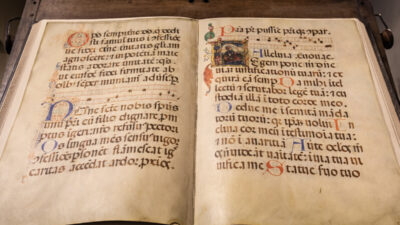
A pelican tearing open its own chest to revive its dead chicks with its own blood was not a myth to medieval readers. It was zoology, verified and taught in monastery schools across Europe.
The bestiary, the illustrated animal encyclopedia of the Middle Ages, packed dozens of these creatures into a single teaching tool. Here are five of the strangest entries monks treated as scientific fact.
1. The lion that resurrects its own cubs
Bestiaries almost always open with the lion, and never by accident. According to the tradition inherited from the Physiologos, a Greek text compiled in Alexandria between the 2nd and 4th century, lion cubs are born dead. Three days later, their father breathes on them and brings them back to life.
For a medieval reader trained in theology, the message was obvious. The lion’s resurrected cubs stood in for Christ rising on the third day. This wasn’t poetic license tucked into the margins, it was presented as observed animal behavior, on the same page as descriptions of real species.
2. The unicorn that only trusts a virgin
The unicorn could not be captured by force. Bestiaries insisted the only way to trap one was to seat a virgin in a clearing and wait. The animal would approach on its own, lay its head in her lap, and fall asleep, at which point a hunter could kill it.
The scene reads like folklore now, but it carried a precise theological reading in the 12th and 13th centuries. The unicorn’s death at the hands of a trusted companion mirrored the betrayal of Christ by those closest to him.
3. The pelican that kills itself to save its young
The pelican’s supposed habit of tearing open its own breast to revive its dead chicks with its own blood became one of the most reproduced images in Christian Europe, painted on altars and copied into manuscripts for centuries.
Like the lion, the pelican was read as a direct stand-in for Christ’s sacrifice. The bird’s self-inflicted wound and the blood that brings its offspring back to life gave preachers a visual shorthand for the crucifixion that required no explanation.
4. The tree that fights off serpents with its own shadow
Fewer people have heard of the peridexion tree, but bestiary compilers gave it real weight. Its fruit was said to attract doves, while its shadow alone was strong enough to repel serpents that could not otherwise reach the birds.
The allegory was spelled out directly in the manuscripts themselves: the tree stood for the Church, the doves for the faithful, and the serpent for the devil kept at bay by divine protection. Few entries in the bestiary state their symbolism as plainly as this one.
5. The bear that lost its crown
Long before the lion took the title, the bear was the king of animals in Germanic and Celtic oral tradition. That changed as the Church’s written culture spread. By the 13th century, bestiary compilers had deliberately replaced the bear with the lion of the Physiologos as the ruling animal.
The switch wasn’t accidental. The bear carried associations with pre-Christian Germanic traditions that clerical authors wanted distanced from Christian symbolism, so an entire species was demoted in the manuscripts that shaped medieval education.
A zoology built entirely out of sermons
None of this was considered fiction at the time. The Physiologos itself drew on respected ancient authorities, including Pliny the Elder’s Natural History and Isidore of Seville’s 7th-century Etymologies, and bestiaries reached their peak production in 12th and 13th-century England and France, precisely where monastic and cathedral schools used them to teach Latin and theology side by side.
Every lion, unicorn, and pelican in these pages was doing double duty, as a described animal and as a moral argument. The medieval world didn’t need to separate its science from its sermons. It simply hadn’t occurred to anyone that the two belonged apart.