In March 1302, the city of Florence condemned one of its former leaders to exile. If he ever came home without paying a huge fine, he could be burned at the stake. That man was Dante Alighieri, and he spent his exile writing the poem that would make Florence famous.
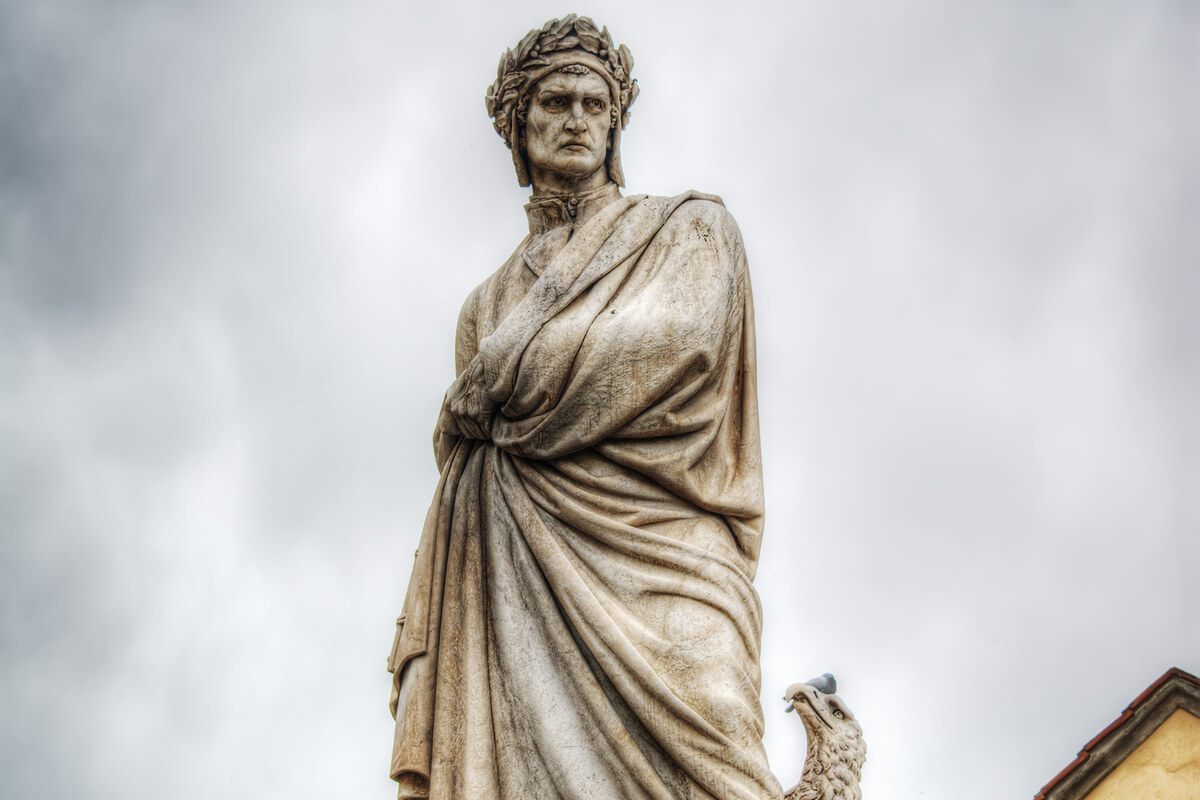
Today Dante is called “il Sommo Poeta”, the Supreme Poet. But the real man behind the Divine Comedy was a cavalryman, a politician and, for almost twenty years, a fugitive.
Before the poem, there was a soldier
Dante was born in Florence around May 1265. Scholars deduce it from his own poem: its first line, “Midway upon the journey of our life”, places him at about 35 in the year 1300, half of the 70 years the Bible gives a human life.
His father was a businessman and moneylender. His mother died before he turned ten. At nine he saw Beatrice Portinari and fell in love “at first sight”, apparently without speaking to her. At twelve, he was promised to another girl, Gemma Donati, in a contract signed before a notary. He wrote sonnets to Beatrice all his life and never mentioned his wife in a single poem.
In June 1289 he rode with the Guelph cavalry at the Battle of Campaldino as a feditore, one of the men responsible for the first charge.
Two months in office, a lifetime in exile
To enter politics, a Florentine had to join a guild. Dante chose the Physicians and Apothecaries, perhaps because apothecaries also sold books. In 1300 he served as prior, the highest office in the city, for just two months.
Florence was then split between the White Guelphs, Dante’s party, who wanted more freedom from Rome, and the Black Guelphs, who backed the Pope.
In 1301, Dante was sent to Rome to plead with Pope Boniface VIII. The Pope dismissed the other envoys and “suggested” that Dante alone remain. On 1 November 1301, while he was stuck there, the Blacks entered Florence with Charles of Valois and spent six days destroying much of the city.
The new government accused Dante of corruption during his two months as prior. He refused to pay: he believed he was innocent, and his property had been seized anyway. The sentence became perpetual exile.
The Divine Comedy was written on the run
Dante moved from host to host, from Verona to Lucca. Disgusted by his own allies, he vowed to become “a party of one”.
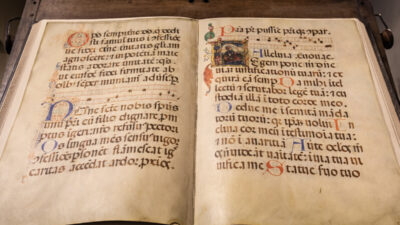
Somewhere along that road, he conceived the Comedy, a journey through Hell, Purgatory and Heaven written in his everyday Tuscan rather than Latin. By 1317, lines of the Inferno were already being copied into the margins of official records in Bologna.
The poem also became a way to repay his hosts. His protector in Verona, Cangrande della Scala, earned a place in Paradise.
Florence wanted him back, on its own terms
In 1315, Florence offered exiles an amnesty. The price for Dante: a public penance and a heavy fine. He refused. When the death sentence was later reduced to house arrest, it came with a condition: return to Florence and swear never to enter the city again. He refused that too.
His death sentence was confirmed and extended to his sons. He still hoped, late in life, to be invited home with honour. The invitation never came.
The monks who hid his bones in a wall
Dante died in Ravenna on 14 September 1321, of malaria caught on the way back from a diplomatic mission to Venice. A friend’s epitaph on his tomb calls Florence “mother of little love”.
Then Florence changed its mind. In 1519, the Medici Pope Leo X allowed the city to take the remains home, a request supported by Michelangelo. The Franciscans of Ravenna had other plans: they made a hole in a wall and slipped the bones inside. The Tuscan delegation opened the sarcophagus and found it empty.
The bones went into a box in 1677, labelled by a friar. Hidden again during the French occupation in 1810, it was forgotten until 27 May 1865, when a worker found it during restoration. A student read the words “OSSA DANTIS”, Dante’s bones, and saved it from being dumped in a common grave.
Florence built a grand tomb for him in Santa Croce in 1829. It has been empty ever since.
Seven centuries later, the verdict changed
In June 2008, the city council of Florence finally passed a motion rescinding Dante’s sentence. Every 14 September, the city still sends olive oil from the Tuscan hills to keep the lamp burning over his tomb in Ravenna.
It may be the longest apology in literary history, offered to a man who described himself, centuries earlier, as “a Florentine and guiltless refugee”.