The Voynich manuscript has beaten some of the best codebreakers of both world wars, and nobody has ever proven they can read a single line of it. Yet its pages tell a surprisingly ordinary story: this book was handled, opened and paged through again and again.
A book that defeated wartime codebreakers
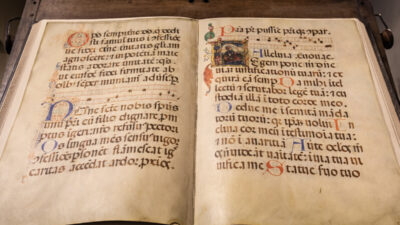
The manuscript is a small illustrated codex, about 23.5 by 16.2 centimeters, with roughly 240 vellum pages. It is written from left to right in an unknown script nicknamed “Voynichese”.
American and British cryptographers tried to crack it, including Prescott Currier, John Tiltman, William Friedman and Elizebeth Friedman. All of them failed. In the 1940s, Friedman’s “First Study Group” even transcribed every line onto IBM punch cards to make it machine readable.
Elizebeth Friedman later described such statistical work as “doomed to utter frustration”. The book has never been demonstrably deciphered.
The clue hidden in the parchment
So what was it? The most tempting answer is a secret grimoire, written to hide forbidden knowledge. The parchment points somewhere else.
Medievalist Lisa Fagin Davis describes it as soft, the texture found in books that have been “heavily thumbed”. That wear suggests the manuscript served a routine, practical function, such as a medical manual or a celestial almanac.
Nothing about it is luxurious. Unlike the Book of Kells, which was made to be looked at, this one was made to be used. There is no gold leaf, the pigments were cheap, and the colors were applied somewhat crudely. The vellum even has holes left by scabs, wounds and insect bites. It has the feel of a workmanlike tool, not a ceremonial object.
Five scribes, not one lonely genius
The handwriting adds another surprise. Journalist Ariel Sabar notes it has “the easy flow of a long-established script”. The pen moves smoothly, without the pauses you would expect from someone carefully encoding a message.
Davis tracked individual letters and found small variations, larger or smaller loops, straighter or curvier crossbars, that change between sections but not within them. Her conclusion: five different scribes probably worked on the book. That makes it the product of a community, rather than the work of a single hoaxer or an unwell mind.
The text also behaves like a real language. Its most common word appears about twice as often as the second most common, following Zipf’s law, a pattern found in natural languages. A 2014 study from the University of São Paulo concluded it differs from a random sequence of words.
Plants, stars and bathing women
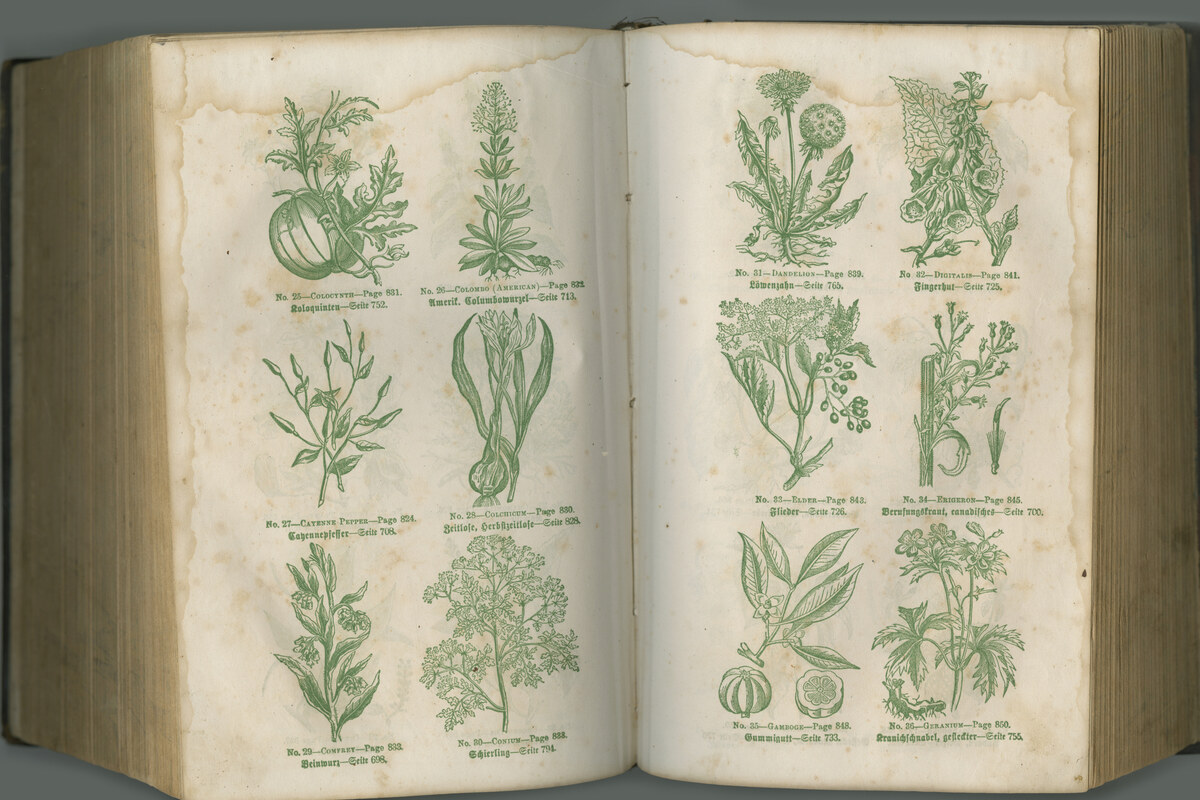
Since nobody can read it, scholars sort the book by its pictures. The herbal section alone fills 126 pages, with one or two plants per page, in a format typical of European herbals of the time.
Almost none of those plants can be identified with certainty. Some are composites, with the roots of one species, the leaves of another and sometimes the flowers of a third.
Other sections show zodiac signs, small nude women bathing in pools linked by pipes, objects resembling apothecary jars, and 25 pages of short paragraphs each marked with a star. The overall impression is of a pharmacopoeia, a reference work on medicine.
Not a modern fake
For decades, some suspected Wilfrid Voynich, the Polish book dealer who bought it in 1912, of forging it himself. A lost book by Roger Bacon would have been worth a fortune.
Science settled that. In 2009, the University of Arizona radiocarbon dated the vellum to between 1404 and 1438. Eamon Duffy pointed out that it is “inconceivable” that “at least fourteen or fifteen entire calfskins” of blank parchment could have survived from the early 15th century for a forger to use.
The book’s paper trail goes back to Prague. In 1639, the alchemist Georg Baresch, its first confirmed owner, complained that this “Sphynx” was taking up space uselessly in his library. A later letter claims Emperor Rudolf II once paid 600 ducats for it, though that has never been proven.
Everyone sees their own answer
Claimed solutions keep coming. In 1921, William Romaine Newbold said he had found microscopic Greek shorthand hidden inside each letter. The marks turned out to be cracks in ink that had dried on rough vellum.
In 2019, Gerard Cheshire announced he had decoded it in two weeks. Davis called his logic “circular and aspirational”, and the University of Bristol removed the reference to his claims from its website.
Perhaps that is the real lesson of the Voynich manuscript. Its first users may well have found it practical, even ordinary. Six centuries later, a book worn soft by routine handling has become a mirror in which every would-be decoder sees exactly what they hoped to find.