In one of the most famous books of the Middle Ages, Jesus says he came to bring not peace, but joy. The correct word is “sword”. A scribe swapped gladium for gaudium, and the slip was never corrected on the page.
A masterpiece riddled with mistakes
The Book of Kells was made around 800 AD by Columban monks linked to the island monastery of Iona, and probably finished at Kells, in Ireland. It holds the four Gospels in Latin on 340 leaves of high-quality calf vellum, or 680 pages.
As many as twelve people may have worked on it. Scholars have told apart at least three scribes and three painters, nicknamed the “Goldsmith”, the “Illustrator” and the “Portrait Painter”.
Yet the text is full of slips. Luke’s genealogy of Jesus names an extra ancestor. Lines that ran too long were finished in a gap in the line above. Evidence suggests the scribes often wrote from memory rather than copying their model, and the mistakes were simply left where they were.
The index that leads nowhere
Medieval Gospel books usually opened with the Eusebian canon tables, a clever system that let readers find the same episode in each of the four Gospels. It only works if chapter numbers are written in the margins of the text.
In the Book of Kells, they never were. The makers also planned twelve pages of tables, then squeezed them into ten, which left two pages blank and the tables confused. The result is a beautiful index that cannot be used.
Nobody knows why. The scribe may have meant to add the numbers later, or he may have left them out on purpose so as not to spoil the look of the pages.
A book made for the altar, not the library
That second explanation fits everything else. Historians believe the book had a sacramental purpose, not an educational one. It would have sat on the high altar and come out only for the Gospel reading at Mass, with the reader probably reciting from memory more than reading.
The clue is in a medieval chronicle: the book was stolen from the sacristy, where the vessels for Mass were kept, not from the monastic library. Appearance came first, practicality second.
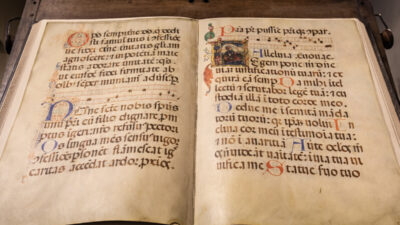
You can see it on the page. The opening words of each Gospel are so heavily decorated that the text is almost illegible. The first page of Matthew holds just two words, Liber generationis, with “Lib” swollen into a giant monogram.
The famous Chi Rho page, built around the first two Greek letters of “Christ”, consumes an entire leaf. Hidden inside its swirling knotwork are animals, insects and three angels. In the 12th century, Gerald of Wales described a Gospel book that many assume was this one: “you might say that all this was the work of an angel, and not of a man.”
Stolen for its cover, found under the dirt
In 1007, the Annals of Ulster recorded that “the great Gospel of Columkille, the chief relic of the Western World” had been stolen at night from the stone church at Kells. The thieves were after its precious shrine.
The manuscript turned up a few months later, “under a sod”, without its golden, jewelled cover. Ripping it free may explain the pages missing from the beginning and end. Scholars think the book once had about 370 leaves, and around 30 may have vanished in that theft.
Its luxury was not quite what people long assumed, either. It contains no gold or silver leaf. Modern analysis showed that the purple from Mediterranean shells and the lapis lazuli from Afghanistan, once seen as proof of its huge cost, were never used. The woad and lichen behind its blues and purples point instead to Scotland, though a yellow made from arsenic, imported from Italy, still travelled a long way to reach it.
Still made to be looked at
The book stayed at Kells until 1654, when Oliver Cromwell’s cavalry was quartered in the church and the town’s governor sent it to Dublin for safekeeping. It has been at Trinity College since 1661.
Today it is bound in four volumes and only two pages are on show at any time, turned every 12 weeks. Its fragility is real: in 2000, a volume flown to Canberra suffered minor pigment damage, probably from the vibrations of the plane’s engines.
So the visitors who file past the glass case are not reading it either. They are looking at it, which is exactly what its makers seem to have intended, twelve centuries ago.