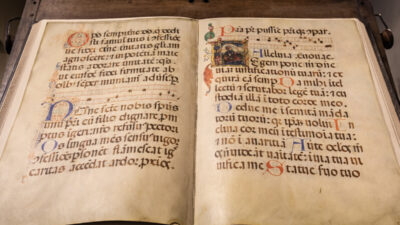
In 2019, researchers found grains of lapis lazuli lodged in the dental plaque of a woman buried around 1100 in Germany. The pigment could only have gotten there one way: she was a manuscript illuminator, and a skilled one.
A colour worth more than gold
Lapis lazuli came from a single source, mines in Afghanistan, and its price rivaled gold itself. Illuminators reserved it for the most important blues in a manuscript, the ones meant to catch the eye first.
Painters shaped their brushes by licking the bristles between strokes, a habit that left faint traces of pigment embedded in their teeth over a lifetime of work. That is exactly what turned up in the skeleton’s dental plaque.
The find that didn’t fit the story
Manuscript illumination is usually pictured as an all-male, all-monastic trade, produced quietly behind monastery walls. The plaque evidence forced a rewrite: women were producing prestige-level work, with access to the same rare and costly pigments monks used.
By the 13th century, illumination had already moved beyond monasteries into urban lay workshops serving the new universities. Those workshops employed artisans of both sexes, and this find simply gave the earliest solid proof of a woman working at the highest tier of the craft, generations earlier than assumed.
A book years in the making
Producing an illuminated manuscript took roughly twelve separate steps: preparing the parchment, sketching in graphite, inking the outline, laying gold leaf and burnishing it to a shine, then building up pigment in layer after layer.
The base material mattered as much as the paint. Ordinary parchment came from sheep or goat skin, but vellum, made from the skin of stillborn animals, was reserved for only the finest, most expensive manuscripts.
Beyond lapis lazuli, illuminators worked with a whole palette pulled from across the known world: red lead, vermilion, azurite, saffron, cochineal, and Pernambuco wood, colors layered rather than blended, which is why they still look vivid seven centuries later.
The tradition behind all of this reaches back to the 6th century, to Cassiodore’s monastery of Vivarium in southern Italy, the model for the Western scriptorium. He had his monks copy and decorate manuscripts deliberately, as a way of reconciling classical learning with the new Christian culture rather than abandoning it.
Serious art, silly margins
By the 15th century, the Limbourg brothers were producing the Très Riches Heures for the Duke of Berry, a manuscript still considered the high point of the entire art form. Decades later, Jean Fouquet became the first illuminator to bring Italian perspective into the genre.
None of that seriousness stopped illuminators from filling manuscript margins with pure nonsense: monkeys riding giant snails, priests gambling with dice, knights locked in mock battle with snails twice their size. The main text stayed pious. The margins did whatever the artist felt like that day.
A craft, not a calling
The image of a lone monk hunched over a manuscript in candlelight is not wrong, exactly, it is just incomplete. Add in the urban workshops, the woman with lapis lazuli in her teeth, and the illustrators drawing armed snails in the margins of holy texts, and a stricter, more human picture appears: skilled professionals, some anonymous, some famous, working a trade the modern world has largely reduced to a single postcard image.