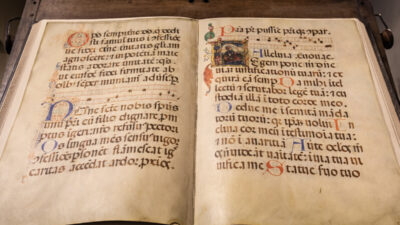
Ask most people who invented printing, and Gutenberg’s name comes up instantly. China was printing entire books five centuries before he was even born.
The story everyone thinks they know
The standard version goes like this: around 1450, a goldsmith in Mainz named Johannes Gutenberg had a flash of genius, built a press, and single-handedly launched the age of the printed book.
It’s a clean story. It’s also missing most of the actual history.
China was there first, by thirteen centuries
Xylography, printing by carving an image into a block of wood, was already practiced in China in the 7th century. The oldest known printed book, the Diamond Sutra, was produced there in 868. That’s 587 years before the Gutenberg Bible.
Movable type came early too. Around 1040, a Chinese artisan named Bi Sheng invented reusable characters made of fired clay, four full centuries before Gutenberg touched a single letter. Korea went further still: in 1234, Choe Yun-ui’s workshop produced movable metal type, and the Korean Jikji, printed in 1377, is the oldest surviving book made with metal movable type anywhere in the world.
Europe had already seen printed material before Gutenberg
This part rarely makes it into the story at all. Mongol envoys under Kublai Khan carried printing equipment during their 13th-century campaigns and used printed seals on diplomatic documents sent to Western Europe. The first printed objects Europeans ever laid eyes on came from the East, generations before Mainz.
So what did Gutenberg actually do?
His real contribution wasn’t invention from nothing. It was synthesis. He combined movable type cast in a lead-tin-antimony alloy, a mechanical screw press adapted from winepresses, and a thick oil-based ink that could grip metal type, all engineered specifically for the Latin alphabet and industrial-scale output.
The result was staggering. A medieval copyist needed up to three years to produce a single illuminated Bible by hand. Gutenberg’s workshop turned out 150 to 180 copies in about two years, cutting the cost of a book by roughly a hundredfold.
The ripple effects moved fast. Within fifty years, an estimated twenty million books had been printed across Europe. More than 200 print shops were running in Germany alone by 1500. And in 1517, Martin Luther’s 95 theses spread across the continent in a matter of weeks, a feat that would have been unthinkable without the press Gutenberg had built.
The man who lost his own invention
Here’s the twist that rarely gets told alongside the triumph. Gutenberg financed his workshop by borrowing 800 florins, twice, from a Mainz banker named Johann Fust, at a time when a fine house in the city cost about 500 florins.
When Gutenberg couldn’t repay the loan, Fust took him to court and won. In 1455, the workshop, the type, the press, all of it, passed into Fust’s hands. Gutenberg died in 1468, ruined, having never profited from the invention that would reshape the world.
A bigger story than one man in Mainz
The real history of printing runs through Tang dynasty China, Goryeo Korea, Mongol diplomatic pouches, and finally a workshop in the Rhineland, spanning more than 800 years and four continents before anyone in Europe printed a Bible. Gutenberg’s genius was real. He just wasn’t the one who got to keep it.