Medieval women who wanted a religious life had two options: marry, or take vows and vanish behind convent walls. Thousands of beguines chose a third path, and it came with a back door that stayed open.
A holy life with no vows
The beguines were lay religious women who flourished from the 13th to the 16th century, mostly in the Low Countries. They lived in semi-monastic communities, yet took no formal vows. They promised not to marry “as long as they lived as Beguines”, to quote an early rule of life, and they were free to leave at any time.
They were not nuns, even if people often confused the two. They took only personal, informal vows of chastity, followed no approved rule, did not live in convents and did not give up their personal property. The movement was never recognized as an official order by the pope.
Why so many women?
In the Low Countries, towns held more women than men, because of urban demographics and marriage patterns. Some women lived alone and devoted themselves to prayer and good works. In the 13th century, some began buying homes next to each other, and the small communities soon drew the attention of clerics and town officials.
One early champion was the preacher James of Vitry. He was inspired by Marie d’Oignies, sometimes called the prototypical beguine, and he later traveled to Rome to seek permission for the religious women of the Liège diocese to live together.
Towns within the town
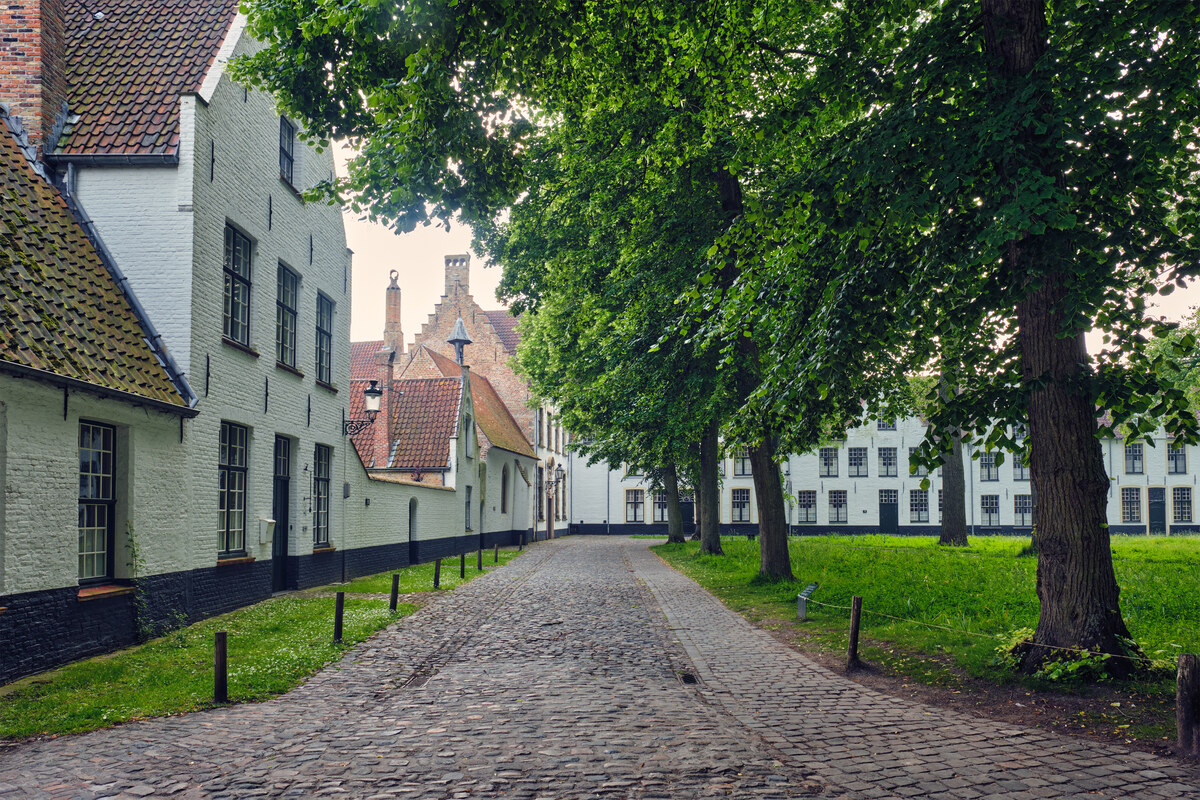
Officials in cities like Cambrai, Valenciennes and Liège set up formal communities called beguinages. They stood near or inside town centers, often close to the rivers that fed the cloth industry.
There was no mother-house and no single rulebook. Each beguinage fixed its own way of living. Some admitted only ladies of high rank, others only women of humble means, and the most popular welcomed everyone. The great beguinage of Ghent held thousands of inhabitants, and the Paris one, founded before 1264, housed as many as 400 women.
Wool, silk and vernacular books
These women paid their own way. In the Low Countries many worked in the lucrative wool trade, while Parisian beguines contributed to the city’s growing silk industry.
They also helped spread reading. Because they could read and write in the vernacular, they translated spiritual and mystical texts into local languages and wrote original works. Mechthild of Magdeburg’s The Flowering Light of the Godhead was translated into Latin almost as soon as it was written, a sign of how much weight the male, Latin-reading elite gave to her words.
Admired and distrusted
Their position bothered people. They kept property and lived among laypeople while claiming the privileges of the religious. Some professed religious were offended by a status taken without a binding rule, and some laypeople resented the implied disapproval of marriage. The Roman de la Rose even gives a hypocritical beguine the name “Constrained Abstinence”.
Others saw it the opposite way. The cleric Robert de Sorbon, who died in 1274, argued that beguines showed more devotion than the cloistered, since they chose a religious life without vows or walls, surrounded by the temptations of the world.
The mystic who was burned
Around the 1290s, Marguerite Porete wrote The Mirror of Simple Souls in Old French, a mystical book about the soul dissolving into union with God. Copies circulated across Europe, but some of its statements were read as disrespect for the Church and its sacraments. In 1310, Porete was burned at the stake in Paris as a relapsed heretic, after a trial led by a Dominican inquisitor.
A year later, the Council of Vienne issued the decree Cum de Quibusdam, claiming that beguines “dispute and preach about the highest Trinity and the divine essence”. After 1312, the movement declined, and some communities were absorbed by monastic and mendicant orders.
The last beguine
Some beguinages outlasted everything. Ghent still numbered nearly a thousand members in 1905. The last Amsterdam beguine died in 1971, yet the Begijnhof remains one of the city’s best-known landmarks. And on 14 April 2013, Marcella Pattyn, the last traditional beguine, died in Kortrijk at the age of 92.
A movement built on freedom to leave lasted for roughly 700 years, held together by nothing but choice.