Sir Geoffrey Luttrell, a Lincolnshire landowner who felt his death approaching, ordered a prayer book to account for his life. Nearly seven centuries later, its margins are one of the richest visual records of ordinary rural England.
A psalter built to help a soul
The Luttrell Psalter (British Library, Add MS 42130) was made around 1320 to 1340 for Sir Geoffrey Luttrell (1276 to 1345), lord of the manor of Irnham in Lincolnshire. Scholars still argue over the exact date. Some prefer 1325 to 1330, others as late as 1330 to 1345.
Its purpose was practical as well as pious. Luttrell wanted to account for his actions, as the colophon states, and the book supported the provisions of his will. He asked for twenty chaplains to recite masses for five years after his death, believed to speed the soul’s passage through Purgatory, plus clerks to recite the Psalms, each paid at a stated rate.
A knight who wanted to be remembered in armor
At the end of Psalm 109, the book shows Luttrell fully armed on a war-horse, with an extravagant display of the Luttrell arms. Above it runs the line “Dominus Galfridus Louterell me fieri fecit”, meaning “Lord Geoffrey Luttrell caused me to be made”.
The image suggests he wanted to be remembered for his youth and his military past. It may also have emphasized his knightly status during a family marriage union. Made as he prepared for his death, the portrait doubles as a statement of legacy.
The margins steal the show
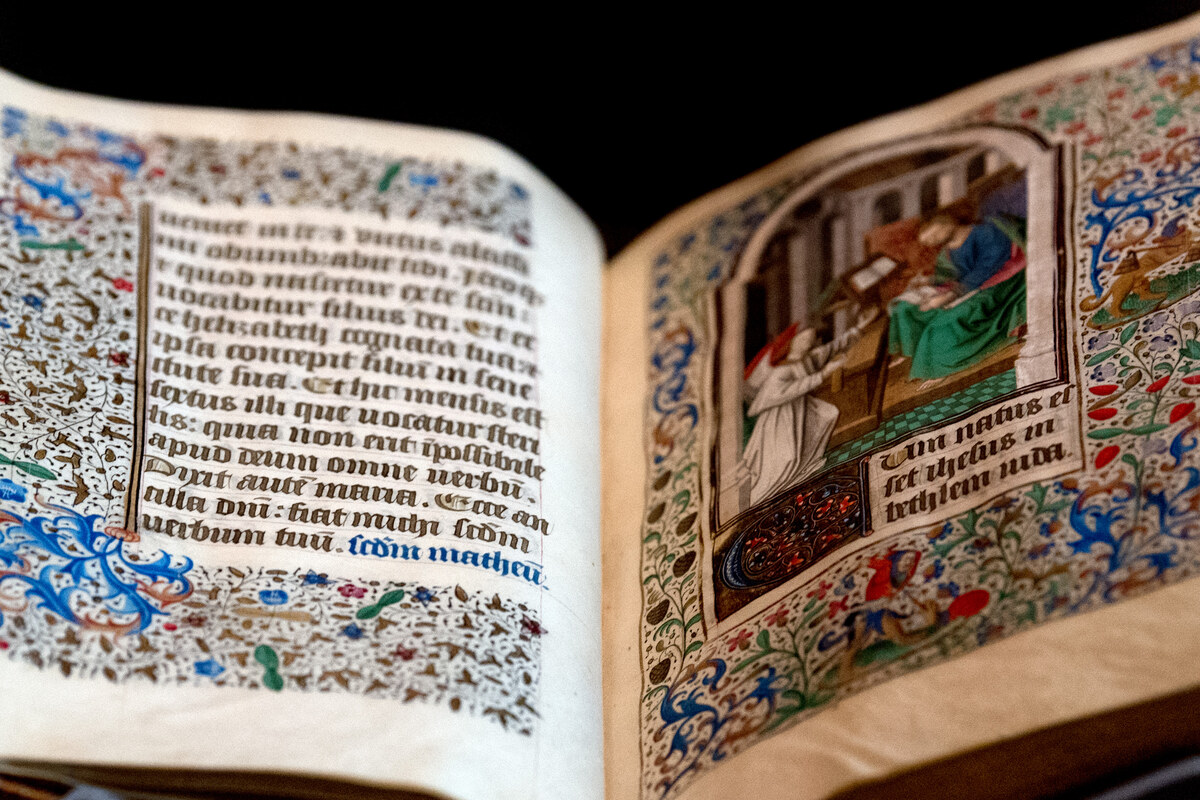
The real surprise sits around the edges of the text. The illustrations show scenes from Luttrell’s life, daily activities around the estate and the town, and curious figures that mix animal and human parts. Farming scenes include both men and women, a sign that at harvest time every available pair of hands was needed.
Servants preparing food and running errands appear in the margins too, placed there to stress that they played a major role, socially and economically. Beggars and street performers are there as well. Scholars read these figures, along with the grotesques, as symbols of the chaos and anarchy that Luttrell and his contemporaries feared.
Music, devotion and the devil
Music takes up a large part of the iconography. People and hybrid creatures sing poems, hymns and psalms as an act of devotion. Yet music in the Middle Ages could also stand for the devil and corruption, and the Psalter tries to bring both sides together “into the service of the sacred”.
One scribe, at least five artists
The book was produced by one scribe and at least five different artists, each with a slightly different style. One is called “the decorator”, another “the Colourist”, a third “the Illustrator”. A fourth, the Luttrell Master, was skilled in rural themes and outlandish grotesques, and he also drew the Luttrell family.
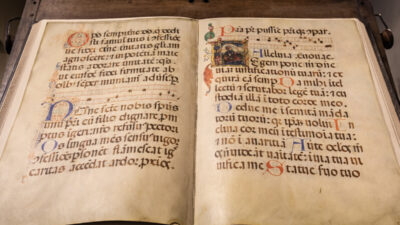
The manuscript has 309 vellum leaves and measures 350 by 245 mm. It is written in Latin, with about fourteen full lines of text in each frame.
A sale stopped hours before it began
The Psalter stayed for generations with the Weld family, moving to Lulworth Castle in Dorset in 1775. In 1929 Herbert Weld Blundell tried to sell it at Sotheby’s. Three days before the auction, British Museum lawyers discovered that the book and the other heirlooms at Lulworth actually belonged to Mary Angela Noyes, wife of the poet Alfred Noyes.
Weld went to court, and his appeal was rejected only hours before the sale. The British Museum bought the manuscript for £31,500, helped by an interest-free loan from the American millionaire J. P. Morgan Jr. Later that year a fire badly damaged Lulworth Castle, and some of the disputed heirlooms were lost.
What a lord never meant to record
Luttrell commissioned a book about salvation and his own status. What survives is also a picture of the farm workers, servants and performers around him. Sometimes the most valuable history is the part the patron barely noticed.