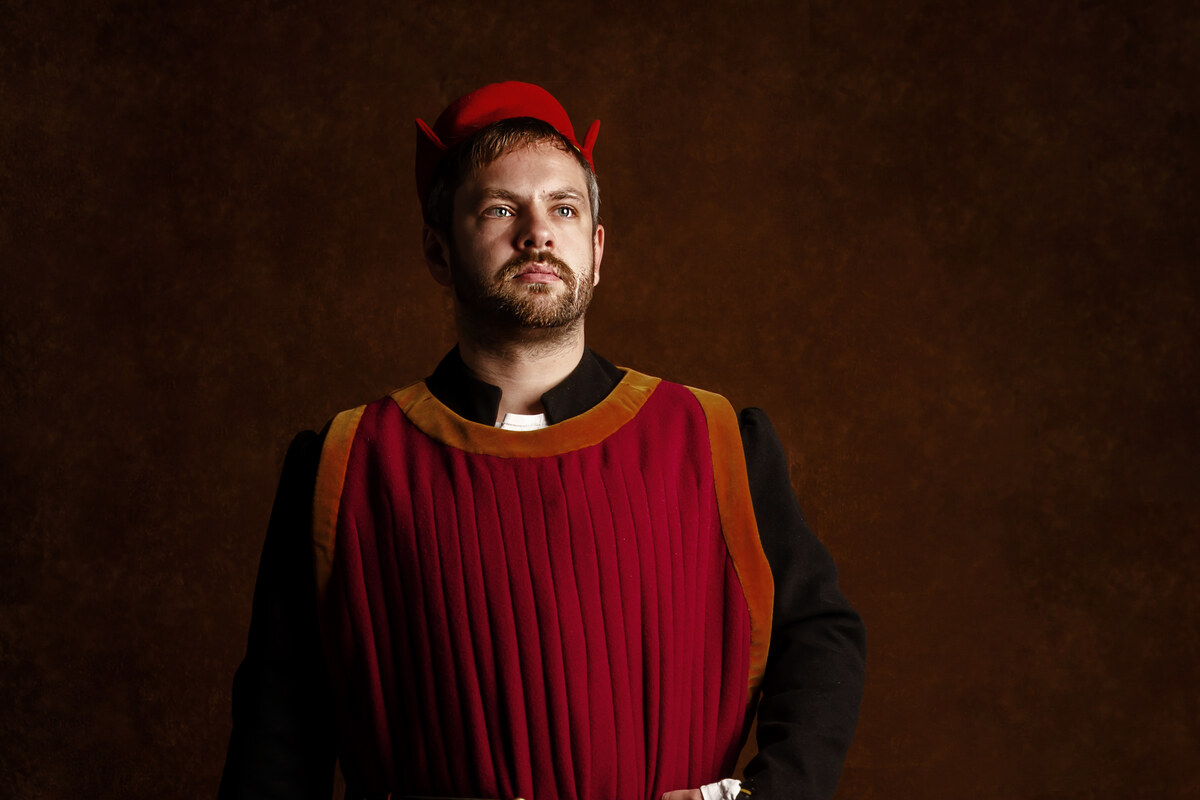
Around 1300, someone put the face opening of a hood over the top of their head instead of their face. That small mistake became the chaperon, the most common male headgear in early Netherlandish painting.
It began as a plain hood
Before 1200, the chaperon was a hood with a short cape, pulled on over the head or fastened at the front. Wool versions kept out the cold, and lighter ones served in summer.
It was worn mostly by the lower classes, by women as well as men, especially in northern Europe. Then the hole made for the face started going over the top of the head. The cape and the tail, called a liripipe in English, hung loose behind. People began making hoods designed to be worn that way, and the hat was born.
It swallowed enormous amounts of cloth
A padded ring called a bourrelet grew around the head, while the tail (the cornette) stretched until it nearly reached the ground. The largest rings, worn by very high-ranking men around 1445 to 1450, looked remarkably like a doughnut. Some were built over a hollow framework, and a drawing survives of an Italian block used to shape them.
A Florentine chaperon recorded in 1515 used sixteen braccia of cloth, more than ten yards (9 metres). In silk or damask, it was a loud signal of wealth.
There were at least six ways to wear it
The tail and the cape could be tied together on top like a turban. The cape could be looped under the chin. For cold or windy rides, the tail could be wrapped over the head and under the chin a couple of times.
The sixth style was for taking it off. In warm weather, or in front of someone far higher in rank, the chaperon was slung over the shoulder. Donor figures in religious paintings always wear theirs this way, because they are figuratively in the presence of the saints.
A miniature from 1447 to 1448 shows how strict this was. Philip the Good of Burgundy wears his chaperon, and so does Chancellor Nicolas Rolin, the only man with enough status to keep his on indoors in the Duke’s presence. Everyone else is bareheaded, even the young Charles the Bold.
The colour could mean rebellion
In France and Burgundy, the colour of a chaperon announced a political side. In 1356, Parisians who rose up against the future Charles V wore parti-coloured chaperons of red, for Paris, and blue, for Navarre. In 1379, the citizens of Ghent rebelled against Duke Philip the Bold of Burgundy wearing white ones. White returned in Paris in 1413, worn by opponents of the Armagnacs.
The factions themselves were sometimes simply called chaperons. In 15th-century Florence, the hood-style cappucci was linked to republicans, as opposed to courtiers. In 1516, an advisor told the Medici to get as many young men as possible to wear the courtier’s cap instead.
A chaperon was used against Joan of Arc
Among the items of male clothing listed in the charges against Joan of Arc in 1431 was a chaperon. It was apparently a hat rather than a hood, because she was said to have taken it off in front of the Dauphin. The judges cited this as further damning evidence that she was taking on male behaviour.
The hood that never fully went away
By about 1480 the chaperon was going out of fashion, and by 1500 it was outmoded in northern Europe. Shepherds and peasants kept the original hood. Lawyers, academics and members of some knightly orders, such as the Order of the Garter, kept the fancy version, which slowly shrank until it was sewn permanently to their robes as a pure ornament. In academic dress today, it survives as the epitoge.
The word travelled even further. Le Petit Chaperon rouge is the earliest published French title of Little Red Riding Hood, and the Italian word for the same garment, cappuccio, lies behind the Capuchin friars, whose hooded robes in turn gave the cappuccino its name.