Picture a medieval army and you probably see rows of steel. In reality, a huge share of the men on those battlefields went to war wrapped in cloth: a thick, quilted jacket called the gambeson.
It was cheap, it was everywhere, and it worked far better than its humble look suggests.
The armor the law expected ordinary men to own
In 1181, King Henry II of England issued the Assize of Arms, a proclamation listing exactly what equipment each free man had to keep, according to his wealth.
A man holding a knight’s fee needed a shirt of mail, a helmet, a shield and a lance. A free layman worth 10 marks needed a hauberk, an iron cap and a lance. And then came everyone else: “all burgesses and the whole community of freemen” were required to own a gambeson, an iron cap and a lance.
In other words, the padded jacket was the legal baseline of English defense. Nobody was allowed to sell it, pawn it or lend it away. For common soldiers who could not afford mail or plate, a gambeson and a helmet remained a common sight on European battlefields for the entire Middle Ages.
Up to 30 layers of linen, rags and horse hair
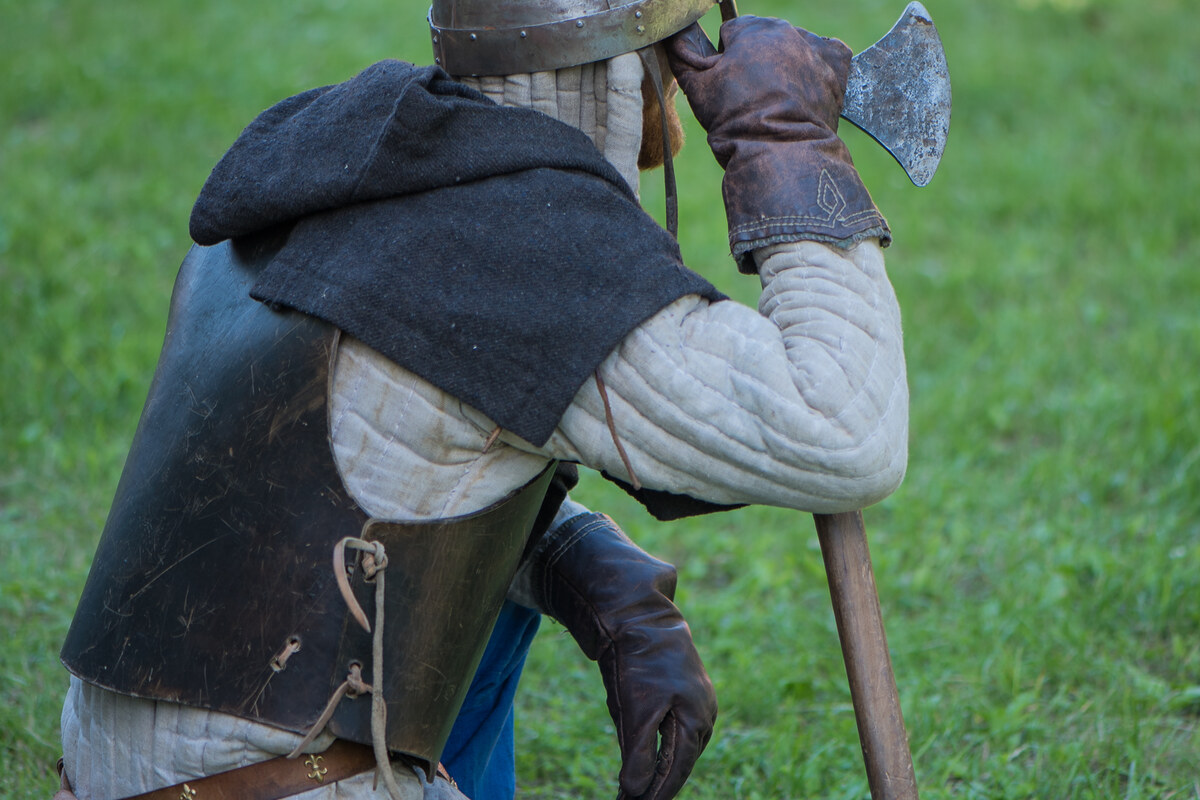
The secret was in the sewing. Gambesons were made by quilting, a technique also called “pourpointing”, which locked layers of fabric and stuffing together. The cloth was usually linen or wool, and the filling could be almost anything: scrap cloth, or even horse hair.
The versions meant to be worn alone, often called padded jacks, were the heavy-duty models. They had higher collars, were faced with leather or heavy canvas, and were built from many layers of cotton, linen or wool. Some accounts say around 18 layers, others as many as 30.
These jacks were reportedly able to stop even heavy arrows. Their principle, many stacked layers of fabric absorbing a blow, bears a striking resemblance to modern body armor, which moved from silk to ballistic nylon and finally to Kevlar.
The jacket that made a knight’s armor bearable
Knights wore gambesons too, just underneath everything else. A good coat of mail weighed between 13 and 15 kg, hanging mostly from the shoulders and upper chest. The padded layer underneath cushioned the body and stopped the metal from chafing the skin.
Evidence for this use under armor appears in images from the mid-12th century. By the 15th century, the arming doublet worn under plate had small laces, called arming points, to attach the steel plates, and sometimes patches of mail sewn into the elbows and armpits, exactly where plates left gaps.
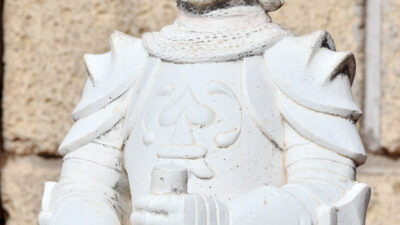
One version, the pourpoint, was cut tightly at the waist to prepare the body for a breastplate sitting between the ribs and the pelvis. The result was clever engineering: the weight of the armor moved from the shoulders to the hips.
From battlefield gear to noble fashion
Then something unexpected happened. The pourpoint, a military garment, became everyday wear for noblemen in the late 14th century, replacing the old tunic. Its wasp-waisted, rounded silhouette helped push European fashion away from the boxy clothes of earlier centuries.
In late 15th-century Italy, arming doublets also became civilian fashion. Men who were not knights wore them, probably because the garment suggested status and chivalry.
Even the names tell a story. “Gambeson” goes back to an Old High German word, wamba, meaning stomach, a cousin of the English “womb”. “Aketon” might come from the Arabic al-qutn, “the cotton”. The medieval Norse simply called it a “weapon shirt”.
A technology that refused to die
Quilted armor outlived the knights who wore it. It survived into the English Civil War as a “poor man’s cuirass”, before being replaced by the leather buff coat. A tougher cousin, the jack of plate, had as many as 1,000 small iron squares sewn between two canvases.
Settlers carried jacks to the New World because they protected so well against arrows. One dating back to 1607 was found on Jamestown Island in 2005.
So the next time a movie shows a medieval army glittering in steel, remember the real uniform of the Middle Ages: a stuffed linen jacket, stitched by hand, and quietly built on the same idea that protects soldiers today.