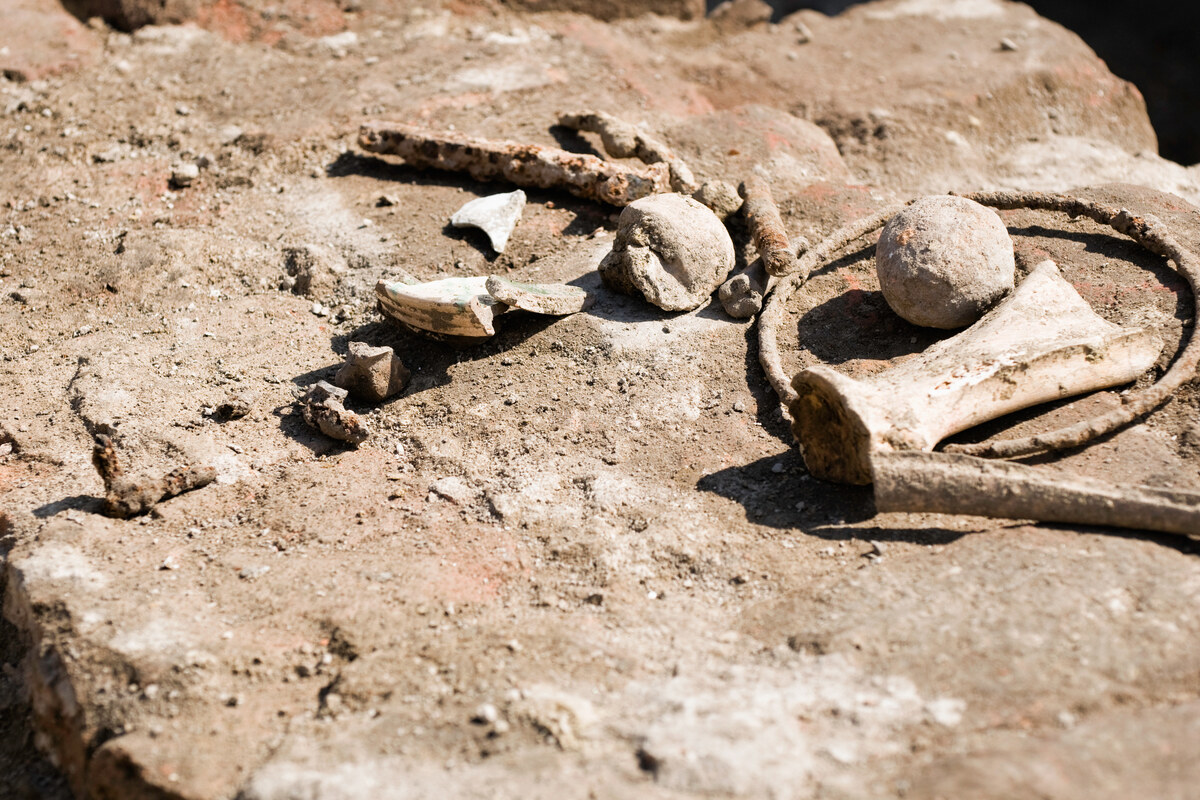
The most famous helmet of the early Middle Ages came out of the ground as a heap of rusted iron. When it was dug up at Sutton Hoo in 1939, it was in more than 500 pieces, and those pieces covered less than half of its original surface.
What visitors see today in Room 41 of the British Museum is not the helmet as it was found. It is the second attempt to solve a puzzle that the first attempt got partly wrong.
A treasure nobody noticed at first
The helmet was buried around 620 to 625 AD inside a ship that had been hauled up from a nearby river and lowered into a trench in Suffolk. It is widely linked to Rædwald, king of East Anglia, although that identification remains possible rather than proven.
Long after the burial, the chamber roof collapsed under the weight of the mound. Strangely, this was a stroke of luck. Because the iron had already oxidised, the helmet shattered instead of being squashed out of shape, and that is what made a reconstruction possible at all.
In July 1939, the excavators simply recorded “the crushed remains of an iron helmet”. No photographs were taken of the fragments where they lay and their positions were not noted. The only trace is a circle on the site plan marked “nucleus of helmet remains”.
A jigsaw puzzle with no picture on the box
The excavation ended on 24 August 1939. Nine days later, Britain declared war on Germany, and the Sutton Hoo treasures spent the war stored in a tunnel between the Aldwych and Holborn tube stations.
In 1945, the job of rebuilding the helmet fell to Herbert Maryon, a retired professor of sculpture. The scholar Rupert Bruce-Mitford later summed up the task as “a jigsaw puzzle without any sort of picture on the lid of the box”, with a great many pieces missing.
Maryon traced every fragment on stiff paper. He then sculpted a plaster head the size of a human head, fixed the fragments onto it and filled the gaps with plaster tinted brown. He spent six continuous months on the helmet, working in his 70s with the use of only one eye.
The icon that did not quite fit
Unveiled after the war, Maryon’s helmet became a star. It was shown at the Festival of Britain in 1951, photographed for Life magazine, and for more than 20 years it was the face of the Anglo-Saxon world.
But Swedish scholars and others had doubts. By building it around the mould of an average man’s head, Maryon may have fixed its size in advance, and someone with a larger head would have struggled just to put it on. The jaw was left exposed, there was a hole between the eyebrows and the nose, and the eye holes were large enough for a sword to pass through.
Maryon had also lengthened the crest with about 4.5 inches of plaster. When Sutton Hoo was excavated again in the late 1960s, the old 1939 dumps yielded four new helmet fragments but no substantial piece of crest, reinforcing suspicions that it was too long.
Taking an icon apart with a saw
In 1968, the British Museum made a bold decision: dismantle the famous helmet and start again. The work went to Nigel Williams, a conservator in his mid-20s.
The plaster-covered wire mesh was “rolled back like a carpet”, each fragment was cut free with a saw, and the skull cap was sliced in half. After four months, the helmet was once again in more than 500 pieces. Williams found the result “terrifying”.
The breakthrough came from the back of the fragments. Their black, wrinkled surface, thought to come from a decayed leather lining, could be matched under a microscope. Near the end, an expert on arms and armour suggested something simple: the cheek guards should switch sides. Swapping them finally closed the gap at the jaw.
On 2 November 1971, after eighteen months, the new helmet went on display. It is the one on book covers today, and in 2006 it was voted one of the 100 cultural icons of England, alongside the double-decker bus and the cup of tea.
A masterpiece that is still partly a hypothesis
Very little of the original neck guard survives, several blocks of fragments there are only speculatively placed, and nobody knows for sure whether it carried seven decorative strips or five.
That may be the real lesson of the Sutton Hoo helmet. The face staring out from its museum case is part Anglo-Saxon craftsmanship, part 20th-century detective work, and the story of how it was pieced together twice now belongs to its history as much as the king who may have worn it.