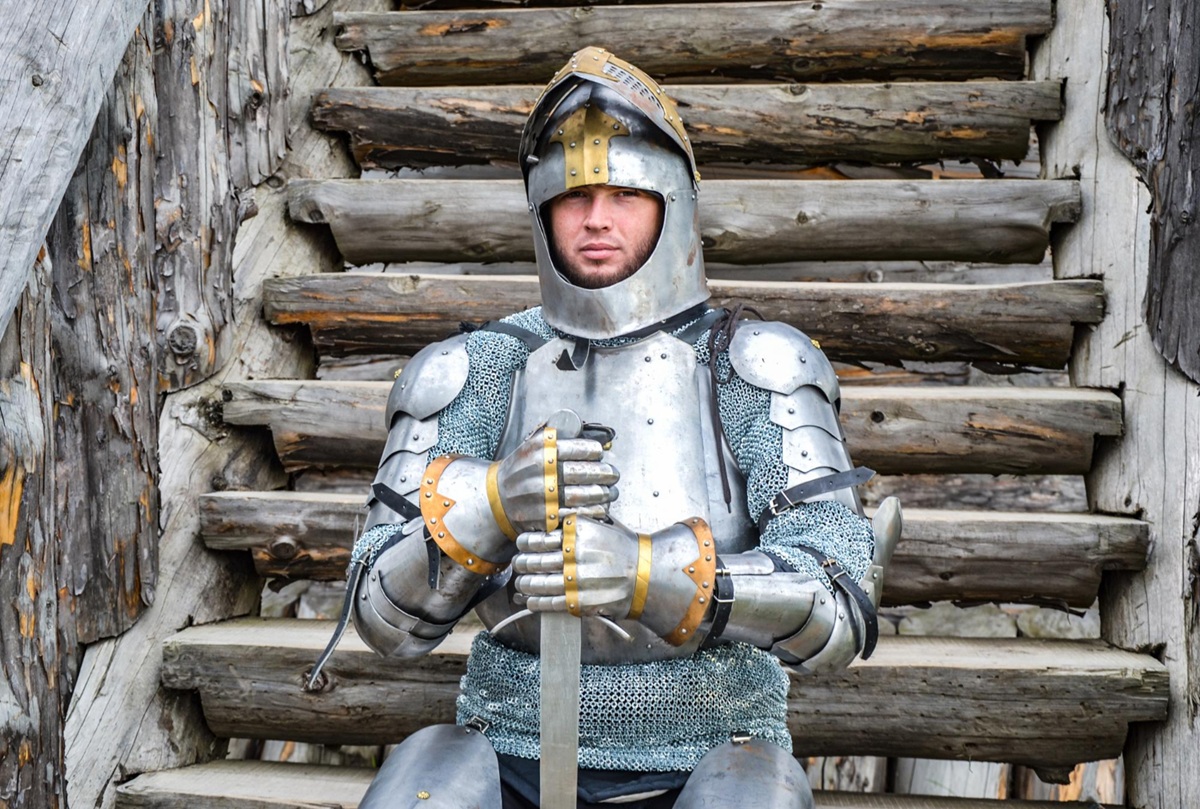
A medieval sword usually weighed between 1 and 1.5 kilograms, roughly what a laptop weighs in a bag. No knight needed Herculean strength to swing one.
The weight myth Hollywood keeps alive
Movies and games love to show knights heaving massive blades that look like they belong in a forge, not a battlefield. The image sticks because it feels dramatic.
The reality is far less theatrical. Even two-handed bastard swords rarely passed 2 to 2.5 kilograms. Every gram was calculated, not piled on for show.
Swordsmiths balanced the blade against the hilt so the weapon felt almost weightless in the hand, shifting fast between cutting and thrusting depending on the fight.
Six weeks of work for one blade
Forging a single sword took a smith working alone about a month and a half, from raw ore to the final polish and sharpening.
The technique itself was remarkably advanced: soft steel at the core for flexibility, hard steel on the outside for the edge, folded repeatedly into a composite blade centuries before modern metallurgy explained why it worked.
That much time and skill made swords expensive enough that, for most of the Middle Ages, owning one was a privilege reserved for the nobility.
Reading a sword like a fingerprint
Surviving swords differ enough in blade shape, pommel, and guard that a 20th-century historian named Ewart Oakeshott built an entire classification system around them.
His scheme sorts medieval swords into 13 distinct types, letting archaeologists date and identify a blade almost as precisely as reading a label.
The blood groove that never carried blood
Look closely at a medieval blade and you will often spot a long groove running down its center. Popular legend calls it a “blood groove,” supposedly there to let blood drain out of a wound.
That story is a 19th-century invention. The groove, technically called a fuller, removed weight from the blade while keeping it stiff enough not to bend under pressure.
It is the same engineering logic behind an I-beam in construction: cut material where it will not weaken the structure, save the rest for strength.
A weapon blessed and packed with relics
Swords were not just tools of war. Many carried saints’ relics hidden inside the pommel, religious inscriptions along the blade, and a cross-like shape that linked the weapon to faith itself.
Legend gave Roland, nephew of Charlemagne, a sword named Durandal said to hold a tooth of Saint Peter and a piece of the Virgin’s cloak inside its pommel.
A sword like that was not only a weapon. It was a blessing a knight carried into every fight.
The day the sword lost to the gun
By the 18th century, the sword’s place on the battlefield was already a memory of its former self. At Culloden in 1746, Highland clansmen charged with claymores straight into English muskets and cannon.
Around 2,000 Jacobite fighters died that day, against roughly 52 on the English side. The blade that had defined a thousand years of warfare could not compete with gunpowder anymore.
A weapon built with such precision, balanced to feel light in the hand, still could not outpace a bullet. Sometimes the most refined tool simply meets a moment history has already moved past.