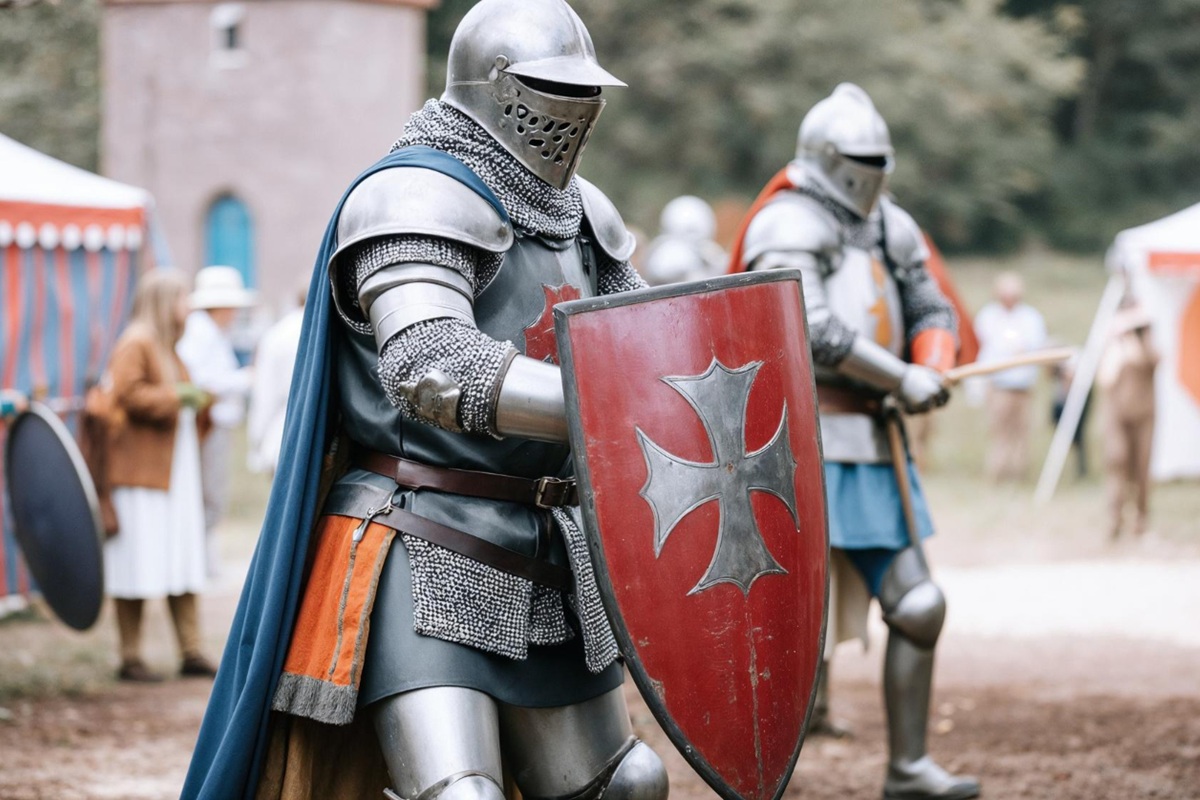
A medieval knight charging into battle rarely rode alone. Military planners built an entire support team around him and gave it the same name as the weapon in his hand: the lance.
A lance was a weapon, and also a small army
Most people picture a lance as simply the long wooden weapon a knight carried into a cavalry charge. In the medieval military system, the same word also described something else entirely: a tactical unit.
A “lance” could include between four and ten mounted men built around a single knight: a page, a valet, two archers and a coutilier. Together they formed a self-contained fighting cell, not one man riding into danger by himself.
Historian Philippe Contamine, a leading specialist of medieval warfare, has documented this structure as one of the defining organizational units of the era, as much an administrative tool as a combat formation.
The knight’s own weapon was too heavy to carry all day
The cavalry lance itself could stretch up to four meters long in some later medieval versions, tipped with sharp iron. On the march, that length made it awkward and exhausting to manage from horseback.
Knights routinely handed the lance to their squire outside of combat. It only returned to the knight’s own hand at the moment of the charge, the one instant it actually needed to be there.
One duke tried to turn this small team into an army
Charles the Bold, duke of Burgundy, saw an opportunity in this structure. He planned to organize his forces into 1,250 lances of nine men each, roughly 11,000 combatants split across ten companies.
The project was ambitious enough to reshape Burgundian military power for a generation. It never got the chance: Charles died at the Battle of Nancy in 1477 before the reorganization was finished.
Not every lance rode on horseback
By the 14th and 15th centuries, infantry began forming their own dense blocks of long lances, built specifically to hold off a mounted charge like the ones described above. These pikemen formations proved so effective that Spanish tercios would later perfect the same idea into a dominant battlefield tactic.
The knight’s mounted lance and the foot soldier’s pike were, in a sense, the same idea pointed in opposite directions: one built to deliver a charge, the other built to stop one cold.
A weapon older than the idea of a knight itself
The lance as an object predates knighthood by hundreds of thousands of years, and it stayed in continuous use as a primary weapon of war from prehistory all the way to the appearance of the bayonet rifle. The oldest known examples are wooden hunting spears found at Schöningen in Germany, fire-hardened and dated to roughly 400,000 years ago.
By the Middle Ages, that ancient hunting tool had been folded into one of the most organized military systems in Europe, complete with its own chain of command riding at a gallop.
What one weapon reveals about medieval warfare
None of this matches the popular image of a lone armored figure winning battles through personal glory. A medieval knight’s effectiveness depended on a coordinated team most people never hear about.
The same pattern still shapes how conflicts get fought today: the figure visible at the front is rarely the one holding the whole structure together.