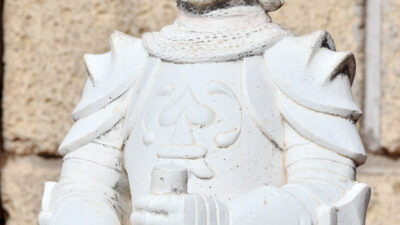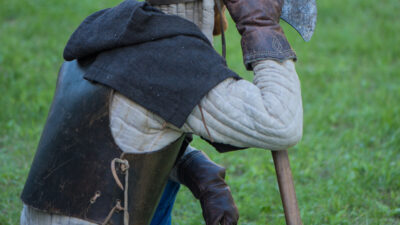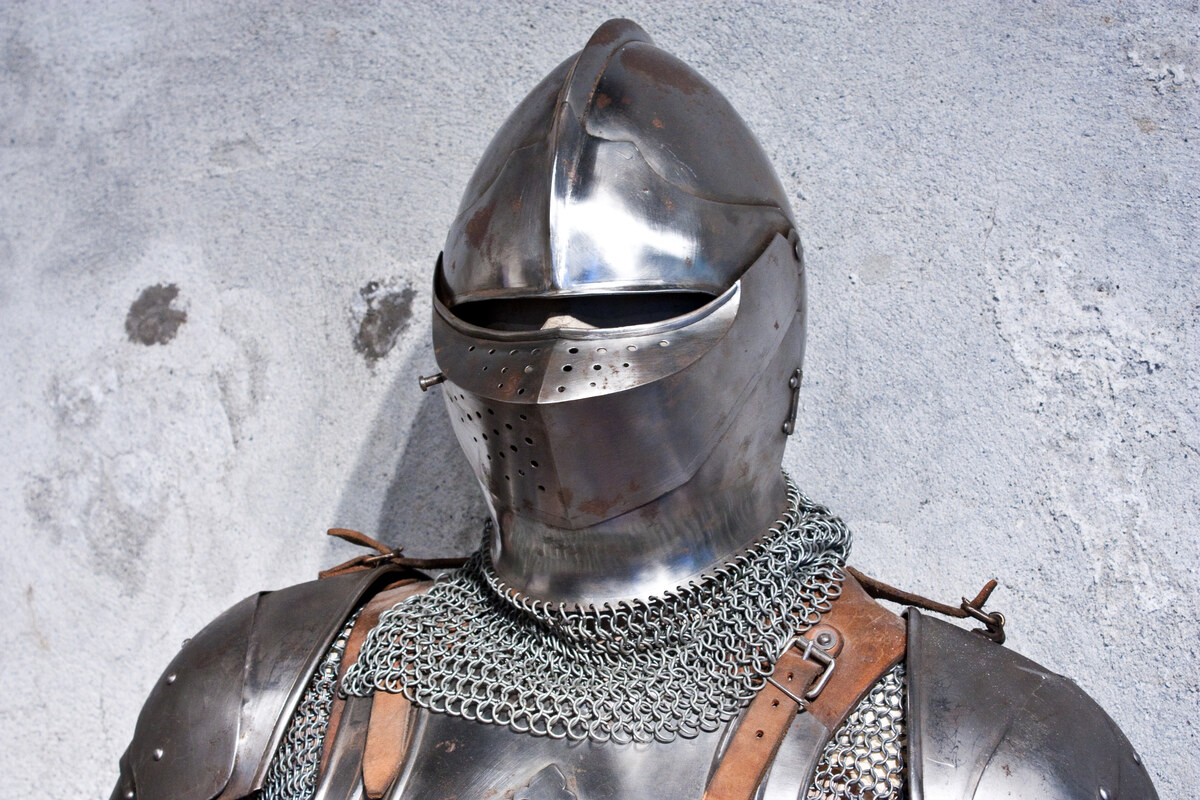
The knight in full shining steel is one of the most familiar images of the Middle Ages. Yet for most of that era, no knight looked like that at all. Plate armor crept onto the body one piece at a time, and the complete suit arrived surprisingly late.
1. It started with knees, shins and forearms
Plate armor did not replace chain mail in one dramatic leap. From the 13th century, armorers began adding isolated metal pieces on top of the existing mail hauberk, protecting the forearms, the knees and the shins first.
These plates were fixed on leather straps or frames, a patchwork of rigid steel over flexible rings. For generations, a well-equipped knight was a hybrid, half mail and half plate.
The complete harness covering the whole body only became common among Europe’s high nobility between 1350 and 1420. In other words, the transition took well over a century.
2. Chain mail never fully disappeared
Even once full plate became the standard for the wealthy, mail survived underneath it. Rigid plates could not bend at every joint, so pieces of mail stayed at the connection points of the body.
Mail protected the gaps between the metal plates: the armpits, the groin and the elbows. It kept this supporting role until firearms made it obsolete for good in the 16th century.
3. Plate armor changed the way knights charged
Heavier armor had consequences far beyond the rider himself. Knights covered in steel needed stronger horses to carry them into battle.
Their tactics changed too. Cavalry moved away from charges in loose, scattered order and toward compact squadrons charging together as one mass. A piece of personal equipment ended up reshaping the battlefield itself.
4. Two rival styles competed across Europe
By the 15th century, plate armor had become as much a work of art as a piece of military technology. Two great production centers dominated the trade: Milan in Italy and Augsburg in Germany.
Each developed its own look. German Gothic armor reached its peak with characteristic flutes and serrated edges, a technical and aesthetic masterpiece. At the same time, Milanese armor favored smooth, rounded forms.
At a glance, the outline of a knight’s armor could therefore hint at which workshop tradition had produced it.
5. It was never truly impenetrable
The idea that a knight in full plate was untouchable is a myth. A powerful crossbow could pierce the plates, and so could the arquebus, one of the early firearms.
Fighters also learned exactly where to aim. They systematically targeted the weak points: the armpits, the inside of the elbows, the throat and the small gaps between pieces.
This created a permanent arms race. Every improvement in armor pushed weapon makers to innovate in return, and every new weapon pushed armorers to respond.
The slow end of a steel era
Gunpowder artillery, introduced in the 14th and 15th centuries, gradually made plate armor obsolete. Its excessive weight and the considerable time needed to put it on did not help its case.
Yet the tradition did not vanish overnight. Around 1540, King Gustav I Vasa of Sweden had a remarkable suit of plate armor made for himself. It is still preserved today at the Livrustkammaren museum in Stockholm, a documented example of the very last generation of this craft.
A technology that grew with its enemies
Plate armor is often remembered as a fixed symbol of the medieval knight. In reality, it was a moving target, adding pieces, changing shapes and adapting to new threats for roughly three centuries.
Its story is less about invincibility than about constant adaptation, a race between protection and attack that would continue long after the last knight hung up his steel.