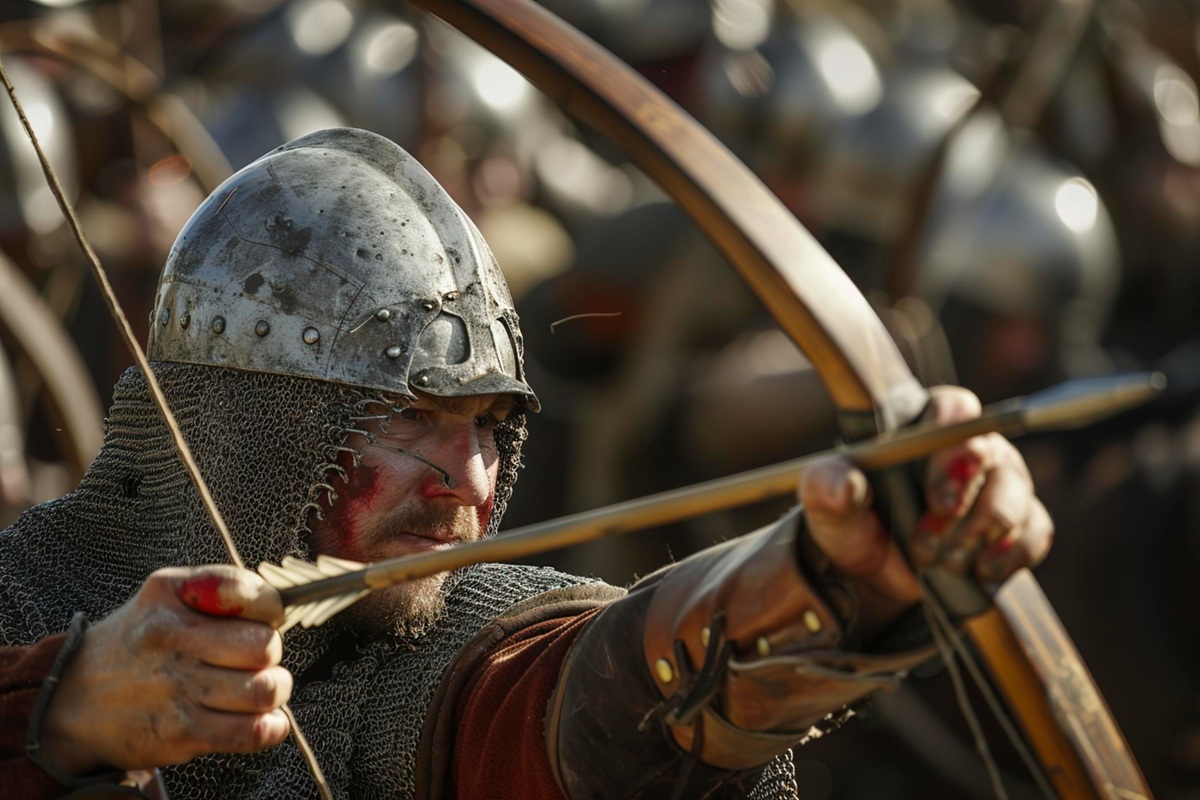
On the muddy field of Agincourt on 25 October 1415, an English archer could draw and loose a heavy war bow up to sixteen times in a single minute, over and over, for hours, while a French army three to five times the size of his own closed in across the mud.
A bow built to test the body’s limits
The English longbow stood between 1.70 and 2.10 metres tall, roughly the height of the archer holding it, carved from yew imported from Italy, Spain, or the Pyrenees.
Bows recovered from the wreck of the Mary Rose show draw weights ranging from 80 to 180 pounds. A modern recreational bow rarely exceeds 40 pounds. Pulling that much resistance ten to sixteen times a minute, with a practical range of 165 to 250 metres, was less a skill than an ongoing physical ordeal.
The law that quietly built an army
That kind of strength did not appear overnight. Edward I ordered every free Englishman to practise archery after church on Sundays, turning a weekly religious obligation into a standing national training program.
Generations later, that law is a large part of why Edward III and then Henry V could field thousands of trained archers at will, without needing to recruit and train a specialist corps from scratch.
What the storm of arrows actually looked like
At Agincourt, around 12,000 English archers were capable of loosing a combined 75,000 arrows a minute at the height of the exchange, a density of roughly 72 arrows per minute over every square metre of ground they targeted.
Not every arrow was the same. Flat or barbed heads flew at longer range, 100 to 300 metres, aimed mainly at horses. Bodkin points, narrow and hardened specifically to pierce plate, were reserved for under 60 metres, the only distance at which they could reliably beat quality armor.
The French cavalry, badly outnumbering the English but bogged down in mud, absorbed that curtain of arrows for hours before the battle turned decisively.
The boys who kept the arrows flying
A single campaign could burn through 400,000 to 800,000 arrows, a number no archer’s personal supply could ever cover alone. Young boys worked the battlefield itself, running fresh bundles to the archers under fire so the rate of fire never dropped.
That scale of production is exactly what the Mary Rose wreck later confirmed. When the ship sank in 1545, it carried 137 longbows and roughly 3,500 arrows, each between 61 and 81 centimetres, a snapshot of the industrial-level supply chain a single vessel was expected to carry.
The raw power behind all that effort was documented decades earlier, in 1188, when a Welsh arrow was reported to have punched through a knight’s mail, his leather doublet, his thigh, his saddle, and into his horse in a single shot.
The line only held as long as it stayed a line
None of this firepower worked on its own. It depended entirely on archers standing in a fixed, defended position, protected by sharpened stakes and unfavorable ground for cavalry.
At Patay in 1429, English archers had no time to plant those stakes before Joan of Arc’s cavalry closed in, and the result was a rout instead of a repeat of Agincourt. Field artillery finished the job decades later, at Formigny in 1450 and Castillon in 1453.
The most feared weapon of its age, in other words, was never invincible by itself. It was only ever as strong as the discipline, the position, and the supply line built up around it, a lesson about firepower that has never really gone out of date.