The most famous poem in Old English survives in exactly one copy, and its official name is a shelf address: the 15th book from the left on the top shelf, under a bust of a Roman emperor.
A library catalogue with busts for street signs
Sir Robert Cotton, the antiquarian who owned the manuscript in the 17th century, used his own filing system. Each bookcase was topped with a bust of a Roman emperor, and each shelf had a letter.
So the manuscript became “Cotton Vitellius A.XV”: the 15th book from the left on shelf A, in the case with the bust of Vitellius on top. Scholars still use that label today.
It works like a modern call number, only with a marble face attached. The poem itself has no title in the original. It is called Beowulf simply because that is the name of its hero.
The name nobody had on their lips in 1700
The codex is also known as the Nowell Codex, after the 16th-century scholar Laurence Nowell. Who owned it before him remains a mystery.
The first time the manuscript is mentioned by name is in a letter from 1700. George Hickes wrote to Humfrey Wanley, who had accused a colleague of leaving the poem out of a catalogue of the Cotton library. Hickes replied: “I can find nothing yet of Beowulph.”
The poem that would define a whole literature was, at that moment, close to invisible on its own shelf.
The night the Cotton library burned
In 1731, a fire swept through Ashburnham House in London, where the Cotton collection was being kept. Around a quarter of the manuscripts Cotton had bequeathed were destroyed.
Beowulf survived, but not unharmed. The margins were charred, and some readings were lost. Since then, parts of the manuscript have crumbled along with many of its letters.
Even the rescue caused damage. Later rebinding saved the pages from further decay, but it also covered up other letters of the poem.
Two scribes, and one of them gave up mid-sentence
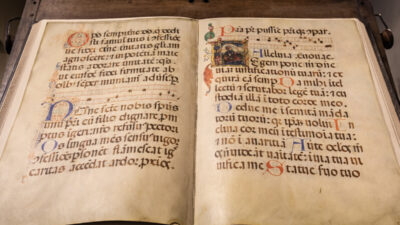
The manuscript is the work of two scribes. The first copied the prose at the start and the first 1,939 lines of the poem, then broke off in mid-sentence.
The second wrote the rest, and his handwriting changes after line 1939. He seems to have written more vigorously and with less interest. He also copied what he saw in front of him without modernizing the spelling. That is a gift to scholars, because his old dialect features help place the poem in a cultural context.
Both scribes proofread their work. There are still many errors.
A copyist who could not read the language
In 1786, the Icelandic scholar Grímur Jónsson Thorkelin made the first transcriptions of the manuscript. He had a professional copyist, who knew no Old English, make one copy, then made a second himself.
Knowing no Old English made the copyist more likely to slip, but also more likely to copy exactly what he saw. Since then the manuscript has crumbled further, so those transcripts are now prized witnesses to the text. The recovery of at least 2,000 letters can be attributed to them, although how much more readable the manuscript really was in Thorkelin’s day is uncertain.
Reading what the fire hid
When Kevin Kiernan prepared his Electronic Beowulf edition, first published in 1999, he used fibre-optic backlighting and ultraviolet light to reveal letters lost to binding, erasure and ink blotches.
The manuscript, only 245 by 185 millimeters, still gives up secrets. The Nowell Codex now sits in the British Library. A poem that nearly vanished on a shelf, then in a fire, is now readable online for anyone with a screen.