In 1401, one of Europe’s first professional female writers picked a public fight with the most popular poem in France, and won herself a permanent place in literary history for it.
A poem written by two men who agreed on nothing
Around 1230, a poet named Guillaume de Lorris wrote the opening 4,000 verses of the Roman de la Rose. It is a dream allegory: the narrator falls asleep, wanders into a walled garden, and falls in love with a rosebud symbolizing the woman he desires.
Allegorical figures block him (Danger, Malebouche, Jalousie) or help him (Ami, Raison, Venus). Guillaume died before finishing it, leaving behind a polished monument to courtly love, refined, idealized, and unfinished.
Forty years later, a clerk named Jean de Meung picked up the unfinished poem and added roughly 17,700 more verses, over four times the length of the original. His half has almost nothing in common with Guillaume’s.
Where Guillaume idealized love as a moral code, Jean de Meung treated it as a blunt natural instinct. He filled his continuation with satire, crude realism, and long philosophical digressions on nature, astronomy, and optics.
The book only the Bible outsold
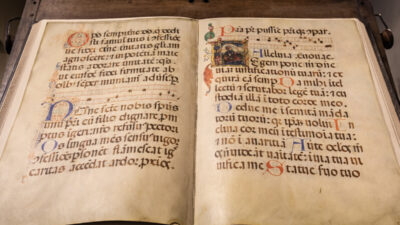
The finished poem became the most copied secular text in medieval France. More than 300 manuscripts survive from the 14th and 15th centuries, a circulation rivaled only by the Bible.
Princes commissioned luxury illuminated copies. The Duke of Berry owned several, some with miniatures depicting the poem’s allegorical characters as real courtiers in fashionable dress. In 1485, it went to print for the first time, under the Parisian printer Jean Dupré.
Christine de Pizan picks a fight
By 1401, the poem had been read and copied for over a century. That’s when Christine de Pizan, an Italian-born poet at the French court and the first known professional woman writer in Western Europe, decided to attack it in public.
Alongside the theologian Jean Gerson, she accused Jean de Meung’s half of the poem of being misogynistic and obscene. Two other scholars, Jean de Montreuil and Gontier Col, defended it as a philosophical masterpiece.
The fight played out through letters circulating among Paris’s literary circles, an epistolary network of arguments and counter-arguments. Historians consider it the first documented public literary quarrel in French history.
The first feminist critique in western literature
Pizan’s attack on Jean de Meung is regarded by medievalists as the first systematic proto-feminist text in Western literature. She dismantled the poem’s misogyny with rhetorical precision that impressed even her opponents.
She also kept her own letters and her rivals’ replies, carefully preserved, forming the first surviving case file of a literary dispute in French history. Six centuries before literary Twitter, she knew the argument was worth documenting.
An argument that never really ended
The Roman de la Rose outlived its critics either way. Chaucer translated part of it into English. Dante drew on its allegorical structure for the Divine Comedy. Dozens of 14th and 15th century poets followed in its tradition.
Six hundred years later, readers still argue over whether beloved but troubling classics deserve celebration or correction. Christine de Pizan just happened to have that argument first, and left a paper trail to prove it.