In 1386, at the Battle of Sempach, Austrian knights who suddenly had to fight on foot discovered that their own footwear was working against them. Many had to cut the tips off their armored shoes on the field, and Swiss chroniclers report that a huge heap of these severed points was found afterward.
A shoe fashion named after Poland
The style behind that pile of metal was the poulaine, a shoe or boot with an extremely long toe. The name comes from the French “souliers à la poulaine”, meaning shoes in the Polish fashion. They were also called pikes, or cracows after the Polish capital of the time.
The main craze began in the mid-14th century at the Polish court of Casimir the Great. From there it spread to France, Burgundy, Germany, England and Scotland, and stayed popular through most of the 15th century.
Monks called them demons’ claws
Churchmen hated them. In 1362, a monk at Malmesbury wrote that men’s beaked shoes were “better called demons’ claws than decorations for men.” In 1368, Charles V of France banned making and wearing them in Paris. An English poem from 1388 complained that men could not even kneel in prayer because their toes were too long.
One famous claim comes from a monk at Evesham, who wrote in 1394 that the toes were so long they had to be tied to the shin with silver chains. He blamed Anne of Bohemia, who married Richard II in 1382. But the style had reached England before she was even born, and no archaeological or pictorial evidence supports the chains. The story looks more like political spin than a fashion report.
What was inside the toe
Poulaine toes were stuffed to hold their shape. Surviving examples from medieval London were packed with moss, and an Italian chronicler noted in 1388 that horsehair was sometimes used too.
The reality was also less extreme than the legend. Surviving soles show the point rarely stretched beyond 50% of the length of the foot, and the most extreme examples belonged to the upper classes.
When the fashion met the battlefield
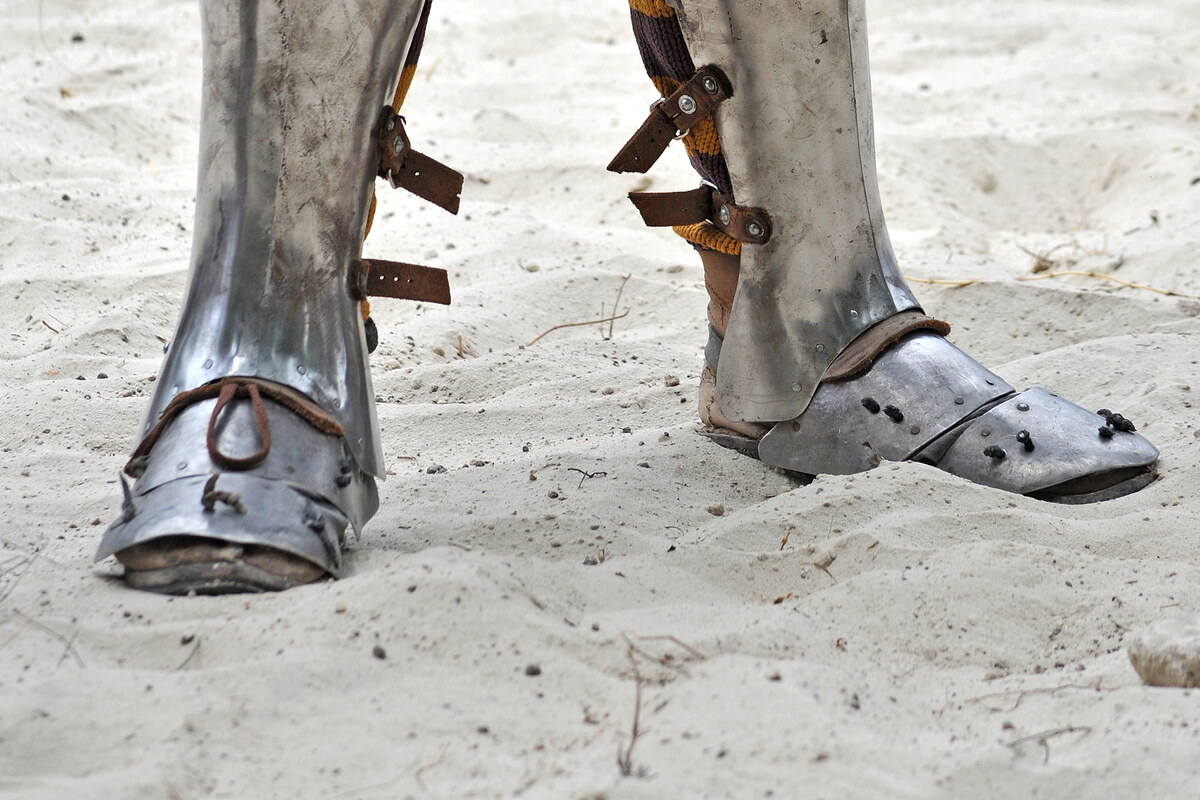
Armor followed fashion. While poulaines were popular, the sabatons that protected a knight’s feet sometimes became just as long or pointed, and they got in the way of walking or running.
At Sempach, the knights of Leopold III, Duke of Austria, had to dismount quickly to fight on foot. They were not prepared for it, so many cut off the tips of their sabatons to keep going. The pile of discarded points was later illustrated in the 1513 Luzerner Schilling. A surviving pair of sabatons made for Maximilian I has extremely long ends for riding, but they are detachable, with catches over the big toe, in case he had to fight on foot.
The price paid by feet
The shoes left marks on bone. A 2021 study of 177 skeletons from four cemeteries around Cambridge found that people from more fashionable neighborhoods during the poulaine years were far more likely to have bunions, misshapen feet and fractures linked to falls. Of the dateable remains, 27% from the 14th and 15th centuries had bunions bad enough to deform the skeleton, against only 6% in the 11th to 13th centuries.
Co-author Piers Mitchell summed it up: “People really did wear ridiculously long, pointy shoes, just like they did in Blackadder.”
Laws, then a new fad
Rulers tried to cap the trend. An English law of 1463 limited pikes to two inches for anyone below the rank of lord, and in 1465 shoemakers in London and its surroundings were banned from making pikes longer than two inches at all.
By the 1480s the fashion had faded in favor of wide duckbill shoes, supposedly popularized by Charles VIII of France because of his own six-toed foot. The poulaine never fully disappeared from memory: it is considered an influence on the winklepicker boots of 1950s Britain.
Fashion has always asked people to pay for style. In the Middle Ages, some of them paid with their balance, their feet and, at Sempach, with the tips of their armor.