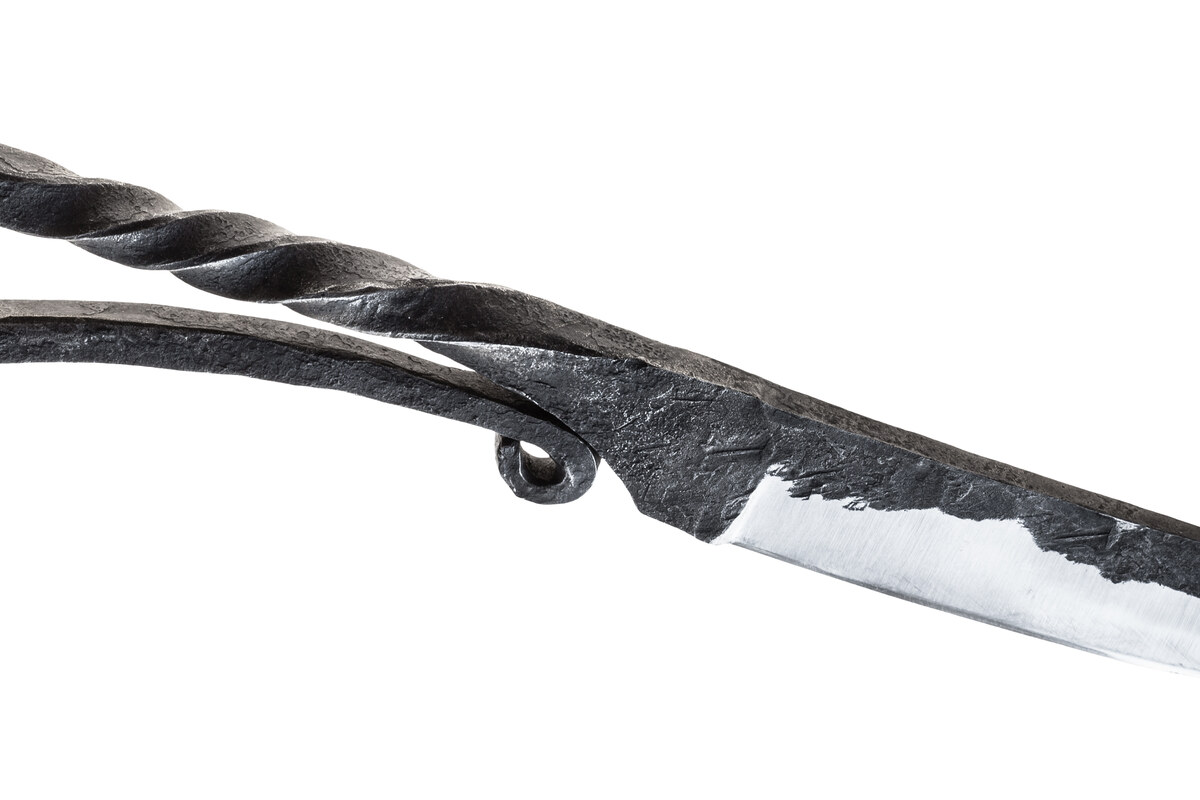
The word “Saxon” almost certainly comes from a knife. Frankish and Saxon warriors of the early Middle Ages carried a short blade called the scramasaxe everywhere they went, and its name may be the reason an entire Germanic people is called what it is today.
A blade built to do everything
The scramasaxe was worn horizontally at the belt, tucked into a leather sheath, by Franks and Saxons alike. It was never just a weapon or just a tool, it served as both at once, from farm work to combat.
It came in several sizes. The Kurzsax measured about 25 centimeters and appeared as early as the mid-5th century, the Schmalsax reached 30 centimeters by the 6th century, and the Langsax stretched to roughly 49 centimeters for dedicated Saxon military use.
A name that outlived the blade
The word “scramasaxe” comes from the Old Low Franconian *scrâmasahs*, combining *scrama* (a gash or cut) with *-sax* (a short sword). That same root, sax, is widely tied to the very name of the Saxon people.
A knife carried daily by ordinary warriors ended up lending its name to how an entire people would be known for the next fifteen centuries.
The knife that helped kill a king
The scramasaxe first appears in written history for a dark reason. In 575, the Frankish king Sigebert I was assassinated by attackers wielding poisoned scramasaxes.
The bishop and historian Gregory of Tours documented the killing around 591, leaving the earliest known literary account of the weapon in action.
Metal secrets ahead of Rome
Merovingian smiths built these blades using a sandwich technique, layering a soft iron core between harder steel edges. The result was a blade both flexible and sharp, and by most measures, better than what Roman workshops had produced before them.
Some smiths also worked manganese into their alloys, adding real hardness to the finished blade. They had no idea why it worked. Modern science would not explain the chemistry behind it for well over a thousand years.
Everyone at the table brought their own
Medieval dining did not mean eating with bare hands, contrary to what many people assume. The knife was the universal table utensil from the early Middle Ages onward, and every diner was expected to bring their own to a meal.
What was missing from the table was not the knife but the individual fork, which stayed rare for centuries. A scramasaxe strapped to the belt for combat and farm work could just as easily end up cutting the evening meal.
More than a survival tool
In Scandinavian versions, scramasaxe sheaths were decorated in the animal-style art typical of Viking craftsmanship, turning a working blade into a mark of status as much as a tool.
The attachment ran deep. Scramasaxes appear in post-mortem inventories right alongside clothing and jewelry, and the ones recovered from Merovingian graves often carry copper and brass inlay in careful geometric patterns, a surprising amount of care for an object whose main job was survival.
A short blade that ordinary people strapped to their belts every morning ended up naming a people, appearing in the murder of a king, and quietly outpacing Roman metallurgy along the way. Not bad for an object most of us have never heard of.