A gold and garnet purse buried with an Anglo-Saxon ruler held just 37 gold coins, and no two of them came from the same mint.
It was buried around 1,400 years ago in a ship under a mound at Sutton Hoo, in Suffolk. Pocket money does not look like that. A collection does.
A purse fit for a king
Only the lid survives. The leather pouch underneath rotted away long ago, but its cover, about seven and a half inches long, hung from the waist belt by three small hinges that are still visible on top.
The lid is a kidney-shaped frame of cellwork set around a sheet of horn. On it sit pairs of gold and garnet plaques: birds of prey, geometric patterns, and men standing between two wolves. Historians call it “one of the most remarkable creations of the early medieval period.”
The person in the grave is usually thought to be Rædwald, King of East Anglia, who died around 624. That has never been proven, but the wealth around the body fits a ruler of his rank.
Not cash, but a carefully chosen set
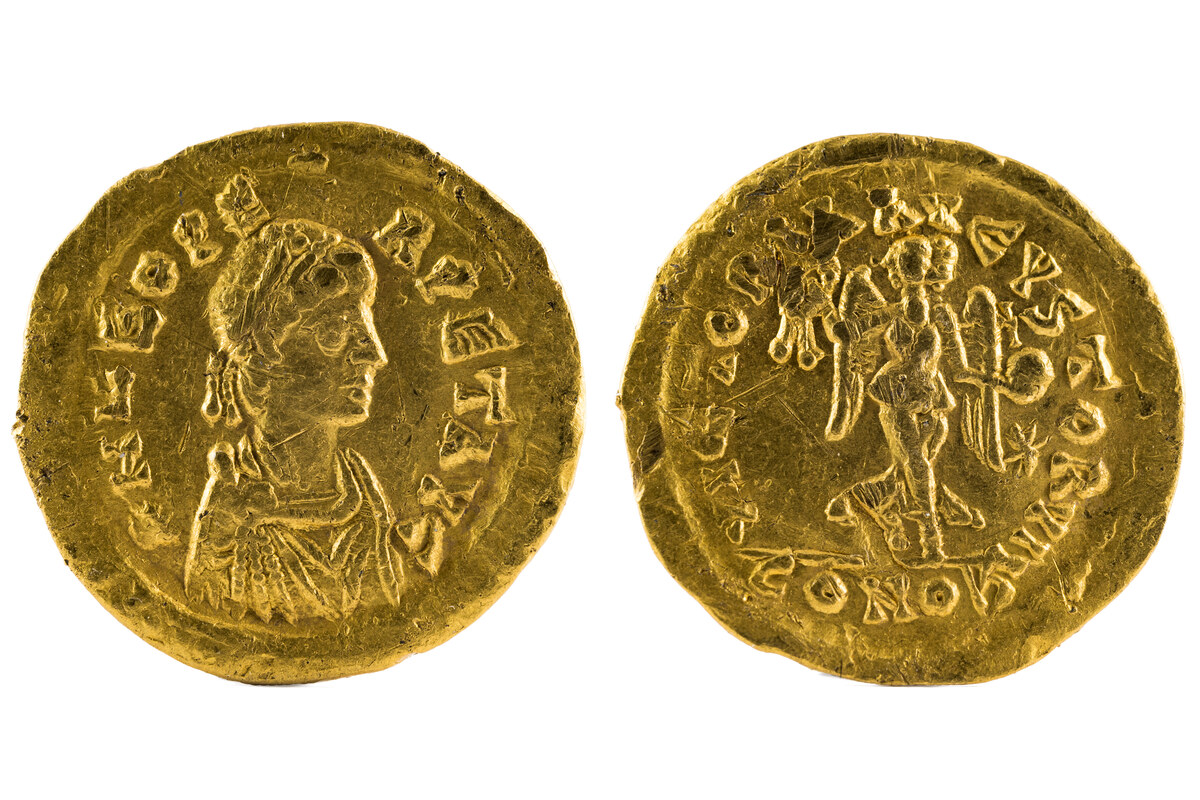
Here is the strange part. Each of the 37 gold coins, small Frankish pieces called tremisses, came from a different mint. That is not the loose change of a market day. The coins were deliberately collected.
Think of a modern collector filling an album one slot at a time. Whoever put this purse together was doing something similar, making sure that no Frankish mint appeared twice.
And the purse held more than coins. There were also three blank coins, never struck with any design, and two small gold ingots. Blanks are useless as money, which makes it even clearer that this was not a simple wallet.
Forty coins for forty ghostly rowers
Now do the sum: 37 coins plus 3 blanks makes 40. That number turns up elsewhere in the grave.
The ship itself was 27 metres long. Its timber has vanished, but the sand kept a perfect imprint, and oar rests along its sides suggest there may have been places for forty oarsmen.
One theory links the two. Like the Roman custom of leaving a coin to pay for the journey of the dead, the purse may have held one payment for each of forty ghostly oarsmen rowing the dead man into the afterworld. Other scholars see the coins as a funeral tribute, or as a sign of political allegiance. Nobody can say for sure.
The coins that dated a king
The coins did one more job, a very practical one. They are the main evidence for when the burial took place.
Gareth Williams, curator of early medieval coinage at the British Museum, analysed these Merovingian coins and narrowed the burial to between 610 and 635. That window fits Rædwald, makes his son Sigeberht (who died in 637) less likely, and leaves another son, Eorpwald, still in the running.
A one-eyed god and a matching outfit
Look closely at the lid. One of the two men flanked by wolves is missing the gold foil on one eye, and he is thought to depict Odin, the one-eyed god. The wolves may also be a nod to the Wuffingas, the “Wolf’s People”, the dynasty linked to this grave.
The purse was not a one-off. It was probably made as a set with the other gold fittings worn on the body. The great gold buckle, 13.2 cm long and weighing 414 grams, is hollow with a hinged back, a secret chamber possibly made to hold a relic. The gold and garnet shoulder clasps held a leather cuirass together in the Roman manner, and no other Anglo-Saxon cuirass clasps are known.
Together, these pieces made their owner look imperial. One description of the ensemble calls it “a careful construct” mixing two worlds: coin-distributing Roman consuls and Germanic warrior culture.
What a purse says about its owner
When the treasure was found in 1939, an inquest ruled it belonged to the landowner, Edith Pretty. She chose to give it to the nation, and most of the Sutton Hoo finds, the purse lid included, are now held by the British Museum.
A modern wallet holds cards and cash for everyday spending. This one held a statement: a ruler with connections across the Frankish world, perhaps ready to pay his way into the next one.