On 5 July 2009, a metal detectorist named Terry Herbert walked a freshly plowed field near Hammerwich, in Staffordshire, and started pulling gold out of the soil. In five days he recovered 244 gold objects. It was only the beginning of the largest hoard of Anglo-Saxon gold and silver ever found.
The final count: almost 4,600 items and fragments, about 5.1 kg of gold, 1.4 kg of silver and some 3,500 pieces of garnet cloisonné. Historian Cat Jarman called it “possibly the finest collection of early medieval artefacts ever discovered”. Here is what makes it so strange.
1. There is not a single piece of women’s jewelry in it
Most Anglo-Saxon gold finds are domestic: vessels, eating utensils, feminine jewelry. The Staffordshire Hoard has none of that. Apart from three religious objects, every item is military.
The contents reportedly “show every sign of being carefully selected”. The hoard was most likely buried between 650 and 675, in the kingdom of Mercia, and holds objects made in the 6th and 7th centuries.
It also beats a famous rival. In quantity at least, it eclipses the 1.5 kg hoard found in the Sutton Hoo ship burial in 1939.
2. Most of the gold was ripped off swords
The hoard contains 66 gold sword hilt collars and many gold hilt plates, some inlaid with garnets in animal designs. Its 86 sword pommels are the largest discovery of pommels ever made in a single context, including types nobody had seen before.
Most of these pieces seem to have been deliberately removed from the weapons they decorated. The epic poem Beowulf describes warriors stripping the pommels from their enemies’ swords.
Yet this careful, warlike selection does not look like simple loot. One theory, put forward by the historian Brooks in 2010, links it to the heriot, the war-gear handed to the king as a death duty when a nobleman died. Others tie it to Peada, briefly king of Mercia in 655 and 656, or to a Viking attack on Lichfield in 875.
3. Anglo-Saxon goldsmiths knew how to make gold look richer
Studying the hoard revealed a trick nobody had credited to Saxon craftsmen. Using a technique called depletion gilding, they altered the surface of the gold so it looked purer than it really was.
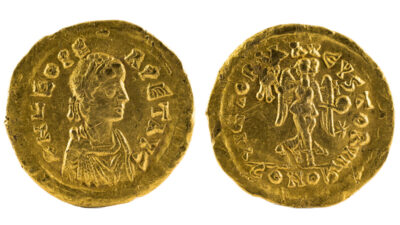
The raw materials were well traveled, too. Byzantine coins are believed to be the main source of the gold. The garnets were probably recycled from Roman objects, and some may have come from as far away as Sri Lanka or India.
4. A golden cross was folded before it went into the ground
The few Christian pieces raise their own mystery. The largest cross, perhaps an altar or processional cross, or the cover decoration of a Gospel book, is folded.
Three explanations compete. Maybe it was folded simply to fit into a small space. Maybe pagans buried it with no regard for its meaning. Or maybe Christians folded it respectfully, to remove its sacred character before burial.
A small gold strip, 179 mm long once unfolded, carries a Latin verse from the Book of Numbers on both sides: “Rise up, Lord, and let thine enemies be scattered; and let them that hate thee flee before thee.” The inner side may hold an abandoned first attempt at the inscription.
5. The finder and the farmer split millions, then fell out
Before the find, detectorists kept asking farmer Fred Johnson for permission to search his field. “I told one I’d lost a wrench and asked him to find that,” he recalled.
On 25 November 2009, the hoard was valued at £3.285 million. Under the Treasure Act 1996, that sum goes as a reward to the finder and the landowner, shared equally. Two museums, in Birmingham and Stoke-on-Trent, launched a public appeal to buy it. Had they failed by April 2010, the collection could have been sold on the open market and broken up. They made it three weeks early.
Herbert and Johnson each received half. The two men were later reported to have “fallen out” over the division of the money.
Gold under gravel
The field was not finished either. In 2012, after another plowing, archaeologists recovered 91 more items, including a helmet cheek piece matching one found in 2009. As Kevin Leahy of the British Museum put it, “Anglo Saxons clearly visited the site more than once to bury items.”
Nobody knows exactly who stood in that remote spot by an old Roman road and chose to bury so much gold. But Beowulf, in Seamus Heaney’s translation, offers lines that experts believe may describe a similar moment: “They let the ground keep that ancestral treasure, gold under gravel, gone to earth, as useless to men now as it ever was.” For thirteen centuries, it was.