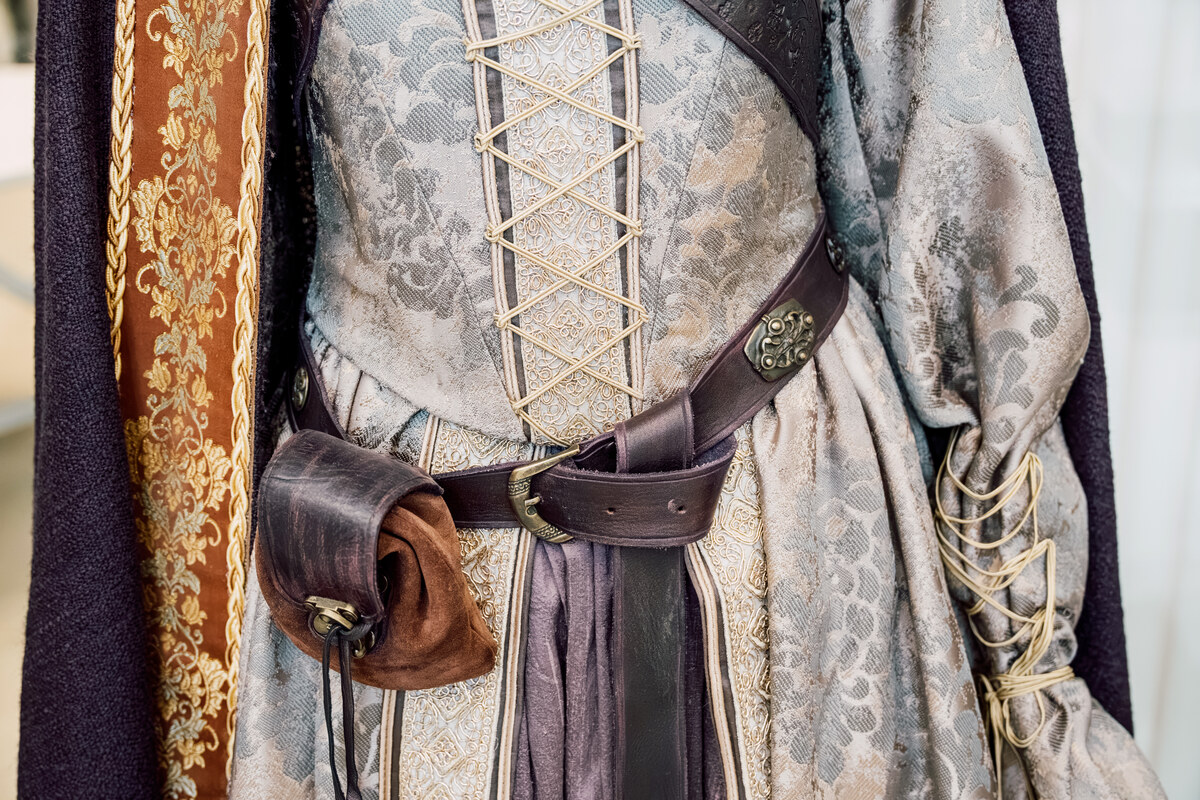
Medieval clothes had no pockets, so everything a person owned for the day hung from one strip of leather or cloth around the waist. Knife, purse, keys and even measuring tools all dangled from the belt, which made it the closest thing the Middle Ages had to a smartphone.
A wardrobe with nowhere to put anything
Garments of the period simply had no built-in pockets. People solved the problem by turning the belt into a mounting rail for their daily kit.
The knife was part of that kit, worn so constantly that it appears in inventories after death alongside clothes and jewelry. By the 14th century it also served as the table fork, and table knives gradually got rounded tips to tell them apart from weapons.
Next came the aumônière, the small purse tied to the belt. Men and women of every rank wore one.
What was actually inside
The word aumônière comes from alms. Part of the coins inside were meant to be handed to the poor whenever you went out, and etiquette manuals for the nobility said so.
The rest of the contents will look familiar:
- combs
- scissors
- small mirrors
- miniature relics or protective amulets
Losing the purse was serious. It could hold documents and wax seals as well as cash, which explains why the cutpurse, who sliced the cord holding it to the belt, shows up so often in medieval literature and police ordinances. Fairs and markets were their favorite hunting grounds.
The belt as a status symbol
Because it was so visible, the belt became a way to show who you were. The buckle could be silver, gilded bronze or plain forged iron, depending on your wealth, and the best ones carried heraldic, plant or animal designs.
Sumptuary laws noticed. Commoners were barred from belts of gold or set with precious stones, which were reserved for the nobility.
Inventories drawn up after a death often list the belt separately from the clothes. A good belt trimmed with silver could be worth about a week of a skilled craftsman’s labor. Even so, archaeologists have found leather straps with up to five different sets of stitch holes, proof that owners mended them again and again instead of replacing them.
One accessory, many meanings
The belt also carried symbolism. A knight received his ceinturon at his dubbing and wore it every time he rode to war, so it marked a military role. In religious life, the cord around a monk’s waist stood for temperance and control of the body.
Francis of Assisi made it his brothers’ signature: a plain rope with three knots, one for each monastic vow. He also forbade them from carrying a purse or touching money, a rule that shows how closely the purse was tied to wealth and trade.
Fashion played with the belt too. Women wore theirs very low on the hips, sometimes at mid-thigh, which lengthened the torso and shaped the silhouette seen in many 14th-century sculptures and illuminations.
When pockets finally arrived
Two changes slowly retired the belt as a storage system. Buttons appeared in the 13th century and began to compete with brooches and belts for holding clothes closed. In the 16th century the first pockets sewn into men’s garments started to push the large escarcelle purse toward decline.
Henri II of France still owned several precious ones, a late sign of how long the habit lasted. The next time you pat your pocket to check for your phone, remember that for most of the Middle Ages the answer to “where are my things?” was simply “at my waist”.