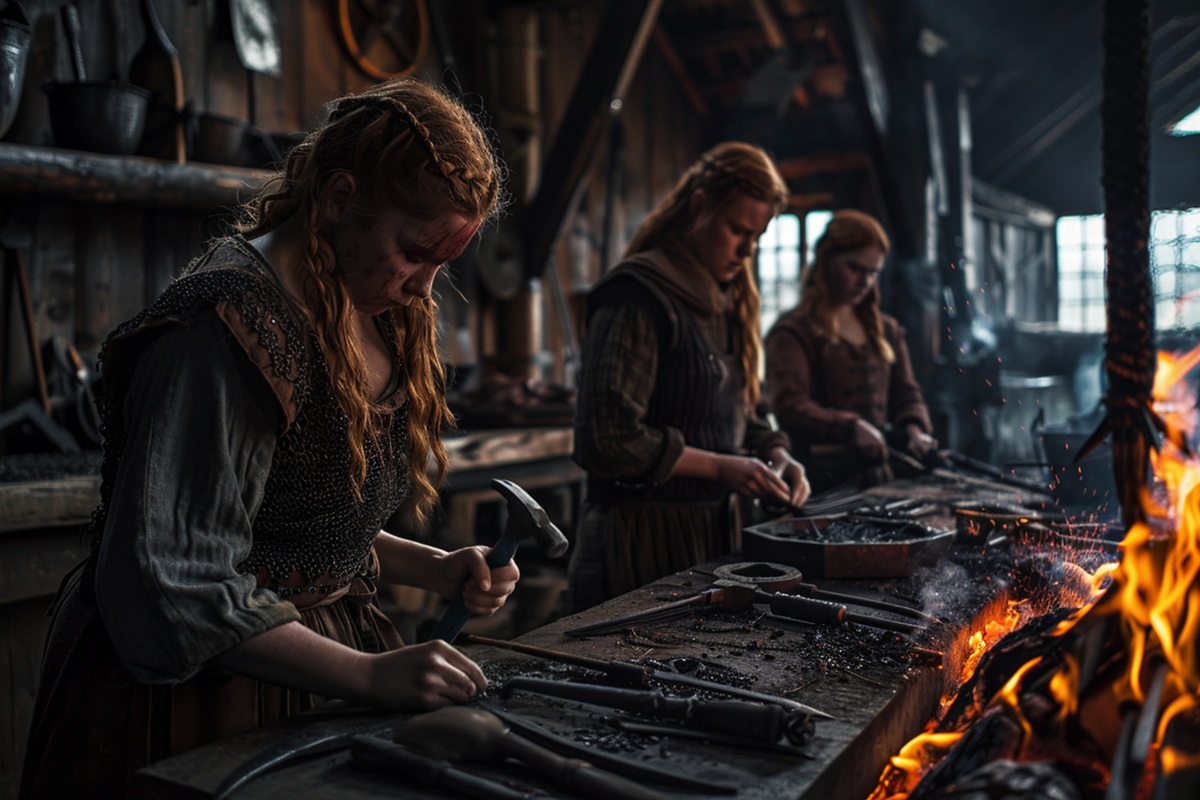
Every goldsmith and metalworker in medieval Europe prayed to the same man: Eligius, a saint whose early life was spent with a hammer in his hand, not a Bible. Long before any diocese called him bishop, kings called him their goldsmith.
The saint who started as a craftsman
Eligius, born around 588, trained as a goldsmith in Limoges. His skill was good enough to make him the master goldsmith of King Clotaire II, and later of King Dagobert I, two of the most powerful Frankish rulers of the early Middle Ages.
He made thrones, reliquaries, and royal jewels with his own hands, not just as a court official overseeing other craftsmen. Only later in life did he become a bishop.
Today he is remembered as the patron saint of goldsmiths, metalworkers, and jewelers, an unusual case of sainthood built on manual craft rather than purely spiritual work.
Proof from a queen’s tomb
A generation before Eligius trained in Limoges, Queen Aregonde, wife of King Clotaire I, was buried with an extraordinary set of gold and garnet fibulae.
Her tomb stayed undisturbed until archaeologists opened it at Saint-Denis in 1959. Among the finds was a large gold cloisonné brooch now considered one of the masterpieces of Merovingian goldsmithing.
It shows the level of craftsmanship already expected at the Frankish court decades before Eligius ever picked up a hammer, the same standard he would later be asked to match, and then personally embody as the king’s own goldsmith.
Techniques that still amaze archaeologists
Merovingian goldsmiths worked in bronze, silver, gold, and ivory, using cloisonné, filigree, gemstone inlay, and lost wax casting to turn small brooches into pieces of extreme technical sophistication.
Fibulae evolved stylistically with such regularity across the centuries that archaeologists still use them today as precise dating tools for excavation layers, a kind of fossil for medieval material culture.
Some fibulae recovered from graves show clear traces of wear built up over decades, proof that their owners kept wearing the same pieces for most of a lifetime before being buried with them.
Other pieces of medieval jewelry carry engraved inscriptions in Latin or in local languages, hidden on the back or along the edge, working as protective invocations or private declarations of love that only the wearer could read.
A tradition bigger than one workshop
Church commissions, reliquaries, altar pieces, and devotional images, made up the bulk of the work medieval goldsmith workshops received, which explains why a master craftsman like Eligius could end his life inside the Church rather than outside it.
Generations later, Charlemagne received diplomatic gifts of goldwork from Byzantium and the Abbasid caliphate, keeping the same tradition of prestige metalwork flowing into his empire long after Eligius was gone.
From a blacksmith’s hammer in Limoges to a queen’s tomb at Saint-Denis to gifts arriving from Baghdad and Constantinople, gold never stopped being a language of power in medieval Europe, and it is worth remembering that language every time a small, worn piece of jewelry turns up in the ground centuries later.