In 1986, the BBC built a high-tech, laserdisc version of England’s oldest public record to celebrate its 900th birthday. Within about 16 years, experts were worried nobody could read the new one, while the 1086 original was still safely in the archives.
The original is the Domesday Book, William the Conqueror’s great survey of England. Its digital remake has become a textbook case of what archivists call digital obsolescence. The parchment, meanwhile, is still doing its job.
A medieval database with no appeal
According to the Anglo-Saxon Chronicle, the king held a “very deep consultation” with his council in 1085, then sent his men into every shire. The book’s colophon says the survey was completed in 1086.
The goal was money. William wanted to know what every piece of land was worth, who held it and what taxes it owed. The survey even valued land at three points in time: when Edward the Confessor died, when the new Norman owners received it, and at the time of the survey.
The chronicler was not impressed by the thoroughness. He complained that “not even an ox, nor a cow, nor a swine was there left, that was not set down in his writ.”
The English held the book in such awe that they named it after the Last Judgment. Around 1179, the royal treasurer Richard FitzNeal explained why: just like on Judgment Day, “there is no further appeal.” Back then, “doom” simply meant a law or a judgment, not a catastrophe.
The numbers inside the parchment
The scale is staggering for the 11th century. The book tallies 268,984 heads of household and names 13,418 places. Historian H. C. Darby estimated this points to a population of 1.2 to 1.6 million.
It lists 5,624 mills, against fewer than 100 recorded a century earlier. It also counts 28,000 slaves. Strangely, London and Winchester are missing: space was left for them in Great Domesday, but they were never written up.
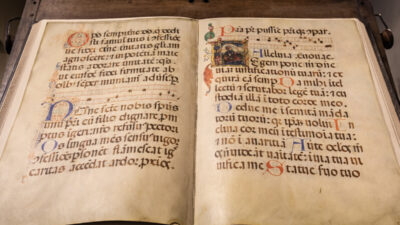
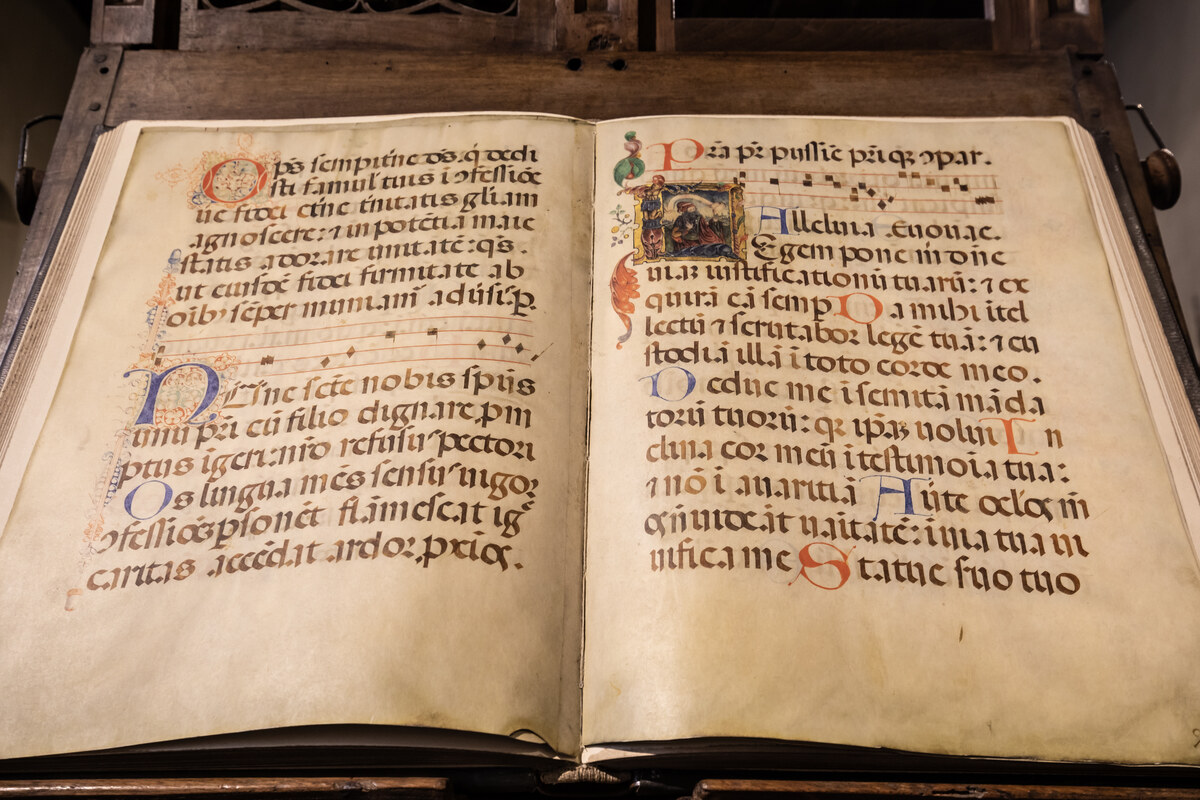
Each hundred (a subdivision of the county) sent its answers sworn by 12 local jurors, half English and half Norman. Then, remarkably, the entire main volume, Great Domesday, appears to have been copied out by a single person on parchment made from prepared sheepskin.
It was not flawless. Darby noted that the clerks were “frequently forgetful or confused,” and that doing sums in Roman numerals led to countless mistakes.
Then came the 1986 remake
For the 900th anniversary, the BBC teamed up with Acorn Computers, Philips and Logica to produce a new Domesday. Over a million people took part, including children from more than 9,000 schools, writing about their local area and daily lives.
The result was stored on adapted laserdiscs in a format called LV-ROM, packed with maps, color photos, video, census data and virtual walks. To view it, you needed a BBC Master AIV computer controlling a Philips VP415 laserdisc player, with a trackball.
One reviewer at the time predicted that “for publishers and knowledge workers, the media for communication will never be quite the same.”
Parchment 1, laserdisc 0
By 2002, there were serious fears the discs could become unreadable. Machines able to read the format had become rare, and working drives even rarer. The still images had been stored as single frames of analogue video, from a time before JPEG compression existed.
Rescuing it took a small army. A Leeds and Michigan university project called CAMiLEON used emulation to recover the data. The National Archives tracked down the original videotape masters. A Windows version went online in 2004, then vanished in 2008 when its programmer, Adrian Pearce, suddenly died. A BBC website, Domesday Reloaded, lasted from 2011 to 2018.
Even the rights are tangled. With contributions from around a million people, the project will likely not be fully free of copyright restrictions until at least 2090.
A 940-year-old record that still works
The parchment original, now held at the National Archives in Kew, has had a very different career. It was evacuated to Bodmin Prison during the First World War and to Shepton Mallet Prison during the Second, rebound several times, and printed in full in 1783.
And it is still practically useful. In the Middle Ages, its evidence was regularly invoked in court. It was cited in a case in 1960, again in 2010 to help prove a manor, and in 2019 in a case about a market.
The project’s own deputy editor later argued that its creators knew the technology would be short-lived, and blamed the archivists for failing to preserve it properly. Nearly a thousand years after one scribe filled a stack of sheepskin with oxen, mills and manors, his work remains easier to consult than the cutting-edge copy made to honor it. It is a humbling thought for anyone who trusts the cloud with their photos.