Legend says the robber baron of Predjama Castle was killed by a cannonball while sitting on the toilet. Wikipedia calls that story “popular but unfounded,” and the real tale of Erasmus of Lueg is stranger than the punchline.
A castle hidden inside a cliff
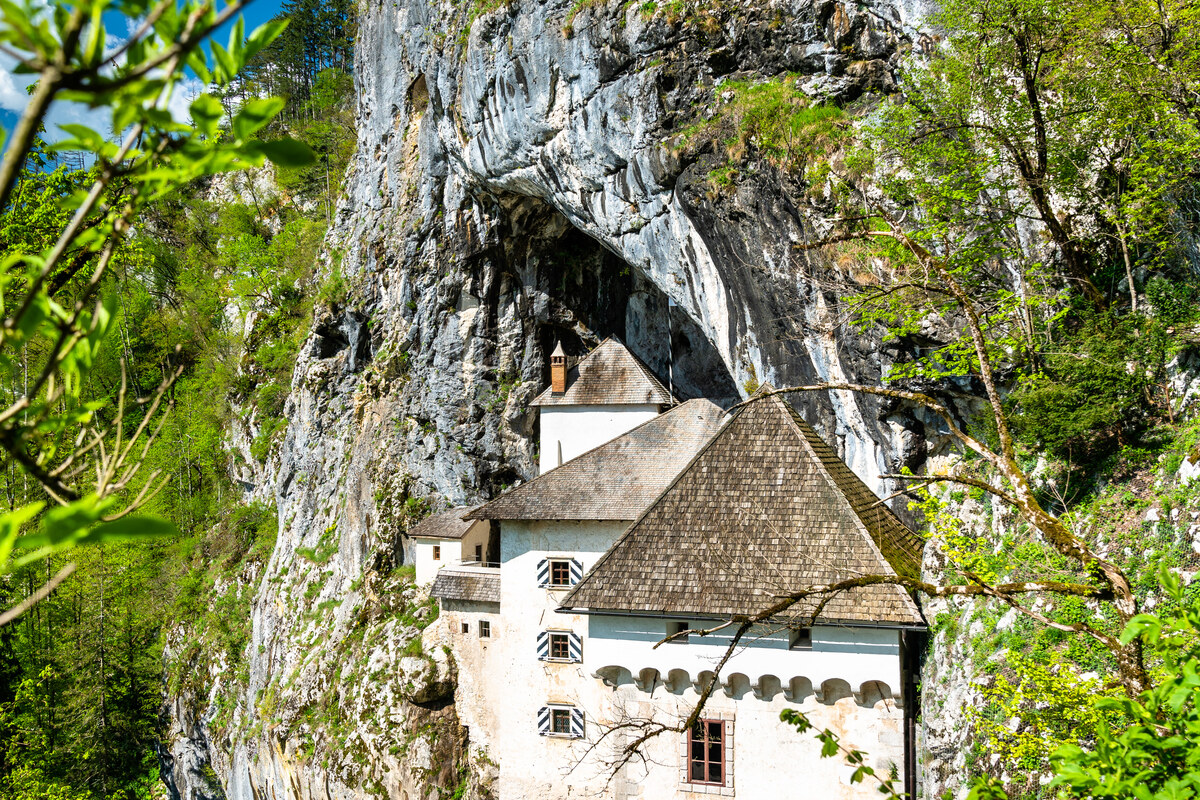
Predjama Castle sits in the mouth of a cave in south-central Slovenia, about 11 kilometres from the town of Postojna. It was first mentioned in 1274, when the Patriarch of Aquileia built it under a natural rocky arch high in the stone wall, precisely to make access difficult.
That is the whole logic of a cave castle: it can only be assaulted from the front, or by drilling through the rock above it. For a besieger, that is a nightmare.
The robber baron with an imperial grudge
In the 15th century the castle became the seat of Erasmus of Lueg, a renowned robber baron and the son of the imperial governor of Trieste. According to legend, in 1483 he killed Marshal Pappenheim at the Vienna court after Pappenheim had offended the honour of Erasmus’s dead friend, the condottiere Andrej Baumkircher.
The problem: Pappenheim was a relative of Emperor Frederick III. Erasmus fled to Predjama, allied himself with King Matthias Corvinus of Hungary, and began attacking Habsburg estates and towns in Carniola.
The siege that could not starve him
The emperor sent the governor of Trieste, Ravbar, to capture or kill him. The plan was simple: starve the castle out.
It did not work. A vertical natural shaft leads out of the original castle to an exit at the top of the cliff, 25 metres from the edge, and Erasmus had ordered it enlarged. Through it, he secretly supplied the castle with food and kept on with his robberies while the besiegers waited below.
The toilet story that refuses to die
Erasmus did die in the end, killed after a long siege. But the popular version goes further. One of his men betrays him, and a shot from a cannon or catapult hits him in his room, on the toilet, in the garderobe.
Wikipedia describes this as a “popular but unfounded legend.” A Slovenian newspaper, Dnevnik, even ran a headline in 2013 that translates as “Erasmus of Predjama did not die on the toilet.” The humiliating detail is a better story than the truth, so it stuck.
What we can actually say is shorter: a long siege, and a robber baron who did not survive it.
The castle you can visit is not his
Here is another twist. After the siege and destruction of the original castle, a second one built by the Purgstall family was destroyed by an earthquake in 1511. The castle standing today dates from 1570, built in Renaissance style and pressed against the vertical cliff under the original medieval fortification.
It then passed through the Cobenzl, Coronini and Windischgrätz families, until it was nationalised by the Yugoslav authorities after World War II and turned into a museum.
Why the legend matters more than the loo
The toilet cannonball tells us what people wanted from a medieval villain: a downfall that was both violent and absurd. The cliff, the secret shaft and the stubborn siege tell us something more useful, which is how much a good defensive position could buy a man who had made an emperor his enemy.
Next time someone tells you how Erasmus died, ask where the story comes from. The answer, as far as the sources go, is nowhere solid.