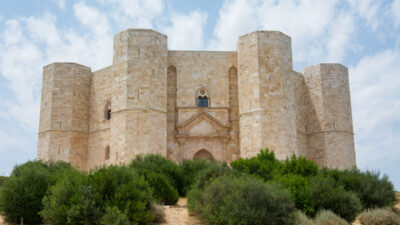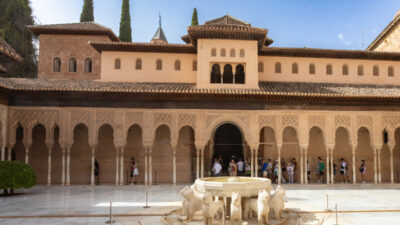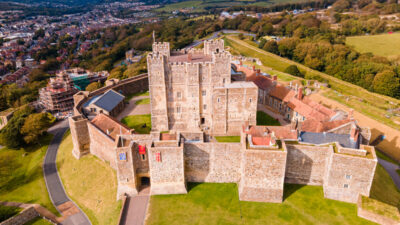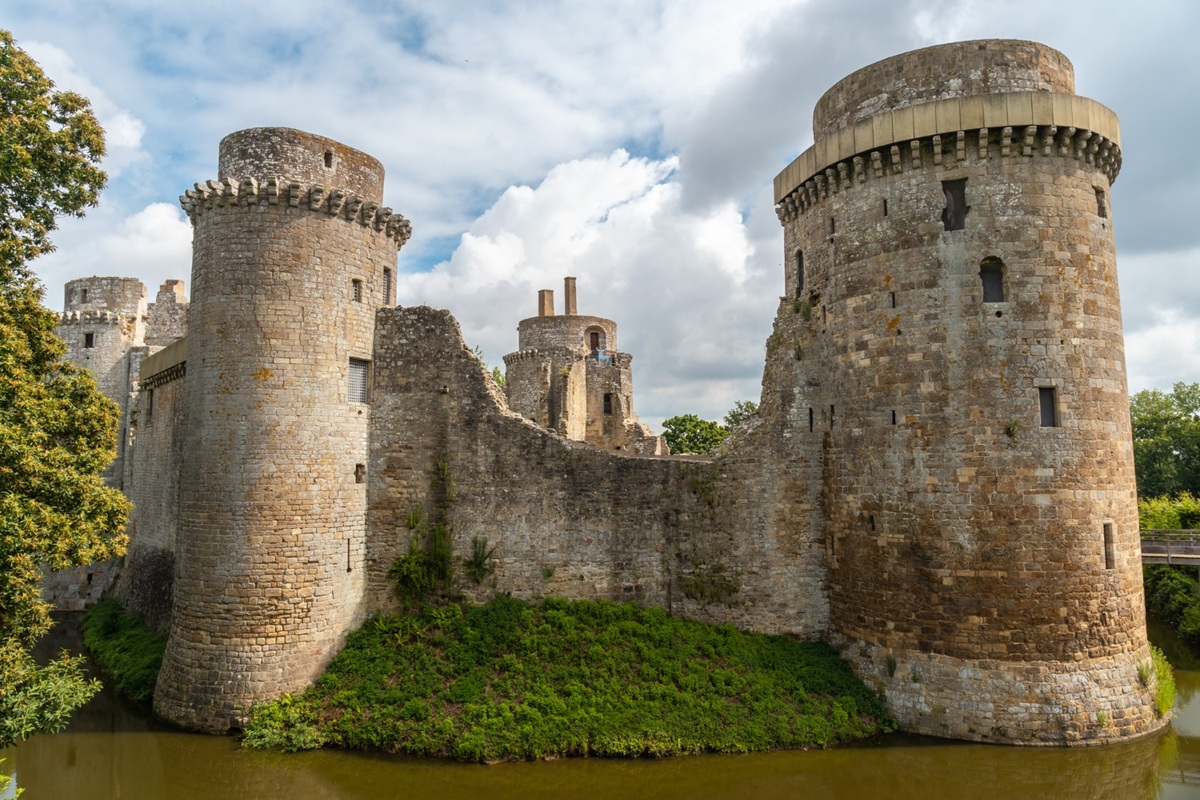
The word for those stone galleries jutting out above castle gates comes from Old French words meaning to strike the neck. That’s not poetic license: machicolations were purpose-built to kill anyone standing directly below a wall, the one spot defenders otherwise couldn’t reach.
The name is a threat, spelled out literally
The term first appears in writing between 1402 and 1404, as “machecoleis.” It combines the Old French “macher” (to strike or batter) and “col” (neck), a blunt description of exactly what the structure was designed to do to anyone caught underneath it.
Unlike most medieval military terms, there’s no metaphor to untangle here. The name is a direct statement of intended violence, written down centuries after the design itself first appeared.
The stone version came from a much older wooden idea, born outside Europe
Machicolations were a stone upgrade of hoardings, temporary wooden galleries bolted to the top of a wall for the same purpose. Long before either version reached Western Europe, similar structures already stood in Umayyad fortifications between the 6th and 8th centuries, including at Qasr Azraq in modern Jordan.
European builders adopted and refined the concept only after direct contact with the Islamic world, turning a temporary wooden fix into a permanent stone feature.
A cathedral had them before most castles did
Machicolations weren’t reserved for military strongholds. The fortified cathedral of Agde, built in 1173, holds one of the earliest documented uses of the feature in France, decades before it became standard on castle walls.
A cathedral built to double as a fortress is a reminder that defensive architecture in the Middle Ages wasn’t only a soldier’s concern.
The design changed shape at least three times
Machicolations went through distinct construction phases. Early versions from the 12th to 14th centuries sat on arches and buttresses, alternating designs appeared from the 13th century onward, and by the mid-14th century, most had settled into rows of simple stone corbels, the version now generalized across Europe.
The Palace of the Popes in Avignon still shows the arch-and-buttress style typical of the form’s earlier, regional phase.
A legendary commander used them to take his country back
Bertrand du Guesclin, Constable of France during the Hundred Years’ War, relied on machicolated fortifications during his campaigns to reclaim strongholds held by English forces.
For a commander famous for retaking castles piece by piece, a defensive feature built specifically to punish anyone standing at the base of a wall was a serious tactical asset, not just a design detail.
Then their job quietly became decoration
By the 15th century, gunpowder artillery made machicolations militarily obsolete almost overnight. Walls built to survive rocks and boiling sand couldn’t stop cannon fire the same way.
Rather than disappearing, the feature survived as pure ornament. Renaissance-era chateaux kept the silhouette of machicolations without any of their function, using them to signal a family’s nobility rather than defend it.
A weapon that outlived its own purpose
A name that means “break your neck,” a design borrowed from the Islamic world, a cathedral that needed it as much as any castle, and a French commander who put it to brutal use: machicolations carry more history in their stonework than their current reputation as a movie prop suggests.
Next time a “medieval” roofline shows off a row of stone teeth along its top, it’s worth asking whether they’re still doing the job they were built for, or simply keeping up appearances long after the fighting stopped.