A Norman lord could raise a working fortress in about the same time it takes to renovate a modern house, using little more than dirt, timber and thirty workers with shovels.
Three months, thirty workers, one fortress
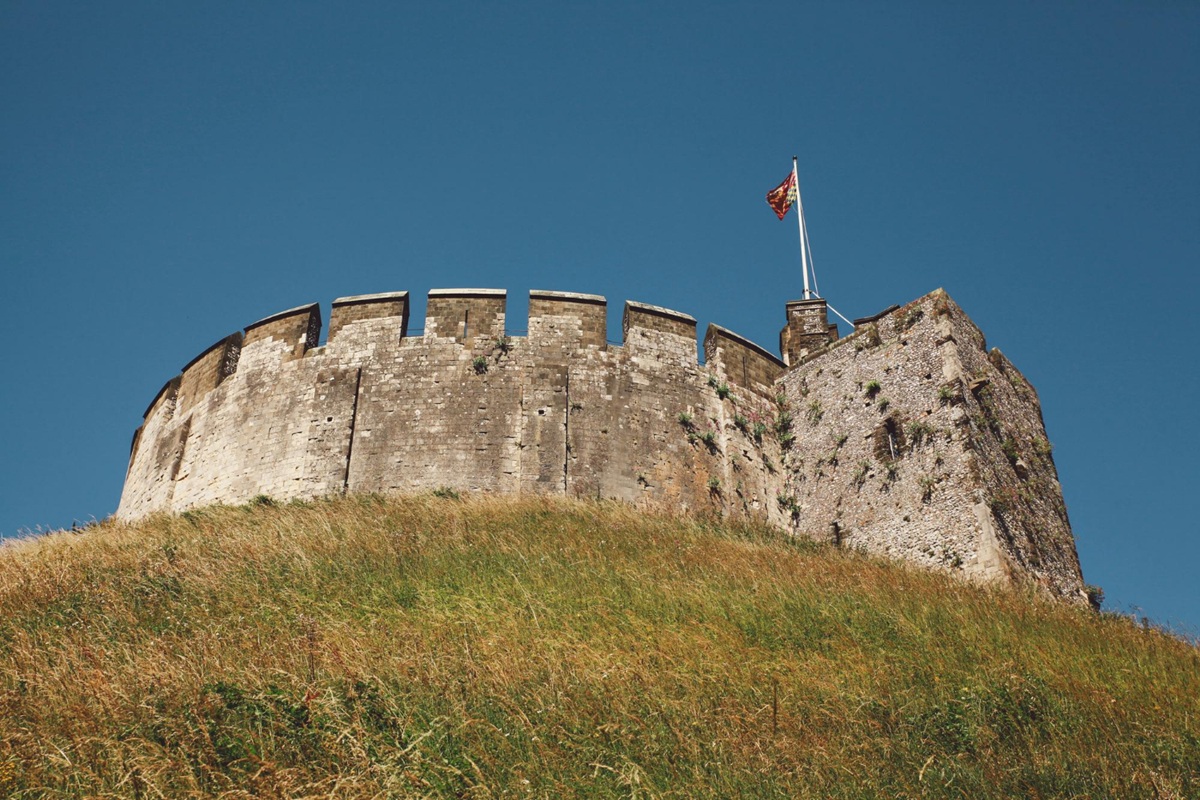
A motte castrale was a fortification built almost entirely from earth: a cone-shaped mound topped with a wooden tower and surrounded by a ditch, with a walled courtyard, the bailey, attached at its base for daily life.
Raising one took roughly 2,000 person-days of labor, about three months of work for a team of thirty men. The mound itself stood between 4 and 15 meters tall, with a base around 30 meters across and slopes steep enough, 35 to 55 degrees, to make a direct climb nearly impossible.
Compared to a stone castle, which could take a decade or more to complete, a motte was fast, cheap and brutally effective.
How dirt mounds conquered England
The Normans didn’t invent the motte castrale, but they turned it into a tool of conquest. Before the second half of the 11th century, this kind of fortification was unknown in both England and Sicily.
That changed in 1066. After defeating Harold at Hastings, William the Conqueror had hundreds of these earthworks built across England to secure his hold on newly seized territory. The campaign of rapid, mass fortification is recorded on the Bayeux Tapestry, which shows laborers digging the ditch and piling the excavated earth into the mound.
Not the crude hut you’re picturing
The wooden towers on top weren’t bare shelters. The 12th-century chronicler Lambert d’Ardres described towers built on three levels, with bedrooms, storage cellars, provision stores and even a chapel.
Tapestries lined the interior walls against the cold, and the wood, combined with wattle and daub and sometimes a coat of lime plaster, worked as effective insulation. For a seigneurial family, a motte wasn’t a step down from comfort, it was a functioning home.
The one weakness no amount of design could fix
Speed and cheapness came with a cost: wood burns. Builders sometimes covered the timber frame with fresh animal hides, leather or turf to slow a fire, but it rarely held against flaming projectiles.
In 1031, the siege of the castle of Bennecy ended when attackers set it alight. Around 1,400 people, mostly peasants who had taken refuge inside, died in the blaze. By the 12th and 13th centuries, rising wood costs and improving siege technology pushed lords toward stone.
Invisible on the ground, obvious from the sky
Thousands of mottes have vanished from the landscape, but not from the record. French archaeologist Roger Agache pioneered aerial photography techniques that reveal the buried ditches and mounds of long-gone mottes through subtle changes in crop growth and soil moisture, invisible at ground level.
Place names still carry the memory too. Villages across France called La Motte-Tilly or Lamotte-Beuvron mark spots where a Norman-style earthwork once stood.
A shape that outlived its own wood
In 2012, excavations at Mauguio in southern France uncovered the largest known feudal motte in Europe, a reminder that these earthworks did far more than hold up a wooden tower.
Historian Pierre Toubert’s concept of incastellamento describes how entire territories reorganized themselves around structures like these. A shape first raised in three months went on to define how large parts of medieval Europe were governed for centuries.