In 1216, England’s own rebel barons invited a French prince to come and take the crown. He landed, he marched, and he even had the king of Scotland kneel before him. Then he reached a castle on the chalk cliffs of Kent that simply refused to open its gates.
Why everyone wanted the key to England
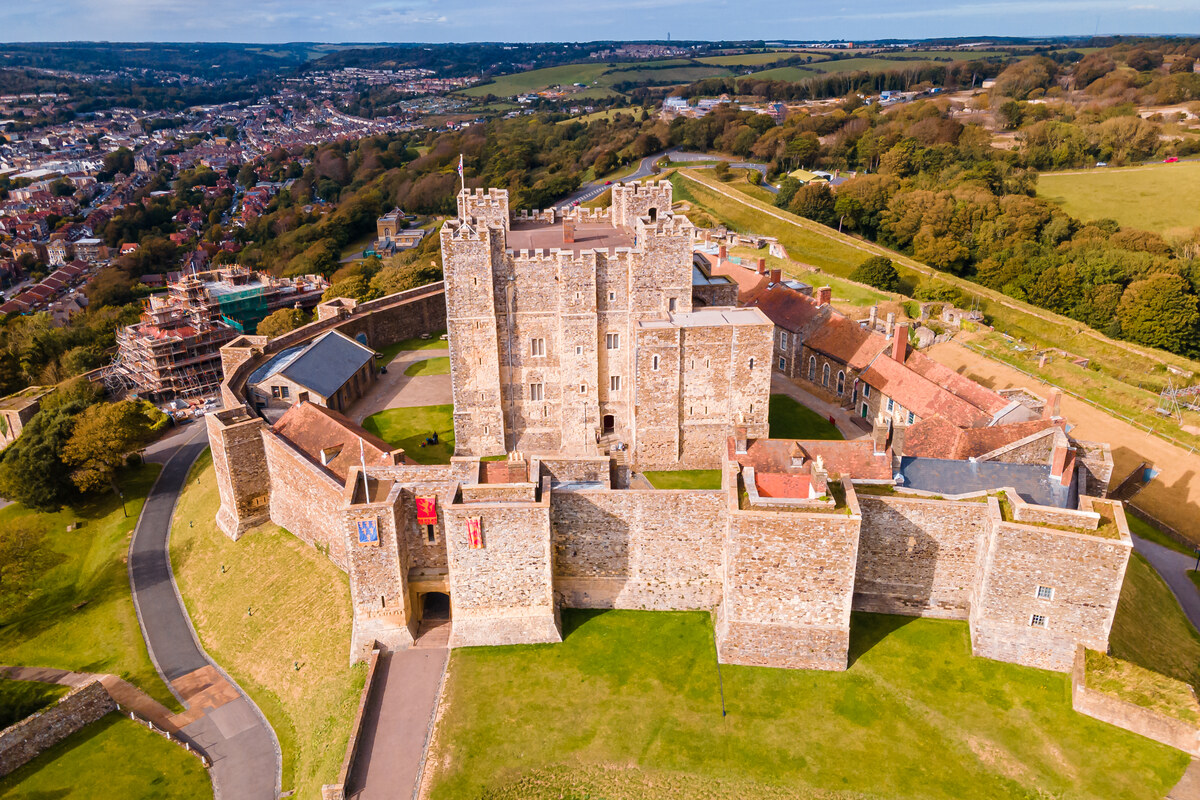
Dover Castle sits on the cliffs above the English Channel. It has long been called the “Key to England”, and historians describe it as the lynchpin of the Angevin kings’ empire.
The site was already ancient. Inside the walls still stands a Roman lighthouse from the early 2nd century, one of only three Roman lighthouses left anywhere in the world and claimed as the oldest standing building in Britain.
William the Conqueror understood its value immediately. After Hastings in 1066, he detoured via Dover, which the chronicler William of Poitiers described as “reported impregnable and held by a large force”. The defenders were ready to surrender, but the Normans, “greedy for money”, set the place on fire. William paid for the repairs, then spent eight days adding new fortifications.
A century later, Henry II turned it into a true fortress. Between 1179 and 1188, he spent more than £6,500 on the castle, when his entire yearly revenue was probably around £10,000. The great keep, built by a man known simply as Maurice the Engineer, dates from this time.
How a king’s broken promise brought a French army to Dover
By 1215, King John had lost Normandy and seen his allies crushed at Bouvines. His barons forced him to accept Magna Carta, a charter that sharply limited royal power. John then refused to honor it, and the country slid into the First Barons’ War.
The rebels looked across the Channel for a replacement. They invited Prince Louis of France, the future Louis VIII, to take the English throne. Louis landed on 21 May 1216, and the royal force gathered to oppose him withdrew without a fight.
Dover became one of his most important targets.
Tunnels, breaches and a constable who would not quit
Louis used every tool a medieval besieger had. His troops surrounded the castle while his ships cut off access to the sea. He started a siege tower, dug mines under the walls and pounded the defences with stone-throwing engines.
Inside, the garrison was commanded by Hubert de Burgh, a royal servant who had already proved his stubbornness in France. Years earlier, he had held the castle of Chinon for an entire year after almost all of the surrounding region had fallen, and was only captured when it was finally stormed in 1205.
At Dover he did not wait passively. He launched repeated sorties against the besiegers, and his men even dug their own tunnels outwards to strike at the French. In August, Louis’s knights captured the wooden palisade of the outer barbican. In September, his miners finally brought down part of the wall and the French poured into the breach. They were thrown back, and the defenders barricaded the gap.
On 14 October 1216, Louis agreed a three-month truce and withdrew to London. While he was there, King John died unexpectedly, leaving a nine-year-old boy, Henry III, as king. An attempt was made to win over the Dover garrison and make it recognize Louis as king. It refused.
The first trebuchet in England
The truce did not hold. Hubert de Burgh, who had used the pause to repair his walls, launched a surprise attack on French reinforcements in the port of Dover itself.
Louis came back on 12 May 1217 with a new weapon: a trebuchet, the first recorded use of one in England. An English fleet cut off his supplies from France, and on 25 May he learned that his second army had been crushed at Lincoln five days earlier. He abandoned the siege and retreated to London.
Hubert de Burgh then finished the job at sea. On 24 August 1217, he intercepted a French relief fleet off Sandwich, scattered it and captured its flagship, commanded by Eustace the Monk, who was promptly executed. Four days later, Louis agreed to peace and formally renounced his claim to the English throne.
The weak spot that went underground
The siege left a lasting mark on the castle itself. The vulnerable north gate, where the French had broken through, was turned into an underground forward-defence complex, and new gates were cut into the outer wall on the east and west sides.
That habit of fighting from beneath the cliffs never really left Dover. In May 1940, some 724 years after Hubert de Burgh’s men tunnelled out to strike at the French, Admiral Bertram Ramsay directed the evacuation of Dunkirk from tunnels dug into the very same chalk. The key to England, it turns out, was always kept underground.