Visitors walk through the Alhambra believing they are seeing a medieval Islamic palace exactly as its sultans left it. They are not. The walls have lost their colors, most of the rooms carry names invented centuries later, and some of its most photographed features were added by 19th-century restorers.
That does not make the Alhambra a fake. Historians still describe it as the only well-preserved palace from the medieval Islamic world. But the building you see is the result of nearly 800 years of additions, explosions, neglect and imaginative repairs.
A red fortress that started small
The name comes from the Arabic al-Ḥamrāʼ, “the red one”, short for “the red fortress”. The color came from the walls themselves, built of rammed earth rich in iron oxide from the local clay.
In 1238, Muhammad I Ibn al-Ahmar, founder of the Nasrid dynasty and of the Emirate of Granada, climbed the Sabika hill and marked out a castle. A chronicle records that “before that year had passed, the construction of the ramparts was completed; water was brought in from the river.”
Yet the founder never built the famous palaces. He may have lived in a tower of the fortress, then in a modest house. The great halls came a century later, under Yusuf I and above all Muhammad V, whose reign marked the peak of Nasrid architecture.
The colors and names have vanished
Today the carved stucco, wooden ceilings and marble capitals look pale, almost monochrome. In the 14th century they were painted in bright red, blue and gold. The Arabic inscriptions were often picked out in gold or silver against red, blue or turquoise backgrounds.
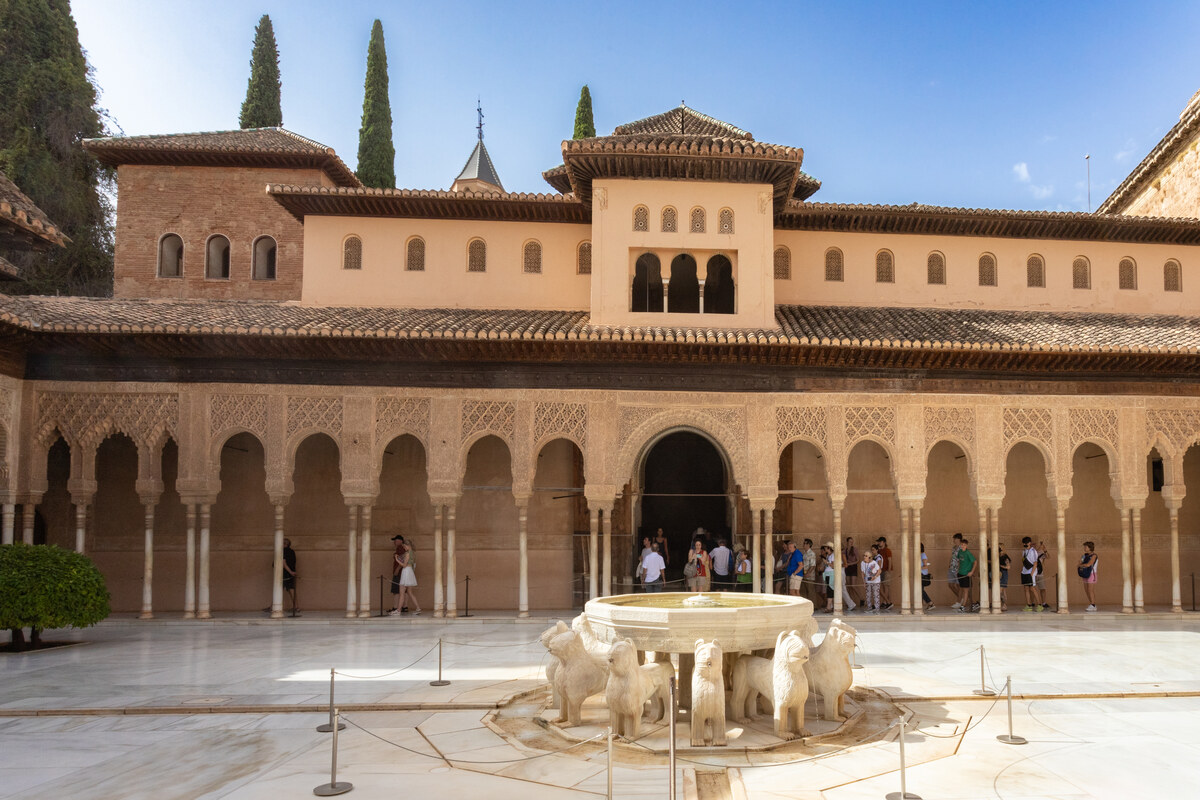
The names on your visitor map are just as misleading. Most were coined after the Middle Ages, often in the 19th century, and the original Arabic names of the buildings are not known. Even the “Court of the Lions” is a modern label. One theory suggests the sultans called it the Palace of the Garden.
The Hall of the Abencerrajes takes its name from a legend about a family massacred there at a banquet, yet there is no actual historical link between that family and the room. Its Arabic name meant simply “the Western Dome”. The Hall of the Two Sisters? It is named after two large marble slabs in the floor.
Gunpowder, squatters and Napoleon
When Granada surrendered in 1492, the Alhambra was handed over without being attacked. The damage came afterwards. Emperor Charles V demolished part of the Comares Palace to build a Renaissance palace of his own, begun in 1527 and still unfinished after 1637.
In 1590, a nearby gunpowder magazine exploded and destroyed the ornate ceiling of one of the halls around the Court of the Lions. The vault you see there now is a Baroque plaster replacement from 1714.
Through the 18th century, the neglected palaces were left to self-interested local governors and squatters. Then came Napoleon’s troops, who occupied the site as a fortified position from 1810. When they left in 1812, they tried to blow up the entire complex. Eight towers exploded before a Spanish soldier, José Garcia, disabled the remaining fuses. An earthquake added more damage in 1821.
The domes that were never Nasrid
Romantic travelers then fell in love with the ruins. Washington Irving lived in Granada and published his Tales of the Alhambra in 1832, drawing international attention to the site. Europe wanted an exotic, “oriental” palace, and the restorers delivered one.
Three generations of the Contreras family ran the restorations from 1828 to 1907. In 1858 and 1859, they added spherical, Persian-looking domes to the Court of the Lions and the Court of the Myrtles. These domes had nothing to do with Nasrid architecture.
The architect Leopoldo Torres Balbás took the dome off the lions pavilion in 1934, triggering an international debate about restoration. His replacement pyramidal roof is still partly wrong: its slopes are too steep compared with similar Moorish roofs.
Even the fountain changed. Upper sections were added in the 16th century and removed in the 20th. The courtyard floor, covered in gravel until the early 2000s, was only paved with white marble after a restoration completed in 2012.
Walls that still speak
Some things did survive the centuries. Poems by court poets such as Ibn Zamrak still run along the walls, and some are written in the first person, as if the room itself were speaking to you. In the throne room, the Hall of the Ambassadors, a ceiling of 8,017 interlocking pieces of wood still forms a picture of the seven heavens.
The Alhambra is not a frozen medieval palace. It is a conversation between Nasrid sultans, Spanish emperors, French soldiers and Romantic restorers, and learning to tell their voices apart makes the visit far more fascinating.