Before the 20th century, only seven people were ever executed inside the walls of the Tower of London. The fortress we picture as a medieval torture factory spent most of the Middle Ages as something far less sinister: a royal palace, a mint, an arsenal and even a zoo.
A palace built to impress Londoners
William the Conqueror founded the castle at the end of 1066, right on the south-east corner of London’s old Roman walls. His biographer William of Poitiers was blunt about the goal: “For he realised that it was of the first importance to overawe the Londoners.”
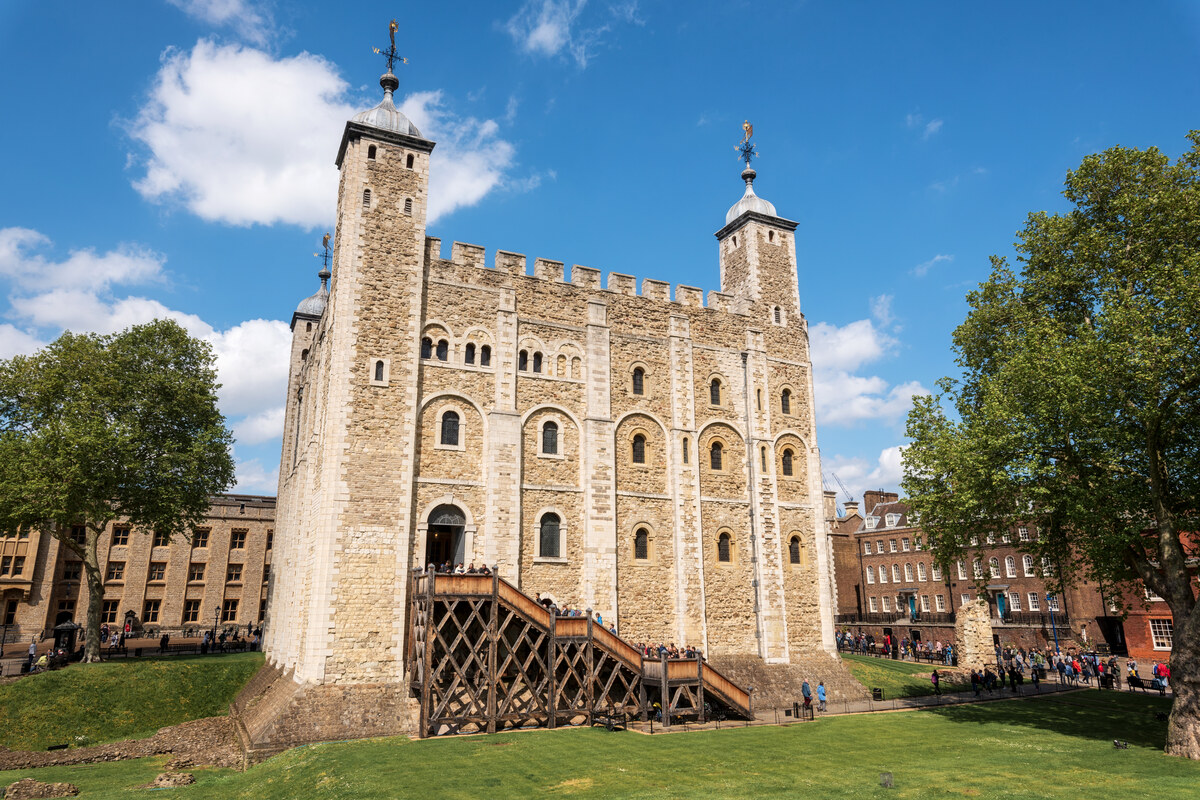
The White Tower, begun around 1078 under Gundulf, Bishop of Rochester, became the earliest stone keep in England. It was the strongest point of the castle, but it also held grand accommodation for the king.
Later kings kept adding comfort. Henry III, described as an aesthete, wanted the Tower to be both formidable and pleasant to live in, and spent nearly £10,000 on it between 1216 and 1227. The habit of whitewashing the White Tower, which gave it its name, began in 1240.
By 1279, the Tower also housed the mint that controlled the country’s coinage. It also kept a royal menagerie, with lions, leopards and a polar bear, a gift from the king of Norway, which went fishing in the Thames while tied to the bank by a chain.
The first prisoner threw a party and walked out
Prisoners did come, but they were an afterthought. The first one on record was Ranulf Flambard, Bishop of Durham, locked up around 1100. He was held in luxury, with servants of his own.
On 2 February 1101, Flambard hosted a banquet for his captors. Once they were drunk, he lowered himself down a rope that had been smuggled in inside a butt of wine. The Tower’s first prisoner was also its first escapee, and the escape was so surprising that one chronicler accused the bishop of witchcraft.
He was not the last. In 1323, Roger Mortimer got out after the Sub-Lieutenant of the Tower let his men inside. They hacked a hole through his cell wall, and Mortimer escaped to a waiting boat. Throughout its history, prisoners bribed the guards to help them flee.
Most inmates were high-status people held for short periods, such as captured nobles waiting for a ransom after the victories of the Hundred Years’ War. Common citizens were sent to the many other prisons that existed for them. Those inside could even buy better food or tapestries through the Lieutenant of the Tower.
Where the torture legend really comes from
The Tower’s grim reputation only took shape in the 16th century, and historians trace it largely to two sources: religious propagandists of that century and romantic writers of the 19th.
Torture did happen, but it was not routine. It had to be approved by the Privy Council, and between 1540 and 1640, the peak years of imprisonment at the Tower, there were 48 recorded cases. The infamous rack had only arrived in England in 1447, brought in by the Duke of Exeter, then Constable of the Tower.
The image of dungeons full of machines owes a lot to one novelist. In The Tower of London: A Historical Romance, William Harrison Ainsworth described underground torture chambers and devices for extracting confessions. That picture stuck in the public imagination far more firmly than the records ever could.
The executions happened outside the walls
Even the death toll is mostly misplaced. Executions were usually carried out on Tower Hill, the open ground outside the fortress, where 112 people were put to death over 400 years. In 1381, during the Peasants’ Revolt, the Archbishop of Canterbury Simon Sudbury was taken from the chapel where he had sought refuge and beheaded there, not inside.
The seven executions on Tower Green, within the castle, were reserved for prisoners whose public death was considered dangerous, such as Lady Jane Grey in 1554. The Tower could even be the safer option: other London prisons like the Fleet were rife with disease.
A prison that never had a prison building
The most telling detail is architectural. Because holding prisoners was only an incidental job, as it would have been for any castle, the Tower had no purpose-built accommodation for prisoners until 1687, when a simple brick shed called the “Prison for Soldiers” went up near the White Tower.
There is a final irony. Ainsworth, the novelist who did so much to darken the Tower’s image, also suggested opening the Beauchamp Tower to visitors so they could read the inscriptions carved by prisoners. The real history was there all along, scratched into the walls, waiting for people to look past the legend.