The largest castle on Earth held out for two months against the armies that had just crushed its owners. Decades later, it was sold, cash on delivery, by the soldiers hired to defend it.
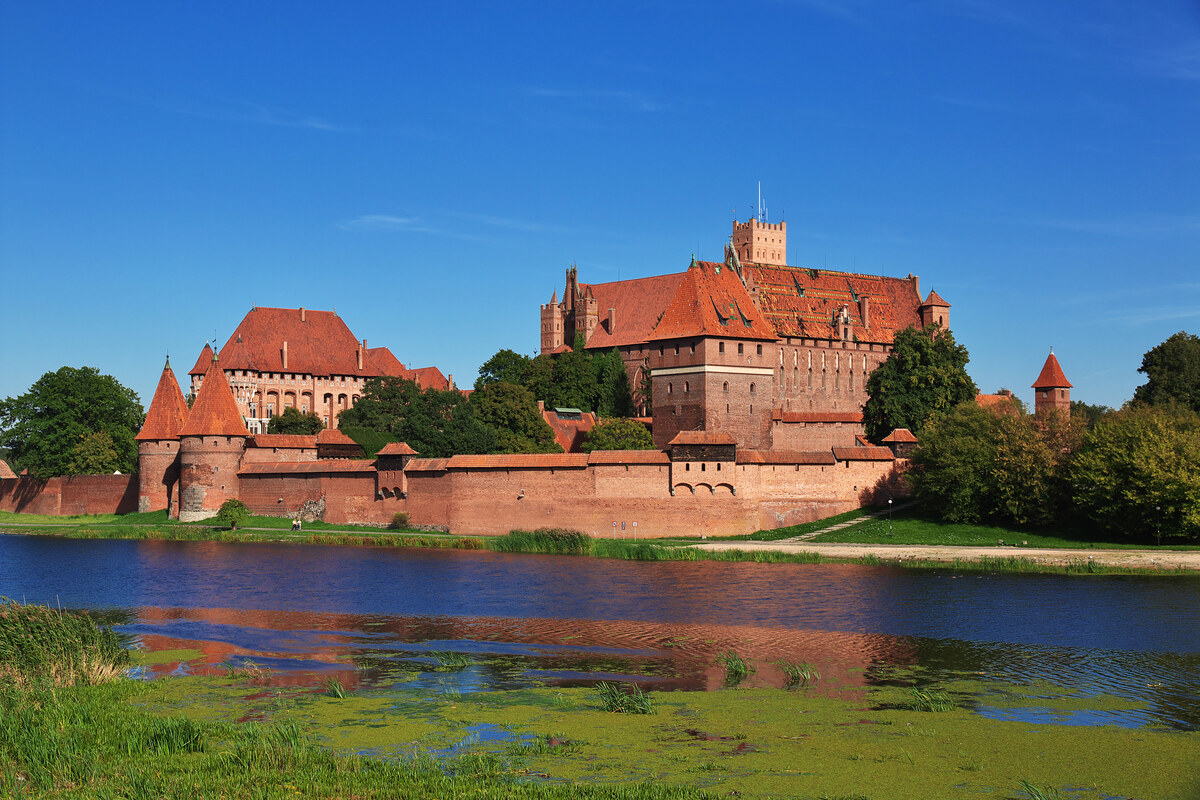
Malbork Castle, known in German as Marienburg, still sprawls along a river in northern Poland. Behind its red brick walls lies a story of crusaders, toilets, siege warfare and one spectacular unpaid bill.
1. It covers four times the area of Windsor Castle
Malbork is the largest castle in the world measured by land area. Its outer walls enclose about 52 acres, four times the area enclosed by Windsor Castle.
It is not really one castle but three: the High, Middle and Lower Castles, separated by dry moats and towers. At its peak it housed around 3,000 “brothers in arms”.
Building it took time. Most historians accept a construction period of 132 years, from 1274 to 1406. When it was finished, it was the largest brick castle in the world.
2. It was built by crusaders who had lost the Holy Land
The Teutonic Order was founded in 1191 in Acre, in present-day Israel. When Acre fell in 1291, the knights moved their headquarters to Venice, then on to Prussia, on the Baltic coast.
There they built Marienburg, named after the Virgin Mary, to tighten their grip on the region after crushing a great Prussian uprising in 1274. In 1309, Grand Master Siegfried von Feuchtwangen made it the capital of the Order’s monastic state.
The location was a money machine. Sitting on the Nogat river in the Vistula delta, the knights collected tolls from passing ships and controlled a monopoly on the amber trade.
3. Its toilets had their own tower
Thousands of knights living in one place create a very practical problem. The answer was the dansker, a toilet tower built over a river or stream and linked to the castle by a covered bridge.
The word is first recorded in 1393 and probably comes from the nearby city of Danzig. Ordinary latrines were enough for most castles, but not for fortresses permanently packed with knights, so danskers became a signature of the Order’s castles.
4. It survived a siege after the Order’s worst defeat
On 15 July 1410, Polish and Lithuanian armies crushed the Teutonic Knights at the Battle of Grunwald. Most of the Order’s leaders were dead or captured, and Marienburg looked doomed.
Heinrich von Plauen, a commander who had not even fought in the battle, rushed to organize its defense. The allied armies advanced slowly, about 15 km per day. The day before they arrived, he burned the town outside the walls to deny them shelter.
The siege that began on 26 July was never intense. King Jagiełło was so sure Prussia had fallen that he started handing out land to his nobles. His army ran short of ammunition, morale sank and dysentery spread. On 19 September, the besiegers simply left. Von Plauen was elected Grand Master that November.
5. Its own mercenaries sold it to the enemy
The castle’s real fall came during the Thirteen Years’ War. With 56 Prussian towns in revolt, the Order lost its income and relied on hired soldiers, at 40 florins a year for each mounted mercenary.
The bills piled up. By the end of April 1455, the Order owed its mercenaries more than 400,000 florins. In May, the soldiers took control of Malbork, and the Grand Master became a hostage in his own capital.
The mercenaries then shopped their fortresses around to any buyer, from Denmark to Brandenburg. Poland won the deal: Malbork, along with two other fortresses, went for 190,000 florins, much of it borrowed from the city of Gdańsk. Malbork was handed over on 6 June 1457, and King Casimir IV entered in triumph two days later. The Grand Master fled to Königsberg.
A castle that kept changing hands
Malbork then served as a Polish royal residence for over 300 years, until 1772. It later became a Prussian barracks, received Napoleon twice and was used by the Nazis as a destination for annual Hitler Youth pilgrimages.
More than half of it was destroyed in 1945. Restoration has been underway since 1962, and the castle became a UNESCO World Heritage Site in 1997. Few fortresses have outlived so many owners, and none has a stranger sale receipt in its history.