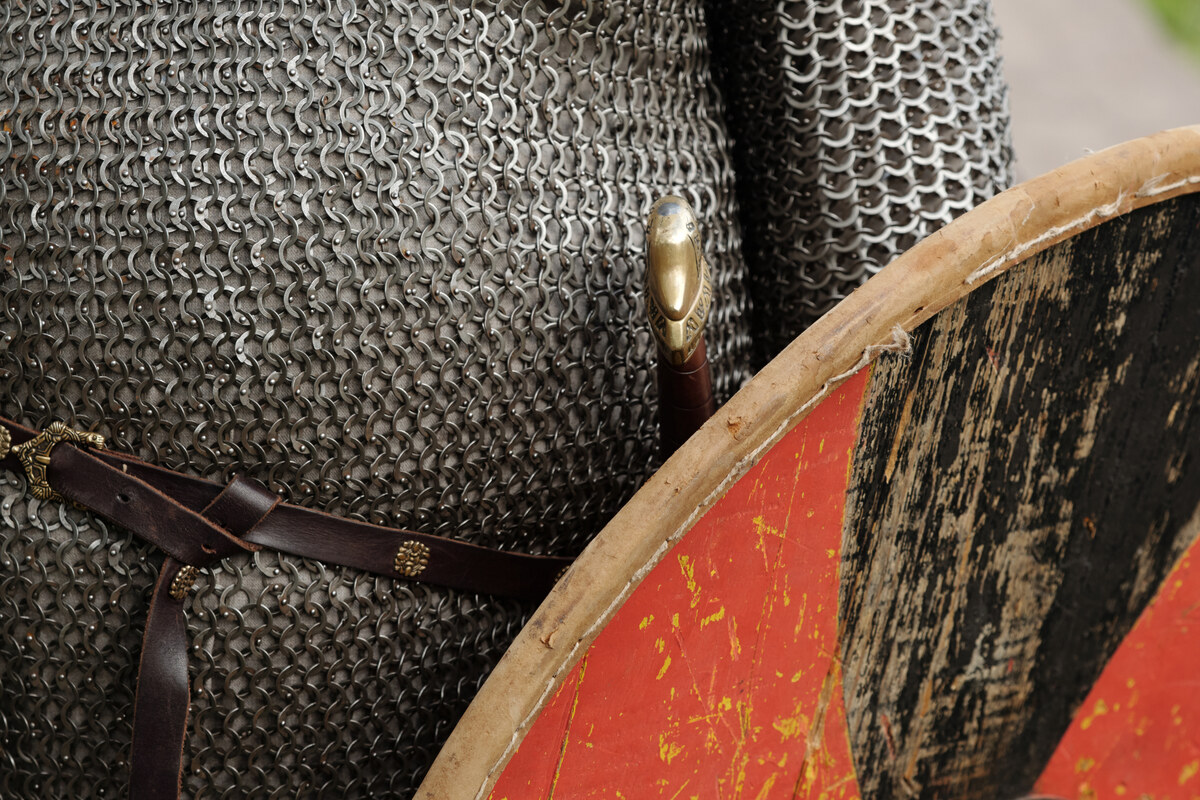
Long before knights, before castles, before the word “medieval” meant anything at all, people were already standing behind a shield. It is the one piece of war gear that never really left the battlefield, it just changed materials.
It’s older than writing itself
The shield is the oldest defensive weapon on record, attested since the third millennium BC among the Sumerians of Mesopotamia. Their shields were rectangular, heavy, and imposing, built for warriors standing shoulder to shoulder.
By the time medieval knights carried one, the object already had thousands of years of history behind it. The teardrop-shaped Norman shield seen on the Bayeux Tapestry was just one chapter in a very long story.
Ancient Greeks solved the grip problem first
Between the 8th and 7th centuries BC, Greek warriors invented a grip system called the porpax and antilabè on their round aspis shields. Earlier designs relied on a single strap, called a telamon, that left little room to actually fight while holding the shield steady.
The Greek system let a warrior grip the shield firmly with a forearm band and a hand strap at the same time, freeing up real mobility in combat. It was a mechanical solution medieval smiths would still be relying on the logic of centuries later.
A shield allegedly saved a duke’s life
Norman legend holds that during a conflict with the Bretons, one of William the Conqueror’s companions threw his own shield between a Breton axe and the duke’s head, saving his life. The story is said to have given rise to a Norman surname and place name still traced back to that moment: “Dur-Écu,” meaning roughly “hard shield.”
True or embellished, the tale reflects how central the shield was to a warrior’s identity, not just a tool but something worth risking your life to hold in front of someone else’s.
Kings kept carrying one long after it stopped working
By the 16th century, plate armor and firearms had made the shield largely irrelevant on real battlefields. Yet Henri II of France still owned an elaborately decorated ceremonial shield, preserved and documented today, carried for prestige rather than protection.
The object had quietly shifted jobs, from stopping blows to signaling status, centuries before it vanished from military use entirely.
It never actually retired
In the 20th century, the shield resurfaced in an unexpected place: police forces adopted transparent riot shields, made of plastic instead of wood or steel, to hold a line against crowds instead of armies.
The function is nearly identical to what Sumerian soldiers were doing five thousand years earlier: stand behind something solid, absorb the impact, protect the person next to you.
Suits of armor now sit behind museum glass, but the shield never actually stopped working. It just kept finding new hands to hold it.