Edward I did not build his four Welsh castles to stop foreign invaders. He built them to keep a nation he had just conquered from ever rising again.
Four castles, one purpose: control
Between 1277 and 1295, King Edward I of England ordered a ring of castles across Wales after his conquest of the region: Caernarfon, Conwy, Harlech and Beaumaris. Historians consider it the most coherent and best-planned fortification network in medieval British history.
These were not border defenses meant to hold off an outside army. They were placed to dominate a population that had just lost its independence, garrisoned to project royal power into territory that was, until recently, its own kingdom.
Each site was chosen with the same logic: control the coastline, control the river crossing, control the valley, and never let a rebellion gather enough distance from a royal garrison to grow.
The most perfect concentric castle ever built
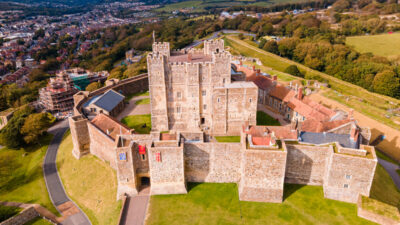
Beaumaris, begun in 1295, is singled out by architectural historians as the most perfect concentric medieval castle ever constructed. Its symmetry, its two fully integrated enceintes and its identical corner towers represent the theoretical high point of defense in depth.
Every wall was designed around three linked functions: a walkway for moving troops fast along the perimeter, clear sightlines for watching the approaches, and firing positions from height through crenellations and arrow loops. A besieger who broke through the outer wall simply walked into a second, fully defended one.
A medieval version of an occupying army’s base network
Strip away the stone and the comparison becomes obvious: a chain of fortified strongpoints spread across newly seized territory, each one able to project force over its surroundings and reinforce the others, is exactly how a modern occupying power secures a region it does not fully trust.
Instead of tanks and checkpoints, Edward had towers and garrisons. Instead of a supply convoy, he had a chain of castles close enough to reinforce each other by land or sea. The logic of controlling a resentful, recently defeated population by studding its landscape with strongpoints has not changed much in seven centuries, only the technology has.
A system built to last, until it suddenly was not
For over a century, the vertical, high-walled model that produced Beaumaris was the answer to almost any siege. Rulers across Europe kept building upward: cylindrical royal donjons, square-plan seigneurial towers, earthen mottes for lesser lords, all the way down to crenellated town houses for the wealthy bourgeoisie. The shape of a fortification revealed the rank of whoever built it.
Then, in 1418, iron cannonballs became standard in European artillery, and the entire model was thrown into crisis. Fortification stopped reaching for the sky and started flattening toward the ground: thick sloped ramparts, wide ditches, angled bastions. The style Vauban would perfect in the 17th century made Edward’s towers look like relics almost overnight.
What a wall tells you about who built it
A castle is never just a defensive structure. Its height, its layout and even the shape of a single crenellation could reveal whether the builder was a king, a minor lord or a rich merchant. Read that way, Beaumaris is not just an engineering marvel. It is a message written in stone, addressed to a conquered people, and still legible today.