In 1792, a soldier looked at a long roll of embroidered linen in Bayeux and saw a useful tarp for a military wagon. That roll was the Bayeux Tapestry, and it was not the last time this medieval masterpiece came within minutes of disappearing.
A tapestry that is not really a tapestry
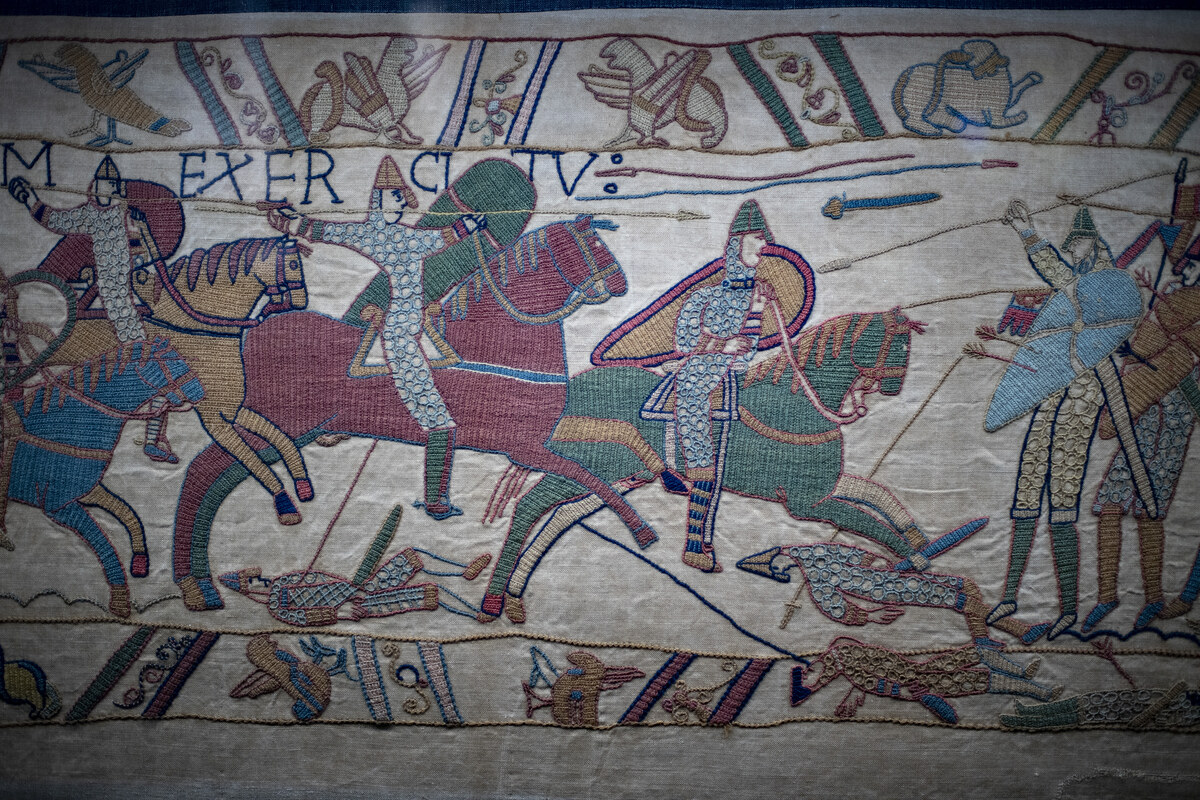
Start with the name, because it is wrong. The Bayeux Tapestry is an embroidery: wool thread stitched onto a coarse linen ground, using four different stitches and only ten natural dye colours.
It is also enormous. Nearly 70 metres long and about 50 centimetres tall, it is made of nine linen panels joined by seams you can barely see. Across 58 scenes, it packs in 623 human figures, 994 animals, 438 plants, 37 buildings and fortifications and 41 ships.
It is generally thought to have been commissioned by Bishop Odo of Bayeux, half-brother of William the Conqueror, and probably made in England by Anglo-Saxon artists, most likely in or around Canterbury. In other words, the story of the Norman conquest of England was very likely stitched by the conquered.
The day it almost became a wagon cover
For centuries the embroidery stayed quietly in Bayeux. The earliest written reference to it is a 1476 inventory of the town’s cathedral.
Then came the French Revolution. In 1792, the tapestry was treated as public property, and a soldier proposed cutting it up to cover a military wagon. A local lawyer, Lambert Léonard Leforestier, arrived just in time to stop it and stored the work in his own house.
Two years later, it was in danger again. During a civic celebration in 1794, it was nearly torn into strips to decorate a parade float. Once more, it survived.
Napoleon turned it into war propaganda
A few years later, the tapestry found a far more powerful admirer. From November 1803 to February 1804, Bonaparte had it displayed in Paris, at the Louvre.
The timing was no accident. France was preparing a possible invasion of England, and a catalogue of the embroidery was handed out to the army to stir the troops’ spirit of conquest. A story about a successful crossing of the Channel in 1066 made perfect motivational material.
The invasion never came, and the tapestry went home to Bayeux in 1804.
The SS arrived a few days too late
The Second World War brought a new kind of danger. In 1941, during the occupation of France, researchers from the Ahnenerbe, the Nazi institute devoted to Germany’s supposed “ancestral heritage”, studied the tapestry. Among them were Herbert Jankuhn and Karl Schlabow, and small fragments were taken from its underside.
The embroidery was later kept at the Château de Sourches until June 1944, then moved to the Louvre. In 1944, Heinrich Himmler ordered it taken to “a place of safety”, thought to be Berlin.
On 22 August 1944, two SS officers finally came to collect it. By then, the Louvre was already back in French hands, and they left without it.
One of those wartime fragments resurfaced only recently, among Karl Schlabow’s archives in Schleswig-Holstein, in northern Germany, and has been sent back to Bayeux.
A comet, a missing ending and a trip to London
The embroidery holds a few surprises of its own. In its upper border, near scene 32, a strange star with a fiery tail streaks across the sky. It is Halley’s Comet, visible in England in late April 1066, and this is the first known picture of it.
The ending, however, is gone. At least two panels are missing, perhaps 6.4 metres in total, and they most likely showed William being crowned king of England.
Today, the tapestry is once again on the move, this time by invitation. Announced by Emmanuel Macron in 2018, a loan to Britain finally took place in 2026: the embroidery arrived at the British Museum on 10 July, and the exhibition opened on 10 September 2026. Even this careful journey left a trace, as two threads were reported broken during transport.
A survivor more than a souvenir
Wagon covers, parade floats, propaganda, the SS: the Bayeux Tapestry has outlived almost everyone who tried to use it. Nearly a thousand years after the needle went through the linen, the real miracle is not only how much story it tells, but that anyone can still see it at all.