Millions of visitors walk through Carcassonne every year believing they are touching pure medieval stone. Large parts of what they see were actually built in the 1800s.
The myth of the untouched fortress
Carcassonne is usually presented as Europe’s best-preserved medieval city, a double ring of walls and towers frozen in time since the Middle Ages.
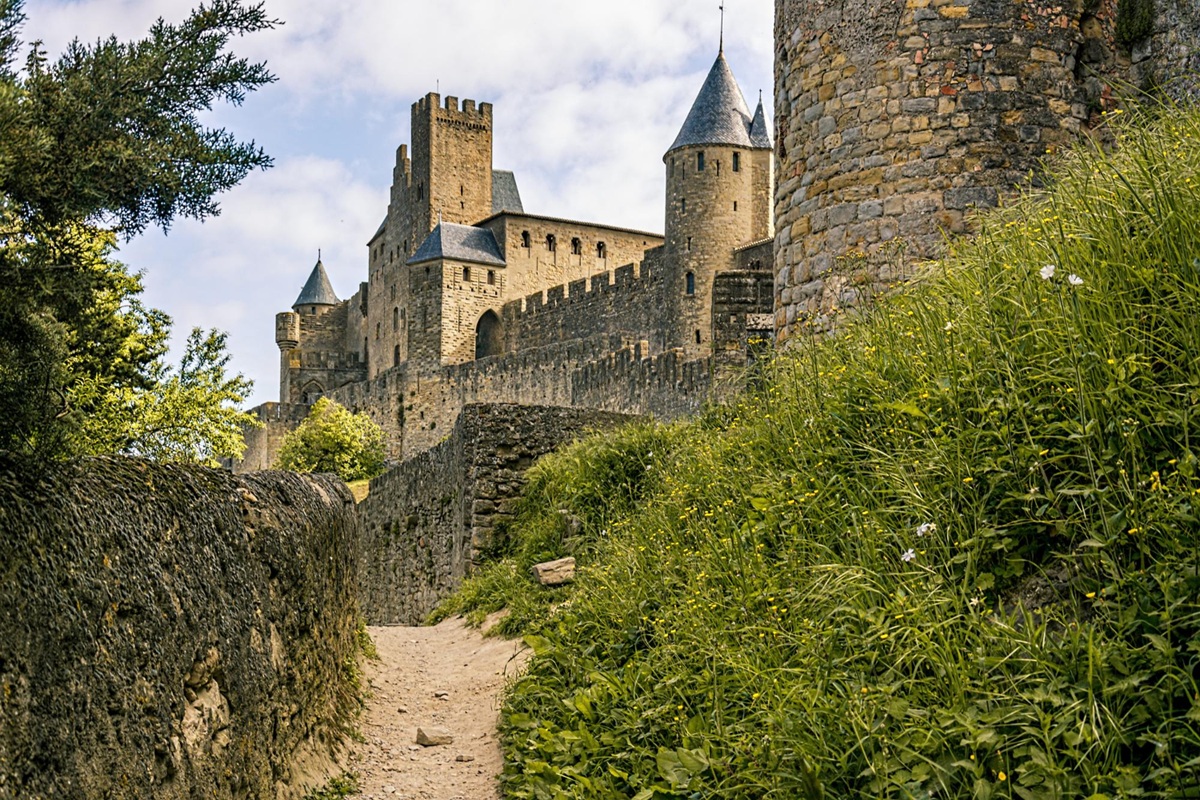
The postcard image, pointed conical roofs topping every tower, feels like the most obviously medieval detail of the whole skyline.
That detail is exactly where the story falls apart.
A 19th-century architect rebuilt the skyline
Between 1853 and 1879, architect Eugène Viollet-le-Duc led a major restoration of Carcassonne. He is the reason those pointed roofs exist at all.
Later research suggests the medieval towers actually had flat roofs with a walkway on top, not the steep cones tourists photograph today.
Viollet-le-Duc based his design on castles from northern France, then applied that northern style to a fortress in the south. Historians consider the result a hybrid that matches no real medieval castle, north or south.
What’s genuinely medieval underneath
Strip away the roofs, and the walls themselves tell an older, real story. The inner ring dates to the Romans, reinforced by the Visigoths, who used it to repel a Frankish army of 7,000 men in 587.
The Trencavel viscounts rebuilt that inner wall in stone during the 12th century. Saint Louis and his successors added the entire outer ring in the 13th century, creating the double concentric fortress still standing today: more than 3 kilometers of ramparts and over 50 towers.
In 1926, workers found something underneath all of it: a Roman mosaic floor, 40 square meters, buried beneath the castle’s own courtyard. Medieval builders had unknowingly built their fortress on top of a wealthy Roman house.
The real engineering hides between the two walls
The most effective part of Carcassonne’s defenses owes nothing to Viollet-le-Duc. It is the narrow strip of ground between the inner and outer walls, known as the lices.
Any attacker who broke through the outer wall didn’t reach the city. They landed in a killing ground, caught in crossfire from defenders on both walls at once.
In peacetime, that same strip doubled as stabling space for horses and a corridor defenders could use to counterattack from the side. Even the base of the towers was shaped to help: a flared, sloped profile that sent dropped projectiles bouncing back out into the crowd of attackers below.
A Middle Ages built partly in the 1800s
Carcassonne isn’t a fake. Its walls, its lices, its Roman foundations are real medieval and Roman engineering, tested in real sieges.
But the skyline that makes it instantly recognizable, the one printed on postcards and film sets, is largely a 19th-century romantic vision of what the Middle Ages should have looked like.
Carcassonne was not the only casualty of that vision. Viollet-le-Duc reshaped other French castles the same way, and his ideas quietly became the template for how an entire era pictures the Middle Ages, one restored rooftop at a time.