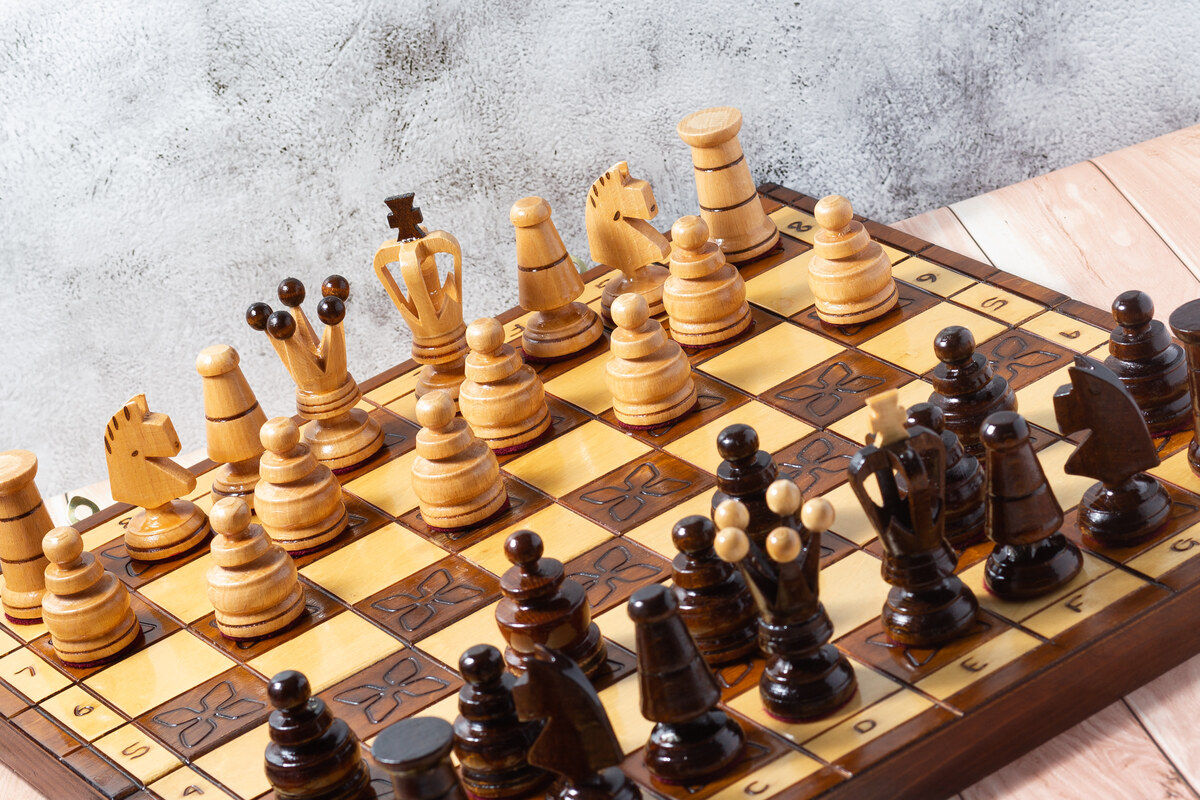
For centuries, a magnificent ivory chess set has carried one name: Charlemagne. Legend says the pieces arrived as a diplomatic gift from the Abbasid caliph Harun al-Rashid. Historians have since traced the set to a workshop near Salerno, built at the end of the 11th century, roughly three centuries after Charlemagne was already dead.
A gift that could never have arrived
The legend is elegant: a Muslim caliph sends an extraordinary chess set to the Christian emperor of the West, a symbol of diplomacy crossing a civilizational divide. The problem is timing. Charlemagne died in 814. Chess itself had not yet reached Europe.
The game most likely entered the continent through Muslim Spain or southern Italy, arriving shortly before the year 1000, close to two centuries after Charlemagne’s death. The oldest documented proof of chess in the West is a Latin poem, the Versus de Scachis, written in northern Italy sometime between 900 and 950. Charlemagne could not have owned a chess set for the simple reason that, during his lifetime, there was no chess set in Europe to own.
Made near Salerno, centuries later
Historians have established where the “Charlemagne set” actually came from: a workshop near Salerno, in southern Italy, producing it at the end of the 11th century. That places its creation roughly 250 to 300 years after Charlemagne’s reign, and well over a century after chess had already taken root among Europe’s intellectual and clerical circles.
The emperor’s name was attached to it only later, turning an anonymous piece of craftsmanship into a legendary relic of imperial diplomacy. No contract, inscription or workshop record was needed to make the story stick. A good enough legend rarely gets fact-checked at the time, and by the time anyone looked closely, the set had already been famous for generations.
Why borrow an emperor’s name
This was not a simple error of dating. Historians point to it as a clear case of Charlemagne’s figure being used to legitimize a precious object, long after his death. A chess set tied to Charlemagne and a caliph’s generosity carried far more weight, and a far better story, than an anonymous workshop piece ever could. The emperor had already become something people reached for to lend authority to an object, not just a historical figure to remember accurately.
The game itself had already reshaped Europe
By the time chess reached Western Europe, it carried plenty of symbolic weight on its own, no emperor required. The 13th-century treatise of Jacques de Cessoles turned the chessboard into a mirror of feudal society, with every piece standing in for a social function. The rules themselves transformed again after 1470, in Spain or Italy: the weak piece inherited from the Arabic vizier, the fierge, became the all-powerful queen, the bishop’s reach expanded dramatically, and the entire game accelerated.
The “Charlemagne chess set” never needed the emperor’s name to matter. It was already a product of exactly the courtly, intellectual world that chess had built across Europe by the 11th century, just not the one the legend wanted people to imagine. The pieces were impressive enough on their own. They just needed a bigger name to travel with.