A stone ledge with holes in the floor needed the king’s personal permission to exist in medieval France. Centuries later and 6,000 miles away, Japanese engineers who had never heard of a French castle built almost the exact same thing.
A gallery built to see straight down
A machicolation is a stone gallery that juts out from the top of a wall, held up on projecting supports, with openings cut straight into its floor. From up there, defenders could drop stones, timber, or burning pitch directly onto anyone standing at the base of the wall, the one spot a straight arrow slit could never reach.
The idea did not start in stone. It began as hourds, wooden fighting galleries bolted onto ramparts for the length of a siege, then dismantled afterward. Stone versions eventually replaced them for good, and one of the earliest confirmed examples in France sits not on a castle at all, but on the fortified cathedral of Agde, built in 1173.
A privilege, not just a weapon
In medieval France, adding machicolations to your walls was not simply a construction choice. It required a “licence de fortifier,” a royal authorization to fortify granted directly by the crown.
That single requirement turned a defensive feature into a status symbol. Owning a wall studded with machicolations meant the king himself had recognized you as important enough, or dangerous enough, to be allowed to defend it properly.
The physics that made it work
Engineers went further than just cutting holes in a ledge. Many castle walls were built with a batter, a base that slopes outward as it nears the ground, rather than rising perfectly straight.
Combined with machicolations directly above, that slope turned the wall itself into a weapon. A stone or beam dropped from the gallery would strike the sloped base and ricochet outward, scattering into the crowd of attackers below instead of simply landing on one target.
Half a world away, the same idea
The name itself carries the intent. “Machicoulis” first appears in writing between 1402 and 1404, built from Old French words meaning roughly “to break the neck,” a fairly blunt description of what the drop was designed to do.
The concept did not originate in Europe either. Similar overhanging galleries with openings already existed in Umayyad fortifications of the 6th to 8th centuries, including at Qasr Azraq in Jordan, well before European builders adopted and refined the idea, likely through contact during the Crusades.
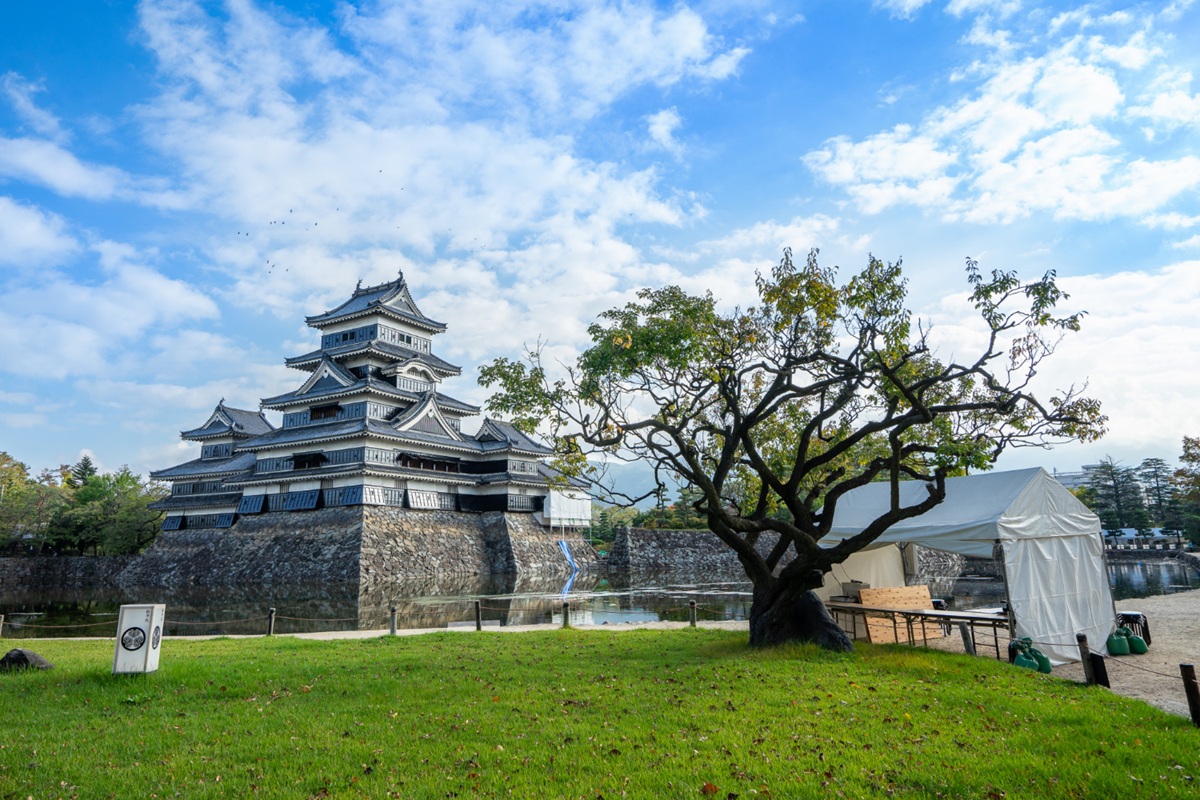
What is harder to explain is Himeji Castle in Japan, a UNESCO World Heritage site whose towers include projecting galleries pierced with openings at their corners, built by military engineers with no documented link to European or Middle Eastern fortification. Two building traditions on opposite sides of the world, solving the exact same tactical problem, arrived at the exact same solution.
A weapon that outlived its purpose
Machicolations stayed genuinely useful into the first half of the 15th century. Then gunpowder artillery made high stone galleries a liability instead of an asset, and military engineers shifted to low, thick, cannon-resistant defenses instead.
The machicolations did not disappear, though. They kept showing up on Renaissance chateaux along the Loire and on noble residences well into the 16th century, no longer defending anything, just announcing, in stone, that someone here had once been granted the right to.