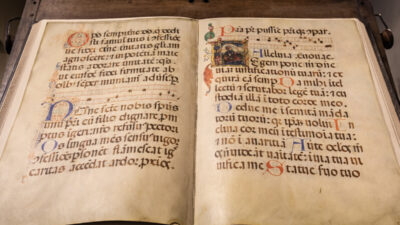
In 1357, a book appeared in the city of Liege claiming to document 34 years of travel across Egypt, Asia, India, and China. It became one of the most copied texts of the entire Middle Ages, outsold only by the Bible. Its supposed author almost certainly never left Western Europe.
A journey too incredible to check
The book was called the Book of Marvels of the World, also known as the Voyage d’outre-mer. It presented itself as the personal account of a knight named Jean de Mandeville, traveling from 1322 to 1356 through Egypt, Central Asia, India, and China.
The pages were filled with wonders: dragons, unicorns, headless men called acephali, dog-headed men called cynocephali, and a race of one-breasted warrior women living in a realm the author called the kingdom of Feminity, which he located in Asia Minor with the same precision he used for Constantinople.
Every detail was framed as something Mandeville had personally witnessed, described with the same confident geography he used for real cities like Constantinople and Cairo.
The doctor behind the mask
Mandeville almost certainly never set foot in Asia. Modern research identified the real author as Jean de Bourgogne, nicknamed Jean a la Barbe (John with the Beard), a physician born around 1300 in Saint-Albans, England, who died in Liege in 1372.
His actual epitaph in Liege names him as a professor of medicine, not a traveling knight.
The book itself was a masterful compilation. It borrowed heavily from Marco Polo, the Franciscan friar Odoric of Pordenone, Vincent of Beauvais, Herodotus, and Pliny the Elder, all repackaged as firsthand experience. Even the one-breasted warriors were lifted straight from Herodotus, centuries old material dressed up as fresh discovery.
Nobody called it fraud, at the time
Medieval readers did not treat this as deception. The modern idea of plagiarism simply did not exist in the same form: compiling existing sources into a new, coherent work was considered legitimate scholarship, not theft.
It was only in the 19th century that historians began describing Mandeville as an impostor.
In the meantime, the book thrived. More than 250 manuscripts survive in ten languages, produced before the 17th century, a scale of circulation matched by almost nothing else from the period.
A fake journey that helped inspire a real one
The book did more than entertain. It seriously discussed the possibility of sailing around the globe, an intellectually bold claim for its time.
That idea reached further than Mandeville could have imagined: it likely influenced Christopher Columbus, who read the text as part of his case for reaching Asia by sailing west.
When printing arrived, the book found a second life. Its first printed edition appeared in 1478, making it one of the earliest bestsellers of the printing press. By 1501, 35 printed editions already existed.
A street named after a literary fraud
A street in Liege still carries Mandeville’s name, tucked behind the Guillemins train station, a quiet tribute to one of the Middle Ages’ most successful literary impostors.
A physician who likely never crossed Europe convinced a continent he had seen its farthest edges, and centuries later, his invented journey helped point real ships toward the horizon.