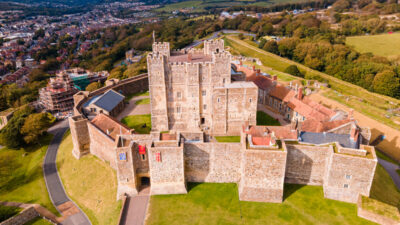
Picture a medieval castle and a drawbridge is probably the first thing that comes to mind, chains creaking, wooden planks rising, a hero galloping across just before it seals shut. That image is mostly Hollywood: the mechanism didn’t become common until three centuries after the first stone castles were built, and it outlived the Middle Ages by hundreds of years.
The castle image everyone gets wrong
Drawbridges feel inseparable from medieval fortresses, but the timeline tells a different story. The early stone castles of the 11th and 12th centuries were usually crossed by simple wooden bridges, the kind you could dismantle or burn the moment an army showed up outside the walls.
The drawbridge as we picture it, a pivoting deck raised and lowered on demand, only became a standard feature of European fortifications starting in the 13th and 14th centuries. Before that, engineers simply hadn’t worked out a mechanism reliable enough to trust.
An engineering problem that took five centuries to solve
Once the drawbridge caught on, it turned into one of the most fiddled-with pieces of military engineering in Europe. Historians count ten distinct categories of drawbridge developed between the medieval period and the 19th century, each one answering a different mechanical headache.
Early designs, known as “queue d’aronde” bridges, used bars that jutted out visibly beyond the castle wall to work the counterweight. That was a problem: those exposed arms were an easy target for enemy archers and, later, cannon fire.
It took until 1728 for military engineer Bernard Forest de Bélidor to solve it. His system used a counterweight running along a sinusoidal path, keeping the lifting force constant throughout the motion while finally removing the vulnerable exterior parts. After 1750, his design spread across French fortifications.
The bridge that could crush its own soldiers
Not every fix came without cost. Many drawbridges relied on a rear deck nicknamed the “tape-cul”, which flipped down into the inner ditch as the front section rose. Soldiers working in that ditch were at real risk of being crushed if the deck dropped suddenly.
It wasn’t until 1860 that engineer Jules Tripier solved the problem, replacing the rear deck with separate tilting rails narrow enough for men to step aside safely. His design was later built into the Séré de Rivières forts and, eventually, the Maginot Line.
Still on duty against tanks
That last detail is the real twist: the drawbridge never actually left service. The Maginot Line, built in the 1930s to defend France’s border against a German invasion, still relied on mechanized drawbridges at its entrances, the same basic medieval concept, refined by two centuries of mathematics and engineering.
Some castles pushed the idea further than others. Château de Lassay in France still has a double drawbridge with a retractable ramp, so that lowering the first deck only revealed a second obstacle waiting behind it.
A medieval idea that never really retired
A device built to stop a horse ended up, centuries later, guarding against armored divisions. The drawbridge’s long, quiet career from wooden castle gate to steel-reinforced border fort is a reminder that medieval engineering rarely disappeared, it just kept getting rebuilt for the next war.