A single custom suit of plate armor commissioned in 15th-century Milan could cost as much as a nobleman’s entire estate. Building one took months of skilled labor, and most knights, even wealthy ones, never owned a complete harness in their lifetime.
A suit built around one body, not a size chart
Before a hammer ever touched steel, the armorer took precise measurements of his client. Not just height and limb length, but scars, old wounds, and the small asymmetries every body develops over a lifetime of fighting.
The result was a suit with sliding lames and overlapping hinges that let a knight run, climb, and mount a horse unaided. The popular image of a knight hoisted onto his saddle by a crane is a 19th-century invention. Mobility was a design requirement, not a luxury add-on.
Milan and Augsburg: Europe’s military luxury houses
Two cities dominated the trade in full plate: Milan in Italy and Augsburg in Germany. Their workshops exported finished harnesses across the continent, and owning one carried the same kind of status a famous brand carries today.
The Milanese armorer Antonio Missaglia, active through the mid-1400s, supplied royal courts with signed pieces still studied as technical references. A suit made for a king or prince in Milan could be worth an entire domain on its own.
Part of that price came from the steel itself. Armorers cold-hammered each plate to harden it through work-hardening, a process modern industry rediscovered and still uses to strengthen automotive and aerospace parts.
Before plate, mail came with its own brutal price tag
For centuries before full plate became standard, knights wore chain mail: a shirt woven from as many as 30,000 individually linked iron rings, weighing between 13 and 15 kilograms and resting mostly on the shoulders and chest.
It flexed enough to absorb a sword’s edge, but it was heavy enough to exhaust a fighter after a few hours of combat. A 12th-century epic poem, Garin le Lorrain, has a soldier crying out, “God, if only I had a small haubergeon!”, a line that says more about how badly ordinary men wanted, and couldn’t always afford, this protection than any price list could.
It was only under Saint Louis, in the 13th century, that rigid plates began replacing mail among the wealthy. Not because rigid armor was safer, but because it was lighter and less exhausting to wear.
Even the helmet hid an economics lesson
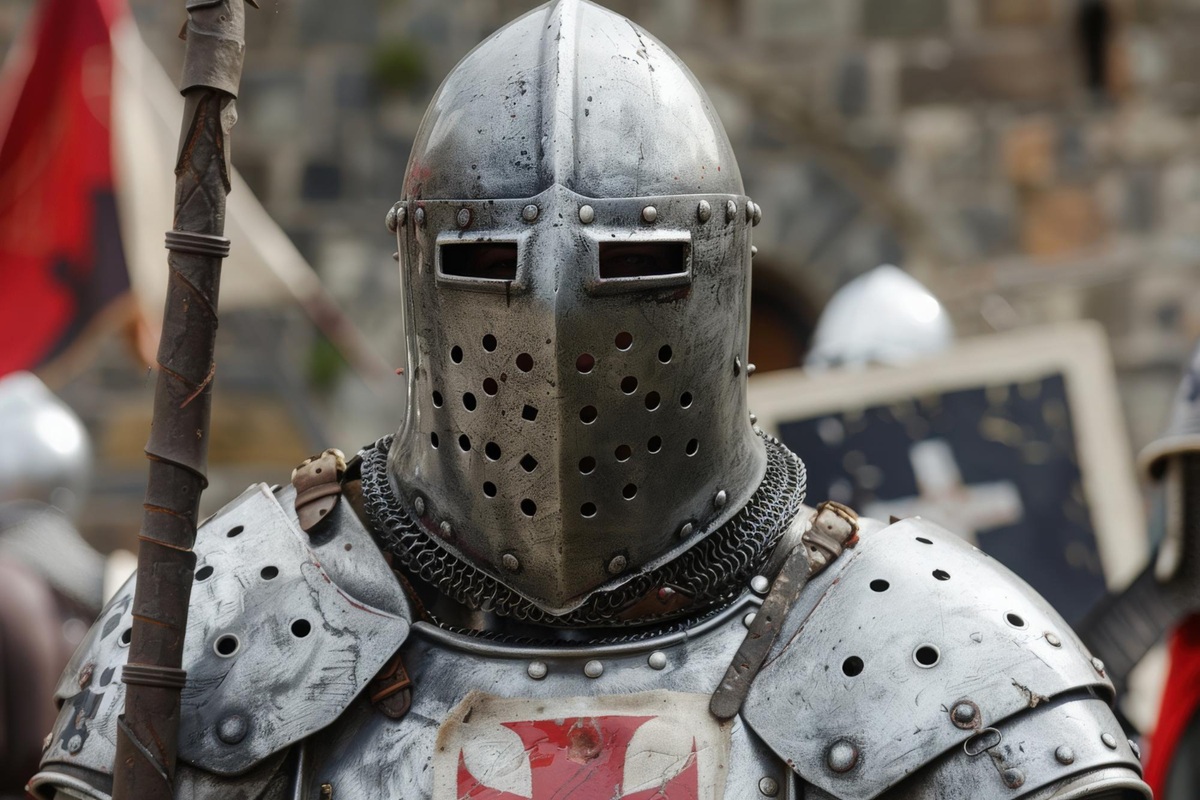
The great helm, the cylindrical helmet first documented on Richard the Lionheart’s seal in 1199, owed part of its design to cost. A simple riveted cylinder was cheaper and faster to forge than the conical helmets it replaced, which helped it spread quickly among knights who could never afford Milanese-level budgets.
It came with a real drawback. The flat top transferred the full force of a blow straight onto the skull, and the enclosed design trapped heat so badly that crusaders sometimes died of heatstroke wearing one in battle.
Because the helmet hid every face on the battlefield, it also created a brand-new problem: telling allies from enemies. That practical headache is what gave rise to heraldry, the painted coats of arms that let knights recognize each other in the chaos of a charge.
The price of being recognized
A knight’s equipment was never just about defense. It was the single most expensive personal investment a medieval lord might ever make, built one body at a time by craftsmen whose techniques, like cold-hammered steel, still echo in workshops far removed from any battlefield.