A knight rarely wore his great helm for more than a few minutes at a stretch. The steel casing that made him unrecognizable and nearly invincible also made it hard to breathe, and taking it off the moment the fighting stopped was a matter of survival, not comfort.
A helmet you could only stand to wear in combat
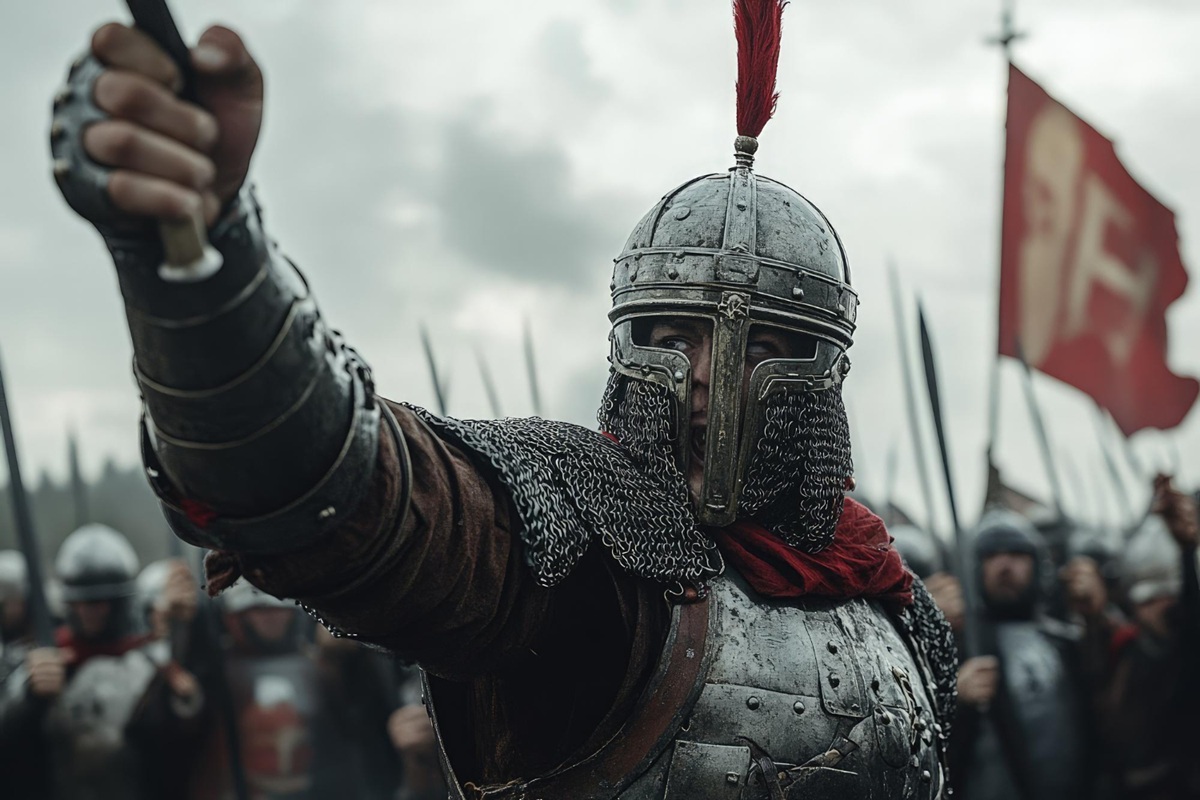
By the late 12th century, the great helm had replaced the open nasal helmet worn by earlier generations of knights. It covered the head completely: a steel cap fixed to a face plate pierced only with narrow slits for sight and breath.
That total coverage came at a cost. Inside the sealed steel shell, heat built up fast and airflow was minimal. Knights only lowered or fastened the helm right before combat began, then pulled it off again as soon as the immediate danger passed, switching to a lighter, open head covering for marching and everyday wear.
The earliest firm evidence for this design comes from an unlikely source: the personal seal of Richard the Lionheart, dated to 1199, which shows the English king on horseback wearing a great helm with a flat top, the oldest dated depiction of the style.
Crusaders who died from the heat inside their own armor
Nowhere did the great helm’s flaw show up more brutally than during the Crusades. Under the Middle Eastern sun, the steel shell turned into an oven, and chroniclers recorded knights collapsing and dying of heatstroke without ever taking a hit from an enemy blade.
Crusader knights adapted quickly. Many swapped the fully enclosed great helm for the chapel de fer, an open-brimmed steel cap that offered shade and ventilation instead of full facial protection. It was a straightforward trade: knights sacrificed coverage for the simple ability to survive the climate.
A design flaw armorers had to fix
The earliest great helms had a flat top, formed from a metal cylinder riveted to an ovoid disc. It looked solid, but it had a serious structural weakness: a blow landing squarely on that flat surface transferred its full force straight down onto the skull, instead of glancing off.
Armorers caught the problem by the 13th century and corrected it, moving toward conical and later “sugarloaf” helm shapes with sloped surfaces designed to deflect strikes rather than absorb them directly. The fix took decades to spread, a reminder that medieval armor design evolved through the same trial-and-error process as any other engineering problem.
The battlefield trick that started as a life-or-death signal
Full facial coverage created an obvious problem: a knight inside a great helm was completely unrecognizable to his own men. William the Conqueror ran into this at Hastings, when his own troops began to panic, believing him dead. He had to lift his helmet in front of them to prove he was still alive and turn the retreat around.
That same anonymity later turned the great helm into an unlikely stage for medieval pageantry. At tournaments, knights topped their helms with elaborate cimiers, painted or sculpted crests in wood, leather or metal representing animals, creatures or family symbols. Before the jousting began, heralds staged a “montre des heaumes,” parading the helmets so spectators could identify each competitor by his crest, and ladies in attendance could formally object to, and disqualify, any knight judged to have disrespected women.
A closing thought
The great helm survived for roughly two centuries before being replaced by lighter, better-ventilated designs like the bassinet and the armet in the 15th century. What looks in film like a knight’s permanent armor was, in practice, gear worn in short, punishing bursts, a piece of equipment its own wearers could barely tolerate for long.