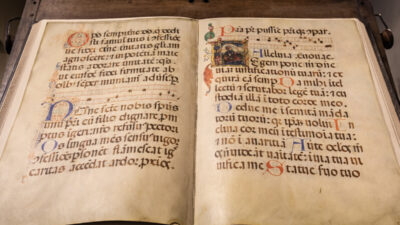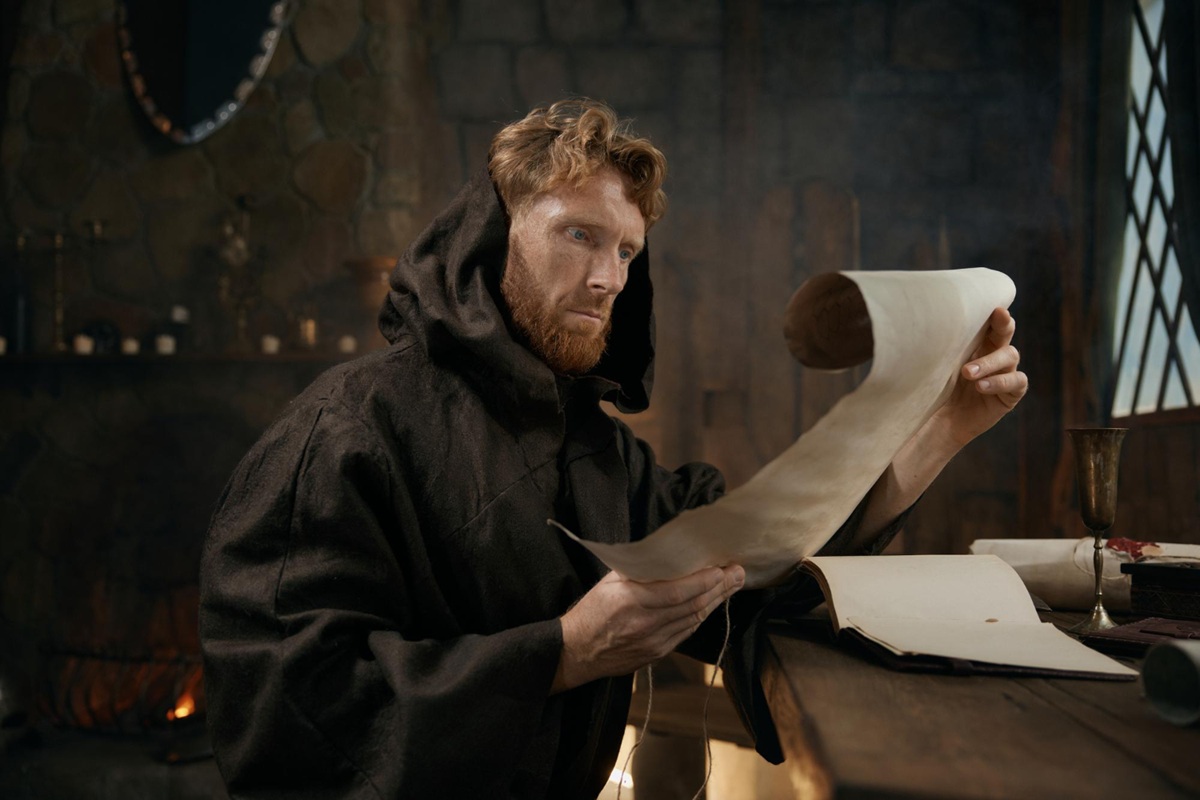
A monk closed his book at the end of a freezing stone niche and wrote four words meant for no one but himself: “I am very cold.”
That sentence, found in the closing note of a medieval manuscript, says more about a scribe’s daily life than any chronicle ever could. For a 12th-century copying monk, every single day followed the same repetitive, sacred rhythm.
The bells ran his entire day
His schedule was never his own. Seven canonical hours rang out from the abbey bell tower: matins, lauds, prime, terce, sext, none, vespers, and compline. Work, meals, and rest all had to fit into the gaps between them.
This rhythm came from Benedict of Nursia, who founded the monastery of Monte Cassino in 529 and built his entire rule around one principle: ora et labora, pray and work. Six centuries later, that same rule still dictated when a scribe picked up his pen and when he put it down for the day.
No grand hall, just a stone nook
Picture a scriptorium and you probably imagine a vast, light-filled hall packed with monks bent over their desks together. That image is mostly wrong.
Most copying happened alone, in a carrel: a narrow niche carved into the cloister gallery, or simply in the scribe’s own cell. Parchment and ink were too valuable to risk near an open flame, so a frozen stylus and numb fingers were simply part of the job.
Only around fifty major monasteries in Europe, among them Saint-Gall, Monte Cassino, Cluny, Corbie, and Fleury, had the resources to produce manuscripts on a large scale. Smaller houses simply borrowed books from these great libraries and copied what they needed.
The man who controlled the gold
Every scriptorium that did function this way answered to one figure: the armarius. Usually the abbey’s sacristan or chanter, he assigned each monk his task for the day and doled out the precious materials: inks, pigments, and sheets of gold leaf.
Nothing left his hands without supervision. A single sheet of gold leaf or a vial of lapis-lazuli blue cost too much to be handed out carelessly, and the armarius checked every finished page for quality before it left the scriptorium.
What he actually thought, in his own words
The idea that copying monks were mindless human photocopiers does not survive contact with their own writing. Many added corrections, marginal notes, and personal commentary to the texts they copied. Bede the Venerable wrote his own Historia Ecclesiastica inside the scriptorium of Jarrow, not instead of his copying work but alongside it.
And at the end of a long day, some scribes simply said what they felt. “Cursed be the hand that wrote so badly.” “Here is good work, and the wine was good too.” “I am very cold.” These small, human colophons are the closest thing we have to a diary from inside a 12th-century scriptorium.
A day that quietly built a civilization
Multiply that one freezing scribe by decades, by dozens of abbeys, by centuries of bell-bound days, and an uncomfortable stone nook becomes the reason entire libraries of ancient and medieval knowledge survived at all. Every cold finger and every sore wrist was quietly rebuilding the foundations of what Europe would still be reading a thousand years later.