Before a single brushstroke of color touched a medieval manuscript page, the gold had to go down first. Skip that step, and the paint simply wouldn’t stick.
A page built in a strict, unbreakable order
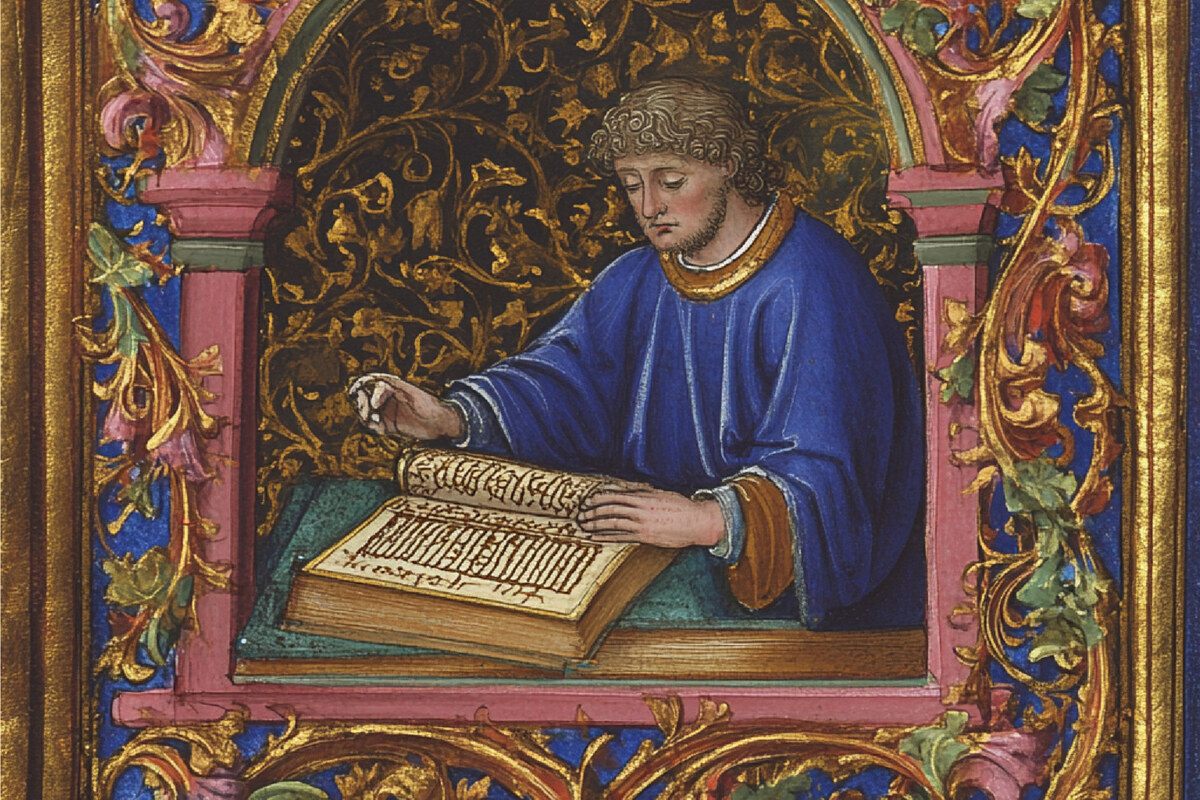
Illuminating a page followed a fixed sequence that never changed. An artist first sketched the design in pencil, then applied thin sheets of gold leaf and burnished them until they shone. Only after that came the paint, built up in layers from the lightest shades to the darkest, and finally the fine ink outlines drawn with a quill.
The order mattered for a purely technical reason: pigment does not adhere to gold once it has been laid down. Put the gold on last, and the whole page would flake apart. That single constraint shaped how every illuminated manuscript in medieval Europe was built, page after page, for centuries.
From a monk’s job to a skilled trade
The word itself started out meaning something much narrower than we use it for today. Illuminare, the Latin root of illumination, referred specifically to applying gold leaf, not to manuscript decoration as a whole. That broader meaning only attached itself in the thirteenth century.
The same century marks another turning point. Until then, illumination had been almost entirely a monastic affair, carried out by monks who copied and decorated manuscripts inside their own abbeys. The rise of universities created a new, secular market, and workshops in Paris and Flanders began splitting the work between specialized artisans, each handling a different stage of production rather than one monk doing it all.
Long dismissed as just decoration
It is tempting to see the swirling borders and gilded initials of a medieval manuscript as pure ornament, a pretty frame around the words that actually mattered. That assumption does not hold up.
Illuminations formed a complex, coherent iconographic program, usually commissioned by a specific patron and carrying a precise theological, political, or memorial message. They were meant to be read almost like a parallel text running alongside the words themselves, not skimmed past on the way to the sentence below.
A gaping mouth for hell, vanishing feet for heaven
Anglo-Saxon illuminators developed a visual vocabulary all their own to carry that message. Hell appears again and again as a gaping mouth swallowing the damned. The Ascension of Christ is shown from below, his feet the last thing visible before he disappears into the clouds.
Both images reflect theological debates specific to the Anglo-Saxon tradition, and both went on to shape how the rest of medieval Europe pictured heaven and hell for generations after. Anglo-Saxon workshops also pioneered polychrome ink, using red, green, and blue to pick out individual body parts and garments on a single figure, a technique that then spread across the continent.
Two workshops, one rivalry
That innovation did not happen in isolation. Irish monks founded the monastery of Iona in 563, and monks from Iona founded Lindisfarne in 635, the community that would later produce the Lindisfarne Gospels around 715 to 720. That insular period, running from the sixth to the ninth century, gave way to a second wave of Anglo-Saxon illumination in the mid-tenth century, fueled by renewed political stability and monastic reform.
Two figures drove that revival from rival centers. Dunstan of Canterbury traveled through continental abbeys and brought new artistic approaches back to England, reviving workshops in both Winchester and Canterbury. Æthelwold of Winchester commissioned the Benedictional that bears his name, still admired today for its lush acanthus borders and figures wrapped in swirling drapery. The two schools pushed each other forward, and Anglo-Saxon illumination reached its peak because of that competition, not despite it.
A visual language still being decoded
None of this was decoration in the idle sense. Every gold leaf page represented a fixed technical process, a real theological argument, and, in Winchester and Canterbury, a genuine artistic rivalry playing out in ink and gold.
The margins of a medieval manuscript still have more to say than most readers ever stop to notice.